

How to Evaluate B2B Data Vendors for Accuracy and Compliance
Your pipeline depends on reaching the right people, but bad data turns outreach into guesswork. Bounced emails, wrong numbers, and outdated job titles waste time and damage your sender reputation.
B2B lead generation platforms solve this by giving you access to verified contact databases, advanced filtering, and workflow integrations that keep your CRM current. This guide covers how these platforms work, what features matter most for enterprise teams, and how the top options compare so you can choose the right fit for your outreach strategy.
B2B lead generation platforms provide verified contact data, buyer intent signals, and automated outreach to connect revenue teams with qualified prospects. Think of them as centralized databases where you can search for business contacts by specific criteria, verify their information, and export lists ready for outreach.
Rather than spending hours on manual research, you get access to millions of contacts that have already been checked for accuracy. The platform does the heavy lifting so your team can focus on starting conversations.
Most platforms share a few core components:
The workflow is pretty straightforward once you get the hang of it.
First, you define your ideal customer profile (ICP). An ICP is simply a description of the companies and contacts most likely to buy from you. Then you apply filters like industry, job title, company size, revenue range, and location to narrow your search.
After building your list, the platform verifies the contacts. From there, you can export them to a spreadsheet or sync directly to your CRM. Once the data is in your system, you launch outreach sequences via email, phone, or both.
Where does all this data come from? Most platforms pull from public business registries, social profiles, web scraping, data partnerships, and user-contributed information. The better ones then run verification processes that combine automated email validation with manual review.
For enterprise teams running large-scale outreach, the right platform changes how quickly you move from identifying a target to having a conversation.
Not every platform offers the same capabilities. Here’s what to look for when evaluating options for enterprise use.
Verified data means emails and phone numbers have been checked for accuracy before you use them. Real-time validation goes a step further. It confirms deliverability at the exact moment you export or launch outreach, catching contacts that may have changed since the last database refresh.
Contact data decays faster than most teams realize. People change jobs, companies merge, and titles shift constantly.
Top platforms refresh their records on regular cycles and flag job changes automatically. This way, you’re always reaching the right person at the right company instead of sending emails into the void.
The more filters available, the more precisely you can define your audience. Common options include industry, job title, seniority level, company size, annual revenue, location, and technographics (the software a company uses).
Firmographics are company-level attributes. They help you build lists that match your ICP down to specific criteria like “SaaS companies with 50-200 employees in the healthcare space.”
Enterprise teams rarely work in a single tool. You want platforms that offer native integrations with Salesforce, HubSpot, and other CRMs.
API access matters too. It allows custom workflows and automated data flows between systems, eliminating manual imports and keeping everything in sync.
GDPR and CCPA compliance matters, especially for teams targeting European markets. GDPR (General Data Protection Regulation) and CCPA (California Consumer Privacy Act) are privacy laws that govern how companies collect and use personal data.
Compliant platforms provide opt-out mechanisms and document their data sourcing methods. Your legal and procurement teams will want this documentation before signing any contracts.
Intent data reveals which accounts are actively researching topics related to your solution. Buying triggers like recent funding rounds, leadership changes, or expansion announcements help you prioritize outreach to companies with immediate needs.
Most platforms use credit-based pricing, where you pay per contact exported or enriched. Enterprise buyers benefit from clear visibility into usage and costs, making it easier to forecast budgets and avoid surprises at the end of the month.
Here’s a closer look at the leading platforms, starting with options that prioritize verified data and workflow flexibility.
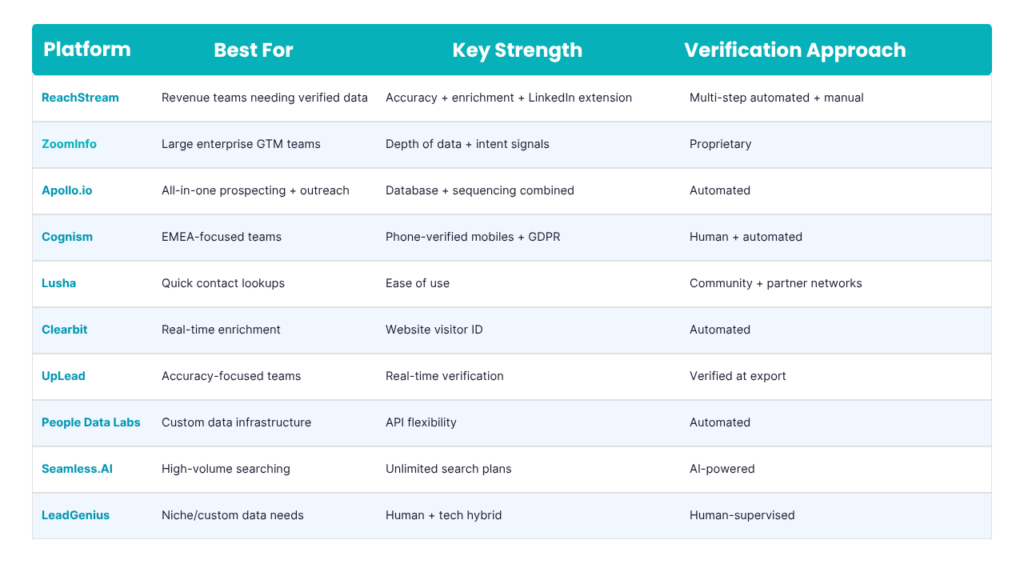
ReachStream is a B2B data platform built for revenue teams that want verified contact data without unnecessary complexity. With 200M+ contacts, 95% stated accuracy, and 20+ filtering attributes, it supports everything from list building to data enrichment to LinkedIn prospecting via Chrome extension.
The platform combines API integration and CRM sync, making it a fit for solopreneurs through enterprise organizations. Teams looking for a simpler user experience often find it hits the right balance between power and usability.
ZoomInfo offers one of the largest B2B contact databases available, paired with intent data and advanced sales intelligence. It’s particularly strong for large enterprise teams with complex go-to-market motions and deep integration requirements.
Apollo combines a contact database with built-in email sequencing and workflow automation. Teams that want prospecting and outreach in a single platform often gravitate here, though the all-in-one approach may mean trade-offs in data depth for some use cases.
Cognism is headquartered in Europe and emphasizes GDPR compliance alongside phone-verified mobile numbers. If your outreach targets EMEA markets, the compliance focus and mobile data quality stand out.
Lusha started as a browser extension for quick contact lookups and has expanded into a broader database. It’s known for ease of use and fast implementation, which helps teams get started quickly without a lengthy onboarding process.
Now part of HubSpot as Breeze Intelligence, Clearbit specializes in real-time enrichment and website visitor identification. It’s a strong fit for teams already in the HubSpot ecosystem who want seamless data flow.
UpLead positions around data accuracy, offering real-time email verification at the point of export. Teams that prioritize deliverability over database size often find it appealing.
People Data Labs is an API-first provider for teams building custom data infrastructure. It’s developer-focused, offering flexible data access for organizations with technical resources to build their own solutions.
Seamless.AI uses AI-powered search to surface contacts in real time. Some plans offer unlimited searches, which appeals to high-volume prospecting teams who don’t want to worry about credit limits.
LeadGenius combines platform technology with human researchers for custom data projects. It’s suited for complex or niche targeting needs that automated databases can’t fully address on their own.
Platforms and agencies solve different problems, so it helps to understand the distinction.
With a platform, you get self-serve data access. You pay for credits or seats, and your team runs the outreach. With an agency, you’re outsourcing prospecting entirely. You pay for leads or booked appointments, and an external team executes on your behalf.
Platforms make sense when you have internal sales capacity and want control over targeting and messaging. Agencies fit better when you lack bandwidth or want done-for-you execution without building an in-house team.
Start by determining your tolerance for bounced emails and wrong numbers. Ask vendors how they verify data and whether they offer accuracy guarantees. A platform claiming 95% accuracy operates differently than one with no stated benchmark.
Request sample data or run trial searches for your specific ICP. Coverage varies significantly across providers, so check whether the platform has depth in your target verticals and geographies before committing.
Confirm native integrations with your existing stack before signing anything. If you require custom workflows, evaluate the API documentation and support resources available to your team.
Involve legal and procurement early in the evaluation process. Ask about GDPR/CCPA compliance, data sourcing documentation, and how opt-outs are handled.
Understand how credits are consumed. Some platforms charge per contact, others per export, and others per enrichment. Model costs against your expected usage volume to avoid budget surprises down the road.
The right B2B lead generation platform depends on your outreach strategy, data accuracy requirements, and integration needs. Teams that prioritize verified contact data with a simpler experience often find that platforms combining accuracy, enrichment, and workflow flexibility deliver faster time-to-value.
The best platform depends on your outreach strategy, target market, and integration needs. Teams prioritizing verified contact data and ease of use often choose platforms like ReachStream that combine accuracy with workflow flexibility.
Costs vary widely based on pricing models. Some platforms charge per contact, others per seat or credit. Enterprise plans typically offer volume discounts, so request custom quotes based on expected usage.
Top platforms use multi-step verification combining automated email validation, phone checks, and manual review. Look for providers that disclose their verification methodology and refresh data on a regular cycle.
Reputable platforms build compliance into their data sourcing and provide opt-out mechanisms required by GDPR and CCPA. Confirm compliance documentation before signing, especially for EMEA outreach.
Most teams see measurable pipeline impact within the first few weeks of active outreach, assuming data quality and targeting are aligned. Faster time-to-value comes from platforms with quick setup and CRM integration.
Marketing professional with a Master’s degree in Marketing, specializing in SEO, content strategy, social media, performance marketing, prospecting, and demand generation.
Access 200M+ verified business emails and grow your sales pipeline effortlessly.
Don't forget to share this post!















Check out our other blogs!
Email ID Checker: Verify Any Email ID Online
ICP Refinement for SDRs: Using Data Filters to Stop Wasting Touches

Email Validator: Validate Email Format, Domain and Mailbox