

How to Evaluate B2B Data Vendors for Accuracy and Compliance
Choosing the right data partner is one of the most consequential decisions a B2B company makes and one of the easiest to get wrong. Sales and marketing teams live or die by the quality of the contact and company data feeding their pipelines, yet many businesses select a B2B database provider based on price alone, only to discover months later that half their records are outdated or duplicated. Bad data doesn’t just waste budget; it wastes rep hours, damages sender reputation, and skews every forecast built on top of it.
This article walks through exactly how to evaluate a B2B database provider — from the criteria that matter most, to the mistakes companies repeatedly make, to what the next few years of B2B data will look like. If you haven’t yet read our broader guide on building a data strategy, our pillar page on B2B data solutions covers the foundational concepts this article builds on.
A B2B database provider is a company that collects, verifies, and maintains structured information about businesses and the professionals who work at them — job titles, direct dials, verified emails, firmographic details like industry and revenue, and technographic data such as the software stack a company uses. Sales, marketing, and recruiting teams license access to this data to fuel prospecting, account-based marketing, lead scoring, and outbound campaigns.
The best providers don’t just aggregate public records. They combine automated crawling, human verification, AI-based validation, and compliance checks (GDPR, CCPA, PIPEDA, DPDPA) to keep records both accurate and legally usable.
Every go-to-market motion outbound email, cold calling, LinkedIn outreach, paid retargeting depends on having the correct person’s correct contact details. When that data is wrong, the downstream effects compound quickly:
Choosing the right provider isn’t just a procurement decision. it directly shapes pipeline velocity, sales productivity, and revenue predictability.
Most providers operate on a subscription or credit-based model. You search or filter a database using criteria like industry, company size, job function, or location, and the platform returns matching contact and company records. Depending on the provider, you can then:
Behind the scenes, reputable providers refresh data continuously rather than relying on a static, one-time scrape — this is one of the biggest differentiators between a reliable provider and a stale list-seller.
Not all providers weigh the same criteria equally, and your priorities should reflect your go-to-market strategy. That said, a few evaluation dimensions apply almost universally.
A few warning signs tend to show up before a list becomes a real liability:
Recognizing these challenges upfront helps you ask sharper questions during vendor evaluation, rather than discovering them after a contract is signed.
Selecting a strong provider is only half the equation. How you operationalize the data matters just as much.
Businesses that choose providers investing in these areas now will face less disruption as regulations and buyer expectations tighten.
ReachStream is a B2B data intelligence platform built to address many of the challenges outlined above. It provides verified contact and company data across a wide range of industries and geographies, with a focus on accuracy, compliance, and ease of integration.
For teams evaluating a provider against the criteria in this article, ReachStream offers:
Rather than replacing the evaluation process described above, ReachStream is designed to hold up well against it — giving teams a provider they can test, verify, and scale with confidence.
Picking the best B2B database provider isn’t about finding the biggest database — it’s about finding the most accurate, compliant, and well-integrated one for your specific go-to-market needs. By evaluating providers on data accuracy, refresh frequency, compliance practices, and integration depth, and by avoiding the common mistakes outlined above, businesses can build a data foundation that supports sustainable pipeline growth rather than undermining it.
For a broader look at building a complete B2B data strategy, visit our pillar guide on B2B data solutions. And if you’re ready to see how accurate, compliant B2B data can strengthen your sales and marketing efforts, ReachStream is worth exploring as part of your evaluation process.
A database provider typically maintains and verifies its own structured dataset with ongoing refresh cycles, while a data broker may resell aggregated lists without consistent verification or compliance oversight.
Best practice is continuous or monthly verification, since studies suggest a meaningful share of B2B contact data changes within a year due to job turnover.
A smaller, accurately targeted dataset aligned to your ICP typically outperforms a larger, less precise one, since it reduces wasted outreach and improves deliverability.
Ask for documentation on data sourcing, consent mechanisms, and how the provider handles opt-outs and regional privacy laws like GDPR and CCPA.
Most established providers offer native integrations with major CRMs like Salesforce and HubSpot, or provide APIs for custom integration.
Prioritizing price per credit over data accuracy, which often leads to higher long-term costs from wasted outreach and poor deliverability.
Many now do, layering behavioral or search-intent signals on top of firmographic data to help identify accounts that are actively in-market.
Request a sample dataset and validate email and phone accuracy against a known set of records before signing a long-term agreement.
Marketing professional, specializing in SEO, content strategy, social media, performance marketing, prospecting, and demand generation.
Access 200M+ verified business emails and grow your sales pipeline effortlessly.
Don't forget to share this post!















Check out our other blogs!
Email ID Checker: Verify Any Email ID Online
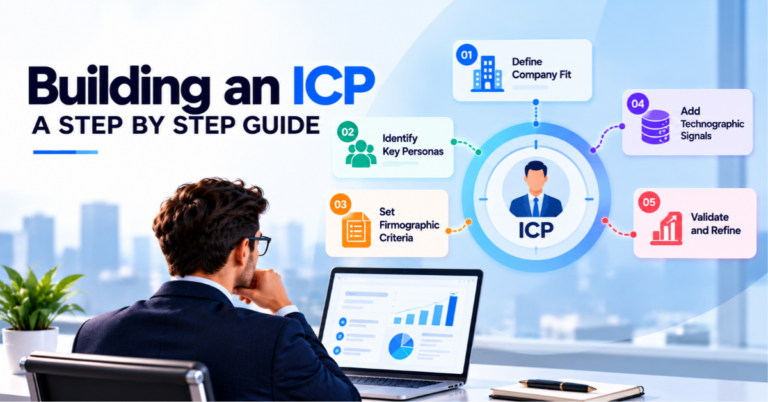
ICP Refinement for SDRs: Using Data Filters to Stop Wasting Touches

Email Validator: Validate Email Format, Domain and Mailbox