How to Evaluate B2B Data Vendors for Accuracy and Compliance
TL;DR
Cognism vs ZoomInfo database size tells only part of the story: ZoomInfo counts roughly 321 million profiles and 104 million companies, while Cognism counts around 440 million contacts across 100 million companies, with a much smaller phone-verified core.
Cognism vs ZoomInfo pricing 2026 starts in a similar range, roughly $15,000 to $25,000 a year in platform fees before per-seat costs on either side.
Cognism vs ZoomInfo data accuracy splits by data type: Cognism's Diamond Data subset claims around 98% verified accuracy, while ZoomInfo's broader email base runs closer to 80-85% after verification.
Cognism vs ZoomInfo direct dials and Cognism vs ZoomInfo phone data both favor Cognism's manually verified mobile numbers over ZoomInfo's larger but more algorithmic 70 million direct-dial figure.
Cognism vs ZoomInfo intent data is a bigger gap than most buyers expect: ZoomInfo's SalesOS bakes in mature buying-signal intelligence, while Cognism's Bombora-based intent layer is a lighter add-on.
Cognism EMEA vs ZoomInfo US sums up the geographic split well: Cognism is strongest in the UK and Europe, ZoomInfo is strongest in the US and Canada.
Cognism vs ZoomInfo vs ReachStream adds a third option worth comparing before you sign a multi-year contract at either platform's price point.
Cognism vs ZoomInfo Comparison: What Actually Sets Them Apart?
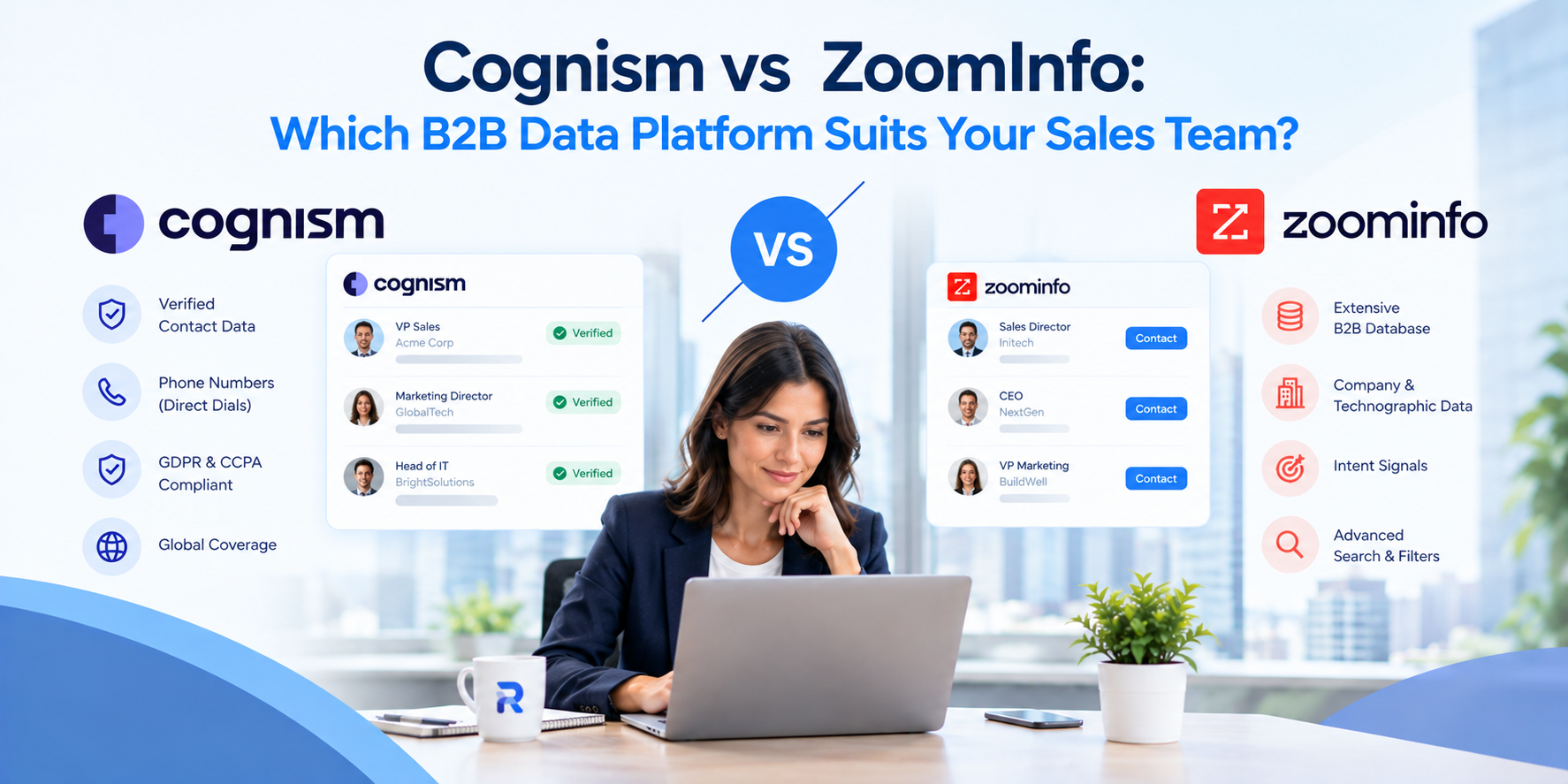
This Cognism vs ZoomInfo 2026 comparison walks through database size, accuracy, compliance, and pricing side by side. Cognism vs ZoomInfo is the comparison most RevOps and sales teams run before renewing a B2B data platform contract, and it usually comes down to two different philosophies.
Cognism built its reputation on GDPR-first compliance and manually verified EMEA phone numbers. ZoomInfo built the larger North American database and layered in a full sales intelligence platform around it. Neither is simply better; the right pick depends on which gaps in your contact data provider actually cost you pipeline.
Cognism vs ZoomInfo Database Size and Data Coverage
Database size is the first thing most buyers check, but Cognism vs ZoomInfo data coverage matters more once you have narrowed the list, since raw record counts hide how much of that data actually resolves to a working contact.
ZoomInfo holds roughly 321 million professional profiles and 104 million company profiles, with about 174 million verified emails. Cognism holds roughly 440 million contacts across 100 million companies, built from a phone-verified core rather than one flat number. Run a zoominfo vs cognism features checklist against your own target list before trusting either vendor’s top-line count.
Cognism vs ZoomInfo Data Accuracy: Which Numbers Hold Up?
Cognism vs ZoomInfo data accuracy is less about which company claims a bigger number and more about verification method. Cognism’s Diamond Data subset, about 10 million phone-verified records out of its full database, reports close to 98% accuracy on that subset alone; the rest of the database is not held to the same standard.
ZoomInfo’s broader email base runs an estimated 80 to 85% accuracy after its own verification pass, reflecting how fast B2B contact data decays, industry estimates put annual decay above 20%, once a person changes jobs, title, or company.
Cognism vs ZoomInfo Direct Dials and Phone Data
Direct-dial coverage looks lopsided on paper. ZoomInfo reports roughly 70 million direct-dial numbers at global scale, while Cognism’s advantage is depth rather than volume, its Diamond Data set runs phone verification by a human researcher, with connect rates reported in the high 80s to high 90s percent range on that verified subset.
If your SDR team runs a phone-heavy sales prospecting software motion, that accuracy gap on the numbers you actually dial matters more than the size of either database.
Cognism vs ZoomInfo Intent Data: Who Actually Has It?
ZoomInfo’s intent data is native to its SalesOS platform and includes technographic and buying-signal intelligence built from a large scraping and partner network. Cognism offers intent data through a Bombora integration, which works but is described by analysts as a lighter feature set than a dedicated sales intelligence platform’s native signals.
If your motion depends heavily on intent-based account prioritization, that gap is worth weighing against the price difference.
Cognism EMEA vs ZoomInfo US: Where Each Platform Is Strongest
Cognism EMEA vs ZoomInfo US is really a question of where your buyers sit. Cognism built its compliance-first data model around the UK and wider Europe, with Do Not Call screening across 15 countries. ZoomInfo’s density is strongest in the US and Canada, and its compliance tooling is primarily built for US regulations rather than a GDPR-standard. A B2B contact database that is excellent in a region can leave real gap in the other.
See how ReachStream compares
See how ReachStream compares as a Cognism alternative and a ZoomInfo alternative, verified contacts without a six-figure annual contract.
Cognism vs ZoomInfo Pricing 2026: What You Will Actually Pay
Cognism vs ZoomInfo pricing 2026 starts in a similar place and diverges from there. ZoomInfo’s Professional tier runs close to $14,995 a year, its Advanced tier $24,995 to $30,000, and its Elite tier upward of $39,995, plus $1,425 to $2,500 per additional seat.
Cognism’s Grow tier runs roughly $15,000 to $22,500 a year for a five-person team, and its Diamond-Data Elevate tier runs $25,000 to $37,500, both billed annually with no monthly option. Neither vendor publishes self-serve pricing, so the real number only shows up after a sales call.
Cognism vs ZoomInfo Compliance: GDPR, CCPA, and DNC
Platform
Database Size
Direct Dials
Starting Price (5 users)
Compliance Focus
Cognism
~440M contacts, 100M companies
~10M phone-verified (Diamond Data)
~$15,000-$22,500/yr (5 users)
GDPR, CCPA, DNC across 15 countries
ZoomInfo
~321M profiles, 104M companies
~70M direct-dial numbers
~$14,995-$30,000/yr (5 users)
Primarily US-focused
Cognism built GDPR compliance into the data layer itself, with Do Not Call and Do Not Contact screening across 15 countries and Article 14 notifications baked into its reveal flow, plus CCPA coverage for US data.
ZoomInfo’s compliance tooling is primarily built for US regulations; GDPR and DNC handling exist but are less central to the product than they are for Cognism. For a B2B lead generation tools stack that touches European contacts, that difference is not cosmetic, it is the difference between a compliant outbound motion and a real regulatory exposure.
Choosing Between Cognism, ZoomInfo, and Other Alternatives
A quick scan of cognism competitors turns up the same four or five names every time. A Cognism alternative usually gets considered when a team is EMEA-heavy but balks at the annual-only Elevate pricing. A ZoomInfo alternative usually gets considered when a team needs lighter-weight sales intelligence tools without the enterprise contract minimums.
Both searches tend to surface the same shortlist, Apollo, Lusha, Clearbit, and ReachStream among the better-known Cognism alternatives for B2B data and ZoomInfo alternatives for B2B data, each trading off database size against price and compliance posture differently.
Common Mistakes When Comparing B2B Data Providers
Comparing Cognism vs other B2B data providers or ZoomInfo vs other B2B data providers purely on total contact count is the most common mistake, since neither total reflects how much of that data is actually verified rather than inferred.
A second mistake is skipping the free trial question: Cognism vs ZoomInfo free trial availability is limited on both sides, most evaluations run through a paid pilot or a sales demo rather than true self-serve access. A third mistake is ignoring Cognism vs ZoomInfo integrations fit with your existing CRM and sequencing tools before signing a multi-year contract.
Where ReachStream Fits In as a Cognism and ZoomInfo Alternative
ReachStream vs Cognism and ReachStream vs ZoomInfo both come down to the same pitch: verified contact and company data without the five-figure annual minimum either enterprise platform requires. ReachStream pricing starts with a free plan and scales into paid tiers as volume grows, instead of a mandatory annual contract.
ReachStream data accuracy leans on real-time verification rather than a single phone-verified subset, with 200M+ verified business emails behind the free and paid tiers alike, making it a reasonable ReachStream alternative to evaluate alongside either enterprise platform.
Compare the data before you sign
Compare a sample of Cognism, ZoomInfo, and ReachStream contacts for your own target accounts before signing an annual contract.
Cognism vs ZoomInfo isn’t a question with one right answer: Cognism wins on EMEA compliance and phone-verified accuracy, ZoomInfo wins on North American scale and native intent data, and ReachStream is worth a look if neither platform’s price tag fits your stage. Test the data against your own list before committing to a multi-year contract either way.
See a Cognism and ZoomInfo alternative in action
See how ReachStream Prospect compares as a Cognism alternative and ZoomInfo alternative, verified contacts included.
1. How does Cognism compare with ZoomInfo for B2B sales teams?
Cognism compares with ZoomInfo mainly on compliance focus and phone-verification depth versus raw database scale. Cognism leans toward EMEA-compliant, manually verified mobile numbers, while ZoomInfo leans toward a larger North American database with native intent data built into SalesOS.
2. How do Cognism and ZoomInfo compare on database size and coverage?
ZoomInfo reports roughly 321 million professional profiles and 104 million company profiles, with about 70 million direct-dial numbers. Cognism reports roughly 440 million contacts across 100 million companies, with a smaller phone-verified Diamond Data subset of about 10 million records.
3. How do Cognism and ZoomInfo compare on GDPR, CCPA, and DNC compliance?
Cognism built GDPR compliance into its data layer with DNC screening across 15 countries and CCPA coverage for US data. ZoomInfo’s compliance tooling is primarily built for US regulations, so teams prospecting heavily in Europe typically lean toward Cognism’s compliance model.
4. Is ReachStream an alternative to Cognism and ZoomInfo?
Yes. ReachStream offers verified contact and company data with a free Ice Breaker plan and paid tiers that scale with usage, rather than the mandatory annual, five-figure contracts both Cognism and ZoomInfo require.
5. How does ReachStream pricing compare with Cognism and ZoomInfo?
ReachStream pricing starts free and scales with usage, while Cognism and ZoomInfo both require annual contracts starting around $15,000 and running into the tens of thousands depending on tier and seat count.
Junaid Hussain Khan
Author
Junaid Hussain Khan
Junaid is Senior Manager – Brand Growth & Strategy at ReachStream, where he drives content, SEO, and growth strategy for B2B sales and marketing teams.
Share
Table of Contents
Access 200M+ verified business emails and grow your sales pipeline effortlessly.
Junaid Hussain Khan is the Business Development Manager at ReachStream, adept at forging strategic partnerships and identifying new market opportunities to propel ReachStream's growth and strengthen its position in the B2B ecosystem.