


How to Evaluate B2B Data Vendors for Accuracy and Compliance
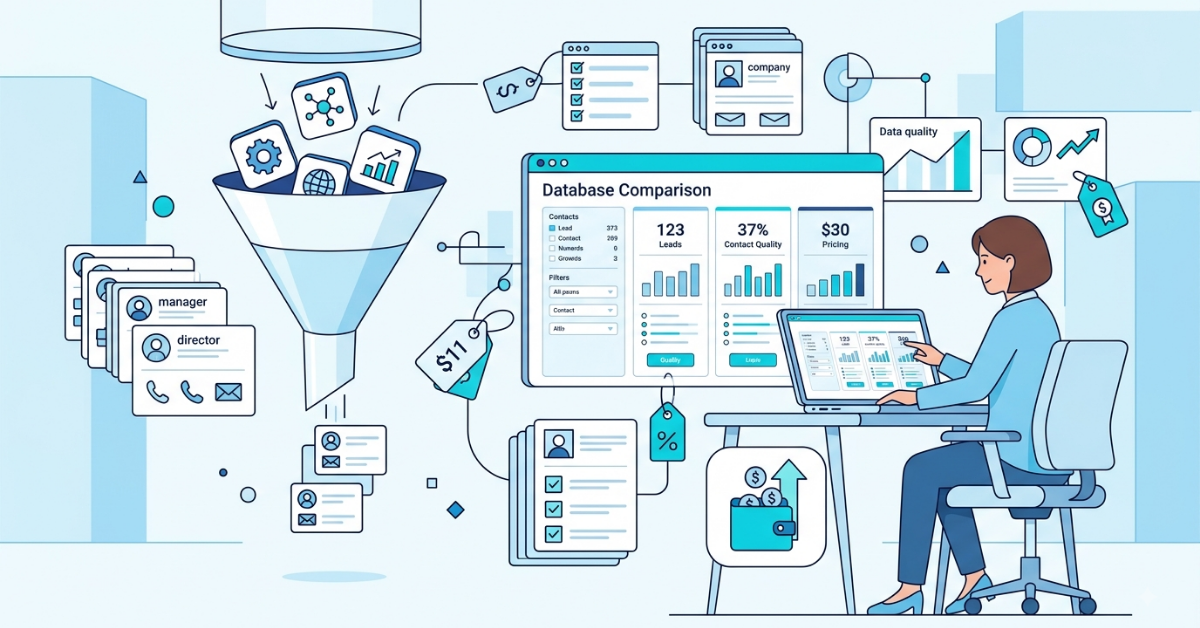
Building a predictable, scalable sales pipeline is one of the most formidable challenges facing small businesses, early-stage startups, and growing B2B enterprises. Unlike large corporations equipped with expansive sales operations teams and substantial enterprise software budgets, smaller organizations must operate with strict resource constraints. Every software subscription, lead list acquisition, and outbound marketing campaign must directly justify its return on investment. Consequently, founders and sales leaders frequently search for an affordable B2B contact database to accelerate prospecting without draining cash reserves.
However, navigating the landscape of sales intelligence and business contact data reveals a common and costly misconception: equating the lowest upfront price with true cost-effectiveness. In the realm of business-to-business sales, a cheap database populated with unverified, outdated, or irrelevant records often proves far more expensive than a premium alternative. Poor data quality results in severe operational inefficiencies—wasted sales development representative (SDR) hours, high email bounce rates, damaged sender reputations, inaccurate target accounts, and ultimately, missed revenue opportunities.
For small businesses entering new markets or scaling outbound sales, manual prospect research is an unsustainable bottleneck. Relying on manual web searches, social media directory browsing, and company website scanning consumes countless hours that sales teams should instead be dedicating to direct outreach, discovery calls, and deal closing. When sales representatives spend half their working day hunting for verified email addresses, direct phone numbers, and correct organizational hierarchies, pipeline velocity grinds to a halt.
An established B2B lead database transforms this erratic, manual effort into a structured, repeatable process. By centralizing millions of professional profiles, company firmographics, and direct contact channels into a searchable interface, databases empower small teams to identify hundreds of qualified target accounts in minutes rather than weeks. This operational leverage is particularly vital for small businesses, where a single founder or a lean two-person sales team must wear multiple hats, balancing lead generation, account management, and customer success.
While the temptation to cut corners by acquiring ultra-cheap or unverified B2B contact lists is understandable for budget-conscious startups, the hidden costs of subpar data quickly accumulate. When contact information is stale or incorrect, the downstream consequences ripple across every stage of the sales funnel:
Investing in verified business contacts is therefore not an unnecessary luxury; it is a foundational risk-mitigation strategy that safeguards team morale, domain health, and marketing expenditures.
When evaluating sales intelligence solutions on a budget, decision-makers must prioritize functional value over sheer database size. Marketing claims boasting hundreds of millions of records mean little if those records do not match your specific target market. An effective, affordable database should deliver several core capabilities.
The core utility of any prospecting database rests on the accuracy of its contact coordinates. Small businesses require reliable business email addresses and, where applicable, verified direct-dial phone numbers. High-quality platforms employ a combination of automated verification algorithms and manual validation processes to minimize bounce rates and ensure that outreach reaches active, working professionals.
Beyond simple email addresses, robust sales prospecting databases must furnish rich contextual attributes that enable precise audience segmentation. Essential data points include:
Data Category | Specific Attributes | Strategic Value |
Company Firmographics | Company name, industry, revenue range, employee count, geographic location | Ensures alignment with your Ideal Customer Profile (ICP) and tiering model |
Contact Demographics | Full name, job title, department, professional seniority | Identifies exact decision-makers and influencers within target accounts |
Technological Insights | Software stack, installed tools, infrastructure clues | Enables triggered outreach based on technology adoption or replacement cycles |
A massive repository of contacts is useless without intuitive filtering controls. Small businesses need advanced search parameters that allow them to narrow down broad industries into highly specific niches—such as filtering for marketing directors at mid-sized SaaS companies located in specific metropolitan regions. Granular search functionality prevents wasted outreach and sharpens campaign focus.
Corporate turnover is relentless; executives change roles, companies restructure, and email domains migrate. Continuous data updates and enrichment capabilities ensure that your database remains fresh over time, preventing your prospecting efforts from decaying due to organizational churn.
Budget allocation for sales technology is a delicate balancing act for emerging companies. Rather than chasing fixed pricing benchmarks, small businesses should evaluate pricing structures through the lens of utility, volume, and cash flow predictability.
Most modern contact data providers operate on recurring monthly or annual subscription models. These plans typically offer tiered access based on user seats, monthly search queries, or export volumes. For teams running steady, continuous outbound campaigns, subscription models offer cost predictability and unlimited day-to-day exploration, as long as usage caps align with actual team capacity.
For very early-stage startups or businesses engaging in sporadic, highly targeted outbound sprints, pay-per-contact or credit-based pricing models are often far more cost-effective. Instead of paying a steep monthly retainer for unused capacity, businesses purchase a fixed pool of export credits. This ensures that every dollar spent directly corresponds to acquired, actionable B2B sales leads.
Evaluating software solely through marketing collateral is a recipe for buyer’s remorse. Reputable database providers offer free trials, freemium tiers, or sample data exports. Small businesses should invariably use these trial periods to verify data accuracy against a sample of their historical target accounts before entering into long-term financial commitments.
Pricing Model | Best Suited For | Key Advantage | Potential Limitation |
Subscription / Tiered | Dedicated outbound sales teams with consistent monthly volume | Predictable budgeting and steady workflow integration | Risk of paying for unused seats or unutilized search quotas during slow months |
Credit-Based / Pay-Per-Export | Startups, solo founders, and part-time prospecting efforts | High cost-control and zero waste on idle months | Higher per-unit cost if export volumes scale unexpectedly |
Free Trials & Freemium | Initial vendor evaluation and data quality auditing | Zero financial risk during the assessment phase | Restricted search filters, capped exports, and incomplete data access |
There is no universal “best database” in the B2B marketplace; rather, the optimal choice is dictated by your company’s unique go-to-market motion, sales capacity, and target audience.
For early-stage companies where the founder or a sole sales representative manages prospecting, simplicity and speed are paramount. Overly complex enterprise platforms cluttered with advanced territory management and multi-tier approval workflows introduce unnecessary friction. Startups require clean interfaces, rapid search execution, and intuitive browser extensions that streamline daily prospecting without extensive onboarding.
Teams executing high-volume email or cold-calling campaigns prioritize contact accuracy, robust export limits, and seamless integration with sales engagement platforms. For these organizations, database reliability and fast data retrieval directly dictate campaign throughput and meeting booking rates.
When targeting high-value enterprise accounts, broad contact lists take a back seat to deep company intelligence and organizational mapping. ABM-driven businesses require databases that excel at uncovering subsidiary relationships, tracking corporate growth milestones, and identifying multiple buying committee members within a single target organization.
Niche service providers—such as boutique agencies, specialized consultants, or regional IT service providers—rely heavily on granular industry and geographic filters. For these businesses, the ability to isolate specific job titles within tightly defined regional parameters is much more valuable than having access to millions of generic records.
Business Model / Motion | Primary Database Priority | Key Features Required |
Early-Stage Startup | Ease of use & affordability | Simple UI, quick learning curve, flexible credit options |
High-Volume Outbound | Contact accuracy & scale | High email deliverability, fast CSV exports, robust CRM sync |
Account-Based Marketing (ABM) | Firmographic depth & org mapping | Company hierarchy data, buying committee identification |
Niche Service Provider | Granular filtering | Precise industry taxonomies, regional and title targeting |
To avoid investing in bloated software that fails to deliver results, small businesses should establish a disciplined evaluation methodology before signing contracts.
Before evaluating a B2B lead database, clearly define your Ideal Customer Profile (ICP). Establish specific criteria such as target industries, company size, geographic markets, job functions, seniority levels, and revenue ranges. Assess the database by how accurately it identifies companies and decision-makers that match these predefined ICP criteria.
Never rely on vendor claims regarding data accuracy percentages. During free trials or pilot periods, run a live test: export a sample of fifty to one hundred records matching your ICP, and cross-reference them using email verification tools, LinkedIn verification, and direct phone checks. Evaluate how many emails bounce, how many job titles are obsolete, and whether the company details are current.
When budgeting for data acquisition, look beyond the headline subscription fee. Calculate the total cost of ownership by factoring in secondary expenses:
Total Cost = Subscription Fee + Internal Sales Time + Data Verification Costs + CRM Cleanup Effort
A slightly higher subscription fee for pre-verified, high-accuracy data is almost always more economical once internal labor and campaign remediation costs are factored in.
When hunting for budget-friendly lead generation for small businesses, buyers frequently encounter platforms that promise massive record counts at impossibly low prices. Awareness of common industry red flags protects organizations from squandering limited capital.
Marketing slogans boasting “500 million global contacts” are frequently misleading. If those millions of records consist of outdated consumer profiles, defunct corporate domains, or unverified foreign entries, the database offers zero utility for a B2B sales team targeting North American SaaS companies. Relevance always supersedes raw volume.
Corporate churn is rapid, with millions of professionals changing roles annually. Low-cost databases that rely on static, infrequently refreshed data scrapers quickly accumulate “ghost records”—emails belonging to individuals who left their companies months prior.
Marketing slogans boasting “500 million global contacts” are frequently misleading. If those millions of records consist of outdated consumer profiles, defunct corporate domains, or unverified foreign entries, the database offers zero utility for a B2B sales team targeting North American SaaS companies. Relevance always supersedes raw volume.
Some budget platforms restrict filtering capabilities behind paywalls, forcing users to manually browse massive, unfiltered lists. Without robust keyword, title, and industry filters, your team spends valuable hours sorting through noise.
Always scrutinize terms of service regarding daily search caps, monthly export limits, and restrictions on CRM data syncing. A low upfront price loses its appeal rapidly if export caps prevent your team from executing normal monthly campaigns without incurring penalty fees.
Red Flag Warning | Potential Consequence | What to Check Instead |
Exaggerated record volume claims | High proportion of dead or irrelevant contacts | Focusable active record count within your specific ICP |
Vague data refresh frequency | High email bounce rates and obsolete titles | Explicit refresh schedules and validation guarantees |
Onerous export caps and quotas | Unexpected overage charges or workflow bottlenecks | Unrestricted or transparently tiered export allowances |
Acquiring a powerful database is only half the battle; maximizing its value requires a disciplined operational workflow. Small businesses must establish a systematic pipeline from raw data acquisition to active sales engagement.
A B2B contact database should not exist as an isolated silo. To maximize efficiency, the platform must integrate smoothly with your broader sales stack, including your Customer Relationship Management (CRM) system, email outreach software, and sales engagement tools. Seamless synchronization eliminates manual data entry, prevents duplicate outreach, and ensures every interaction is accurately tracked from initial prospect discovery through closed-won status.
Within the broader landscape of sales intelligence and lead generation technology, platforms like ReachStream offer practical capabilities tailored to the needs of growing organizations. Keeping promotional considerations proportionate to an educational framework, specialized tools can assist small businesses in streamlining their outbound operations.
ReachStream provides small businesses with access to verified business contacts, company firmographics, and decision-maker profiles designed to support targeted prospecting without enterprise-level complexity. By offering advanced search filters, contact enrichment features, and browser extension capabilities, such platforms enable sales teams to uncover relevant leads directly within their normal web research workflows.
Rather than positioning any single tool as a universal solution, small businesses should evaluate platforms like ReachStream against their specific campaign requirements, team size, and budgetary constraints, ensuring that acquired data directly accelerates their overarching sales strategy.
To simplify the final decision-making process, sales leaders and founders can use the following comprehensive buyer’s checklist when evaluating potential contact database vendors:
Ultimately, finding the right B2B contact database is an exercise in balancing data quality, relevance, usability, coverage, and cost. For small businesses operating on tight budgets, the cheapest option in the short term often proves to be the most expensive over time due to lost sales hours, damaged domain reputations, and missed revenue opportunities.
By starting with a crystal-clear Ideal Customer Profile, rigorously testing data quality during trial periods, evaluating pricing models against actual usage, and avoiding common industry red flags, small business leaders can invest with confidence. A well-chosen database becomes a powerful catalyst for predictable revenue growth, empowering lean teams to punch above their weight and scale their sales pipeline effectively.
For a broader exploration of outbound strategies and pipeline development, consult our comprehensive guide on The Ultimate B2B Lead Generation Guide (2026).
Credit-based or pay-per-export databases are generally the most affordable option for early-stage startups and small teams with sporadic prospecting needs, as they eliminate recurring monthly retainers for unutilized capacity.
Many low-cost databases rely on unverified, scraped data with high error rates. Reliability depends entirely on whether the provider uses active email verification and regular data refresh cycles, rather than on raw database size.
An effective database should provide verified professional email addresses, direct phone numbers, company firmographics (industry, employee count, revenue), and precise contact demographics (job title, department, seniority).
Small businesses should leverage free trials or sample exports to test a cohort of records against live email verification tools, LinkedIn profiles, and historical ICP criteria before committing to a contract.
Free databases can be useful for initial validation or bootstrapping, but they frequently suffer from severe data decay, limited search filters, and legal compliance risks. They are best supplemented by paid verification tools or upgraded once revenue permits.
Because corporate turnover and job changes occur continuously across industries, high-quality B2B databases should refresh and validate their records on a continuous or monthly cycle to prevent high email bounce rates.
Yes. By eliminating manual web research and streamlining prospect discovery, a quality database saves hundreds of hours of SDR labor, directly increasing outreach volume and meeting booking rates.
Beyond upfront subscription costs, businesses must evaluate total cost of ownership factors, including data verification expenses, ease of CRM integration, export limits, search usability, and the internal labor time required to clean bad data.
Marketing professional with a Master’s degree in Marketing, specializing in SEO, content strategy, social media, performance marketing, prospecting, and demand generation.
Access 200M+ verified business emails and grow your sales pipeline effortlessly.
Don't forget to share this post!















Check out our other blogs!
Is Buying B2B Data Legal? What You Need to Know
Intent Data: What It Is and How to Use It for Campaign Targeting
What Mid-Market SaaS Teams Need in Lead Gen Tools
ReachStream Prospect for E-commerce Brands: Outbound Case Study