
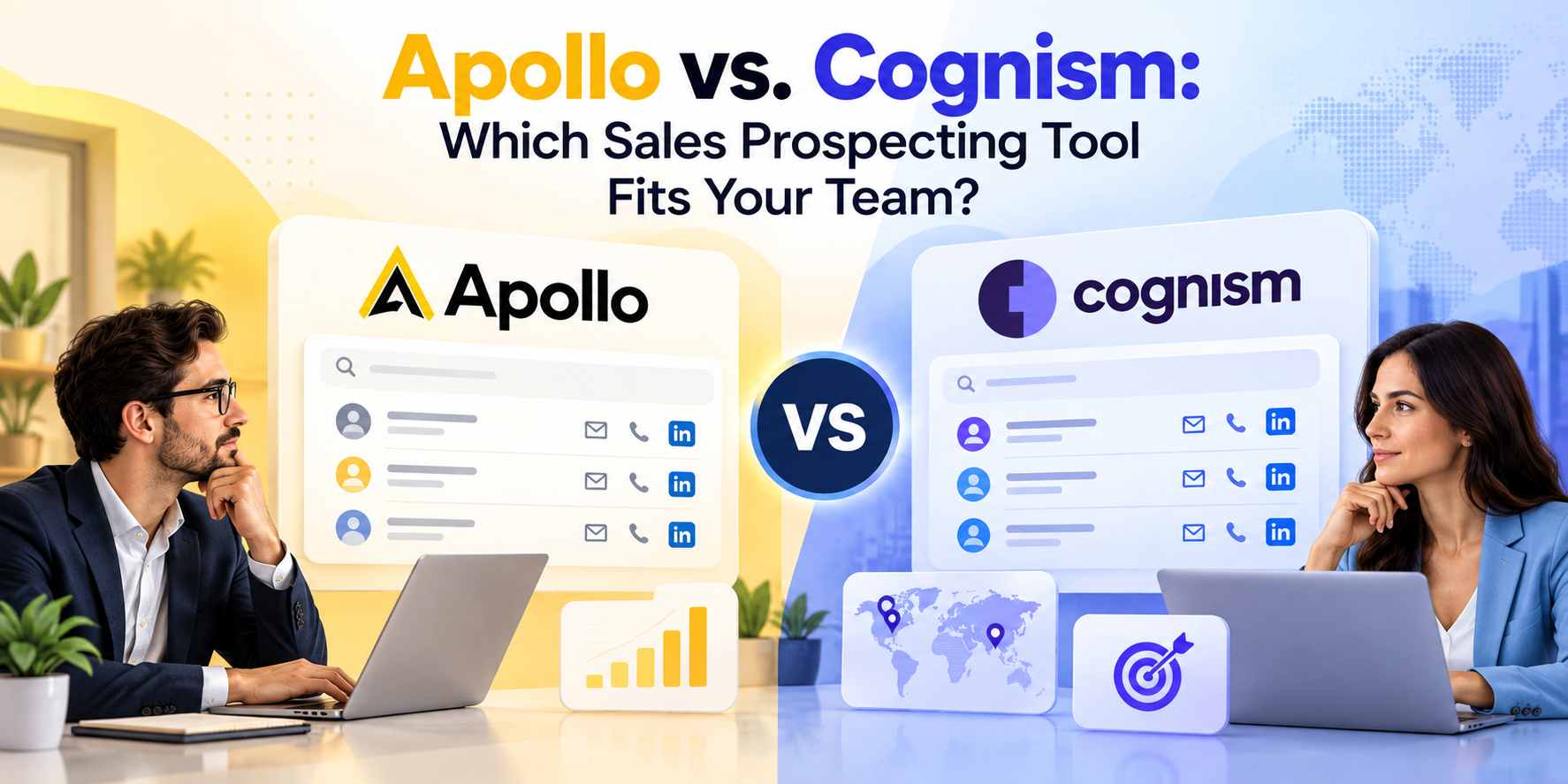


If you’re weighing Apollo vs Cognism, here’s the short answer. Apollo suits US-heavy teams that want data, sequencing and a dialer in one affordable tool. Cognism suits teams that spend their day on the phone in Europe and need compliance-checked mobile numbers. Price is the other big split: Apollo publishes its plans and starts free, while Cognism quotes every deal individually, usually on an annual contract.
Both are sales intelligence platforms, meaning tools that help sales teams find, verify and prioritize the people they should be talking to. Where they differ is in how they build their B2B database, what they charge, and which regions they cover well.
A B2B data platform is a searchable database of business contacts and companies. Contact enrichment fills in missing fields, like a phone number or job title, on records you already own. Sales intelligence adds signals such as buying intent, hiring and technology use on top of that data..
Apollo (Apollo.io) is a GTM platform that pairs a large B2B contact database with email sequences, a built-in dialer, call recording, AI research and a Chrome extension that works on LinkedIn and Gmail. Plenty of smaller teams run their entire outbound motion from it.
Cognism is a London-based sales intelligence provider with a narrower focus: accurate contact data, especially mobile numbers, delivered with GDPR and Do-Not-Call screening built in. Most Cognism customers pair it with a separate engagement tool such as Outreach or Salesloft.
So any Apollo vs Cognism comparison is partly a data question and partly a workflow question. One is sales prospecting software with a whole toolbox attached. The other is a specialist data feed. Looked at purely as sales intelligence, it’s breadth versus depth.
The Apollo database vs Cognism database question starts with size. Apollo’s pricing page lists access to roughly 240 million contacts and 30 million companies, which puts it among the widest B2B databases on the market. Width isn’t the same as accuracy, though. Independent tests of large Apollo exports keep flagging a real share of catch-all and invalid emails, so many teams run Apollo lists through an extra verification step before sending.
Cognism builds its data differently. A research team phone-verifies a subset of mobile numbers, branded Diamond Data, and Cognism claims around 98% accuracy on those records. That subset is reported at about 10 million contacts, so the headline figure doesn’t describe the whole database. On Apollo vs Cognism data accuracy, the fair summary is that Cognism wins on verified mobiles and Apollo wins on reach.
Cognism says it holds about 95 million US B2B contacts, including more than 30 million decision-makers, with verified mobiles for 75% of US decision-makers. Those are respectable numbers. Even so, reviewers consistently describe Cognism’s strongest coverage as the UK, DACH, the Nordics, Benelux and France, and some US-focused teams report lower match rates than they get from US-first providers.
Apollo was built in the US and its coverage shows it, particularly across SaaS, tech and SMB accounts. Looking at Apollo vs Cognism for US sales teams, or for SaaS companies selling into North America, Apollo generally gives you more records per dollar. If your territory runs from London to Berlin to Stockholm, Cognism earns its place.
Apollo’s feature list is long. Paid plans include email sequences, a US dialer on Professional, call recording, AI-written emails, intent topics, lead scoring and the Apollo Chrome extension for pulling contacts from LinkedIn profiles and company websites. Comparing Apollo vs Cognism for SDRs, that single login from search to first touch is a big part of Apollo’s appeal.
Cognism keeps its scope tighter: search and filters, contact and company data, Bombora-powered intent on higher tiers, sales triggers, a Chrome extension for LinkedIn and an API. Its Pro package adds higher-quality mobile data and on-demand mobile verification. In an Apollo vs Cognism Chrome extension comparison, both reveal contact details on LinkedIn, but Cognism’s extension is about the data while Apollo’s also drops contacts straight into a sequence.
Both tools connect natively with Salesforce and HubSpot. Apollo’s Professional and Organization plans add advanced CRM integrations, so reps can sync activity both ways and enrich records on a schedule. Cognism sells CRM enrichment as a standalone product or an add-on with ongoing maintenance included, and it can push contacts into Outreach and Salesloft sequences.
For RevOps, the Apollo vs Cognism CRM integration question usually comes down to ownership. Apollo can become the system reps live in all day. Cognism sits behind your existing stack and keeps the records in it fresh.
Apollo publishes its prices. In 2026 the Free plan costs nothing and comes with limited mobile and export credits. Basic is $49 per user per month billed annually ($59 monthly), Professional is $79 ($99 monthly) and Organization is $119 ($149 monthly) with a three-seat minimum. Credits are pooled across the team and reset every billing cycle.
Cognism doesn’t publish prices at all. Its current packages, Standard and Pro, each include five seats and are quoted deal by deal. Its earlier Grow and Elevate contracts are at $15,000 to $37,500 a year for a five-person team, typically paid annually upfront with no monthly option or free plan. Discounts are common, so your quote may land elsewhere.
That gap is why Apollo vs Cognism pricing in 2026 often settles the decision for smaller teams. Five Apollo Professional seats come to about $4,740 a year at list price.
| Platform | Best for | Starting price | Data strength | Coverage and compliance |
|---|---|---|---|---|
|
Apollo |
US SMB and mid-market teams that want an all-in-one tool |
Free plan; paid from $49/user/mo billed annually |
About 240M contacts; broad, but emails benefit from extra verification |
Strongest in North America; GDPR and CCPA program |
|
Cognism |
Teams calling into the UK and EU |
Custom quote on an annual contract |
Phone-verified Diamond Data mobiles |
Strongest in EMEA; DNC screening in 12+ countries |
|
ReachStream |
Budget-conscious US sales teams |
Free plan; paid from $29/mo billed yearly |
500M+ business contacts with ESP-verified emails |
US-focused B2B data platform with published pricing |
Compliance is where Cognism leans hardest. It relies on legitimate interest under GDPR, notifies people that they’re in its database, is registered as a data broker in California, and checks numbers against Do-Not-Call registries in the US, UK, Germany, France, Australia and elsewhere. Cognism compliance explainer goes deeper.
Apollo also runs a GDPR and CCPA compliance program and supports opt-outs, but its tooling is built for high-volume outbound rather than regulated calling. On Apollo vs Cognism compliance, Cognism is the safer default for phone outreach into Europe, while US teams that lead with email usually find Apollo’s controls sufficient.
ReachStream Prospect sits between the two. Like Apollo, it publishes its prices and starts free. Like Cognism, it puts data quality ahead of extra tooling, with ESP-verified emails and a built-in email verifier that catches bad addresses before they reach your sequences.
The ReachStream B2B contact database covers 500M+ business contacts across 400+ industries, with firmographic and technographic filters, a Chrome extension, an ABM list builder, CRM-ready exports and contact enrichment through ReachAPI.
Pricing is simple. The Free plan includes 100 export credits a month. Starter is $29 a month billed yearly ($39 monthly) for 5,000 export credits a month, Pro is $49 ($59 monthly) for 10,000, and Business is $79 ($99 monthly) for 20,000 credits across three seats.
For teams that want an affordable alternative to Apollo, or a Cognism alternative for US sales teams without an annual platform fee, the ReachStream prospecting platform is a sensible place to start. For a wider field of Apollo vs Cognism alternatives, our guides to Apollo alternatives and Cognism alternatives cover more options.
The Apollo vs Cognism choice comes down to geography, workflow and budget. Apollo gives US-focused teams a broad database plus sequencing and dialing for a published per-seat price, though its email data benefits from extra verification. Cognism gives Europe-facing teams phone-verified mobiles and strong compliance, at a custom price that usually lands in five figures.
Run both against your own target accounts before deciding. And if you’d like verified US data with transparent monthly pricing, the ReachStream B2B data platform deserves a spot on the shortlist.

Author

Access 200M+ verified business emails and grow your sales pipeline effortlessly.
Don't forget to share this post!















Check out our other blogs!
Email ID Checker: Verify Any Email ID Online
ICP Refinement for SDRs: Using Data Filters to Stop Wasting Touches

Email Validator: Validate Email Format, Domain and Mailbox