Written by:

Abdul Kareem
B2B Prospecting Strategies for SDRs to Book More Meetings
> Sales Prospecting
How to Evaluate B2B Data Vendors for Accuracy and Compliance

TL;DR
- B2B prospecting strategies for SDRs work best as a sequence, not a list of random outreach tactics.
- Start by defining your ideal customer profile and the buyer persona you are trying to reach inside it.
- Research and select target accounts before you send a single message, not after.
- Build your prospect list from accurate, verified data rather than a rough guess at who fits.
- Qualify each lead against real buying signals before you reach out, not after you get a reply.
- Personalize outreach across the right channels using a small set of templates, not a blank page each time.
- Each step filters the list down, so more of what is left turns into booked meetings.
Why Most SDR Prospecting Wastes Time
If you are an SDR, most of your week disappears into research. You check a title. You check a company size. You check a working email. This happens before you send anything. That research often takes longer than the outreach, and the leads at the end are not always worth the time.
The fix is not more hours at the keyboard. It is a repeatable set of B2B prospecting strategies for SDRs. These turn research into a short process, so more of your time goes into talks that become meetings.
This guide walks through that process step by step. It covers who you sell to, list building, qualification, channels and personalization.
Quick Answer
Good B2B prospecting strategies for SDRs follow a sequence. Define your ICP. Research and select target accounts. Build a list from accurate data. Qualify each lead. Then personalize outreach across the right channels. Each step filters the list down, and more of the prospects left turn into booked meetings.
What Makes B2B Prospecting Strategies for SDRs Work
Most prospecting advice focuses on activity: more calls, more emails, more touches. It is easy to measure. It is also easy to inflate. On its own, it does not fill a pipeline.
SDR prospecting best practices treat each stage as a filter. It is not a funnel you pour names into. You start broad, with an ideal customer profile. You narrow at each step, and the people left are worth a personal message.
That is the real difference between prospecting techniques for B2B sales teams. Some generate volume. Others generate meetings. Volume wears out a list fast. A filtered process keeps producing leads worth calling, week after week. Most B2B prospecting strategies fail right here. They skip the filter and go straight to outreach.
Define Your ICP and Buyer Personas
Before you open any search tool, write down who you are trying to reach. Your ideal customer profile (ICP) describes the companies. Think industry, size, revenue range, location and technology.
Your buyer persona describes the person inside that company. Think title and role on the buying team. Add the problem that makes your product relevant to them.
The ICP narrows which companies you look at. The buyer persona tells you which person to contact first. Skip either one, and you prospect against a guess, not a target. That guess is what makes B2B prospecting strategies for SDRs fall apart, and it happens before the first email goes out.
Select and Research Target Accounts
Once your ICP is clear, decide how you will prospect. You can go broad, or work a shorter list of named accounts. Account-based prospecting strategies narrow the field to a smaller set that fits your ICP closely, then go deeper on each one. This works well in a specific, identifiable market.
Account research comes before the first message. Pull firmographic data to confirm fit: size, industry, revenue, funding, technology stack. Then work through decision-maker identification.
Who holds budget? Who influences the decision? Who will use what you sell? A note on a recent hire or a technology change gives you something real to reference, and that beats a generic opener.
Build a Targeted Prospect List With Accurate Data
With your ICP, personas and target accounts defined, turn that into an actual list. This is one of the B2B prospecting strategies for SDRs that depends most on the tool behind it. Targeted prospect list building saves you hours, or it costs you them.
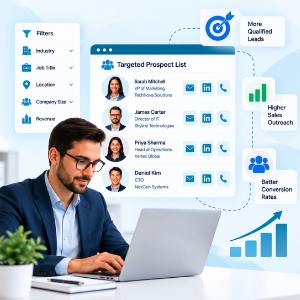
The ReachStream Prospect product page lets you search by job title, job level, department and industry. Add company size, revenue, location and technology, with more than 20 filters in all. You can build a list that matches your ICP, not just a rough guess at it.
Stacking filters one at a time can feel slow. The AI Conversational Search feature covers a faster way. Describe who you want in plain language, for example VPs of sales at mid-size SaaS companies in Canada, and that description becomes editable filters. The List Builder page then keeps the list dynamic. It updates on its own as new contacts match what you need, and it does not go stale, either.
Keep Your Prospect List Current
This is how SDR lead generation strategies move from a one-time export to a list that stays current. Prospect segmentation, grouping by industry, size or persona, also sets up more targeted messaging later.
Signals That Mean a Lead Is Ready
A name that fits your ICP is not automatically a qualified lead. Before you reach out, check for buying signals. Look for recent hiring in the department. Look for a new leader. Look for new funding, or a technology switch that points to a real, current need.
See Real-Time Lead Data in Action
Try ReachStream Prospect’s filters and AI Conversational Search on your own target accounts.
Qualify Leads Before You Reach Out
Then add basic lead qualification. Confirm the contact still holds the role. Confirm the company is still a fit. Now you are not working a stale record.
Good sales prospecting techniques for SDRs qualify before they contact, not after. That is how SDRs can find qualified leads faster. It is not searching more broadly. It is applying the same checks each time. Outreach time goes to contacts worth the effort.
The Data Behind Qualifying First
Abstrakt Marketing Group analyzed more than 6.2 million outbound dials from its own 2025 client programs. It found a 6.5 percent connect rate and a 15.3 percent pitch-to-meeting rate (as of November 9, 2026, State of Outbound Lead Generation). That is one provider’s client data, not an industry survey, but it makes the same point. Most dials and emails do not convert, and qualifying first protects your time.
| Approach | Best for | Time per verified contact | Scalability | Data freshness risk |
|---|---|---|---|---|
|
Cold calling |
Reaching a decision-maker directly |
Handling objections in real time |
High, one-to-one |
Low, does not scale past a short list |
|
Email |
Reaching people who screen calls |
Read on their own schedule, easy to personalize |
Medium, template plus one detail |
High, scales to many contacts |
|
LinkedIn and social |
Building familiarity before a direct approach |
Research before outreach, especially with senior buyers |
Medium, profile-level context |
Medium, works best combined with other channels |
Choose the Right Outbound Channels
Sales prospecting techniques for SDRs rarely rely on one channel alone. Cold calling still works for reaching a decision-maker directly, and it also handles objections in real time. This works best on warmer or referred accounts.
Email reaches people who screen calls but read messages on their own time. It is also easy to personalize at scale. LinkedIn and other social channels build familiarity first, and this matters most with senior buyers, who research vendors before they respond to outreach.
B2B sales prospecting methods often combine two or three channels in a short sequence: a LinkedIn view, then an email, then a call. That tends to beat any one channel used alone.
Match the Channel to the Buyer's Seniority
Outbound sales strategies for SDRs should match the channel to the account’s seniority, and attention span matters too. Do not just default to whatever is fastest to run.
A Simple Daily Prospecting Workflow
The six steps above can feel like a lot to hold at once. Here is how they fit into a day.
Daily Prospecting Checklist
- Spend the first 30 to 45 minutes building or refreshing your target account list against your ICP.
- Research the top accounts on that list: firmographics, decision-makers and any recent buying signals.
- Pull and qualify contacts for those accounts, checking title, role and current company fit.
- Block your outreach window for calls and emails sequenced across channels, then update your CRM and flag follow-ups.
Make This Workflow a Daily Habit
Run this loop daily. The B2B prospecting strategies covered above stop being a one-time project. They become how you work each day, and that consistency is the real point of B2B prospecting strategies for SDRs.
Personalize Outreach at Scale
Personalizing each email from a blank page does not scale. It works for only a handful of accounts a day. The account research from account selection gives you a shortcut: a recent hire, a product launch, a pain point tied to their role. Drop one or two of those details into a template.
Do not rewrite the whole message. Keep a small set of templates built around common triggers, such as new funding or a technology switch, and fill in the specific detail per account.
Sales development representative strategies that work at scale rely on this structured personalization. They do not rely on fully custom writing for each contact. The goal is a message that reads as written just for that account, while still coming from a process that takes minutes per email, not an hour.
What Customers Say
“I can filter by job title, company size, and location without getting lost in a complicated system.”
Dorothy M., Lead Development Manager
Use Sales Prospecting Tools to Keep Data Clean
Sales prospecting tools for SDRs decide whether the steps above take minutes or hours. ReachStream Prospect gives SDRs access to 450M+ contacts and 25M+ companies, including 55M+ direct dials and mobile numbers across more than 150 countries.
Each email can be verified in real time before export, so credits go toward contacts you can actually reach. Data Enrichment is designed to fill in incomplete or outdated records, adding verified emails, phone numbers and company details.
The Chrome Extension page covers a related shortcut. It pulls verified contact details straight from LinkedIn and LinkedIn Sales Navigator, so SDR prospecting activities that start on LinkedIn do not need a tab switch. You still find a working email.
You can try this with ReachStream’s free plan. It includes 100 export credits and 200 email view credits, no credit card required.
Start Free With ReachStream Prospect
Try ReachStream Prospect’s filters, AI Conversational Search and verified data on your own target list.
Conclusion
Booking more meetings is rarely a volume problem. It is usually a filtering problem: too many unqualified names, and not enough time on the ones worth a personal message.
B2B prospecting strategies for SDRs win by starting with a clear ICP. They move through account research and qualification, and they end in personalized, multi-channel outreach. That beats a longer list worked the same way for everyone on it.
See Prospect Pricing for Your Team
Compare ReachStream Prospect plans and find the right fit as your outreach volume grows.
Frequently Asked Questions
What B2B prospecting strategies work best for SDRs?
Treat prospecting as a sequence. Define your ICP and buyer persona. Research and select target accounts. Build a list from accurate data. Qualify each lead. Then personalize outreach across the right channels. Each step filters the list so your time goes toward contacts worth reaching.
How can SDRs find qualified B2B prospects faster?
Speed comes from applying the same checks each time, not searching more broadly. Filter by firmographic fit first. Confirm current buying signals, such as hiring, funding or a technology change. Verify the contact still holds the role before you reach out.
How do SDRs book more meetings with prospecting?
Meetings come from working a smaller, better-qualified list with personalized, multi-channel outreach. They do not come from higher call or email volume. A structured workflow filters accounts and leads before outreach, and that produces more talks worth booking.
What data should SDRs use to identify potential buyers?
Start with firmographic data: industry, company size, revenue, location and technology stack. Add role-level details, such as job title and department. Add buying signals, like recent hiring or a new leader. Together these confirm the contact and company are worth prospecting now.
How can SDRs build a targeted prospect list?
Build from your ICP using filtered search: job title, job level, industry, company size, technology. AI Conversational Search can turn a plain-language description into those filters. A dynamic list builder then keeps the list current as new matches appear.
What is the best prospecting workflow for a new SDR?
A simple daily loop works best. Refresh your target account list. Research the top accounts. Qualify the contacts. Run outreach across channels. Then update your CRM and flag follow-ups. Repeating this daily turns prospecting into a habit, not a one-time push.
How can SDRs personalize cold emails at scale?
Keep a small set of templates built around common triggers, such as new funding or a new leader. Insert one or two specific details from your account research into each one. This gives each email a genuine, account-specific detail without writing it from scratch.
Which channels work best for B2B sales prospecting?
Cold calling, email and LinkedIn each do different work. Calls handle objections in real time. Email reaches people on their own schedule. LinkedIn builds familiarity before a direct approach. Combining two or three in a short sequence tends to beat a single channel.
How often should SDRs refresh their prospect list?
Treat your list as something that needs regular refreshing, not a one-time export. A dynamic list builder can update automatically as new contacts match what you need. Data refreshed on a regular cycle stays more reliable than a list built once and left alone.
Abdul Kareem
Author
Abdul Kareem

Abdul Kareem writes about B2B sales prospecting, email deliverability, and cold outreach for ReachStream, focusing on practical guidance that sales and marketing teams can put to use right away.
Share
Table of Contents
Access 500M+ verified business emails and grow your sales pipeline effortlessly.
Power Your Sales
with Targeted Data
Abdul Kareem writes about B2B sales prospecting, email deliverability, and cold outreach for ReachStream, focusing on practical guidance that sales and marketing teams can put to use right away.
Don't forget to share this post!















Check out our other blogs!