

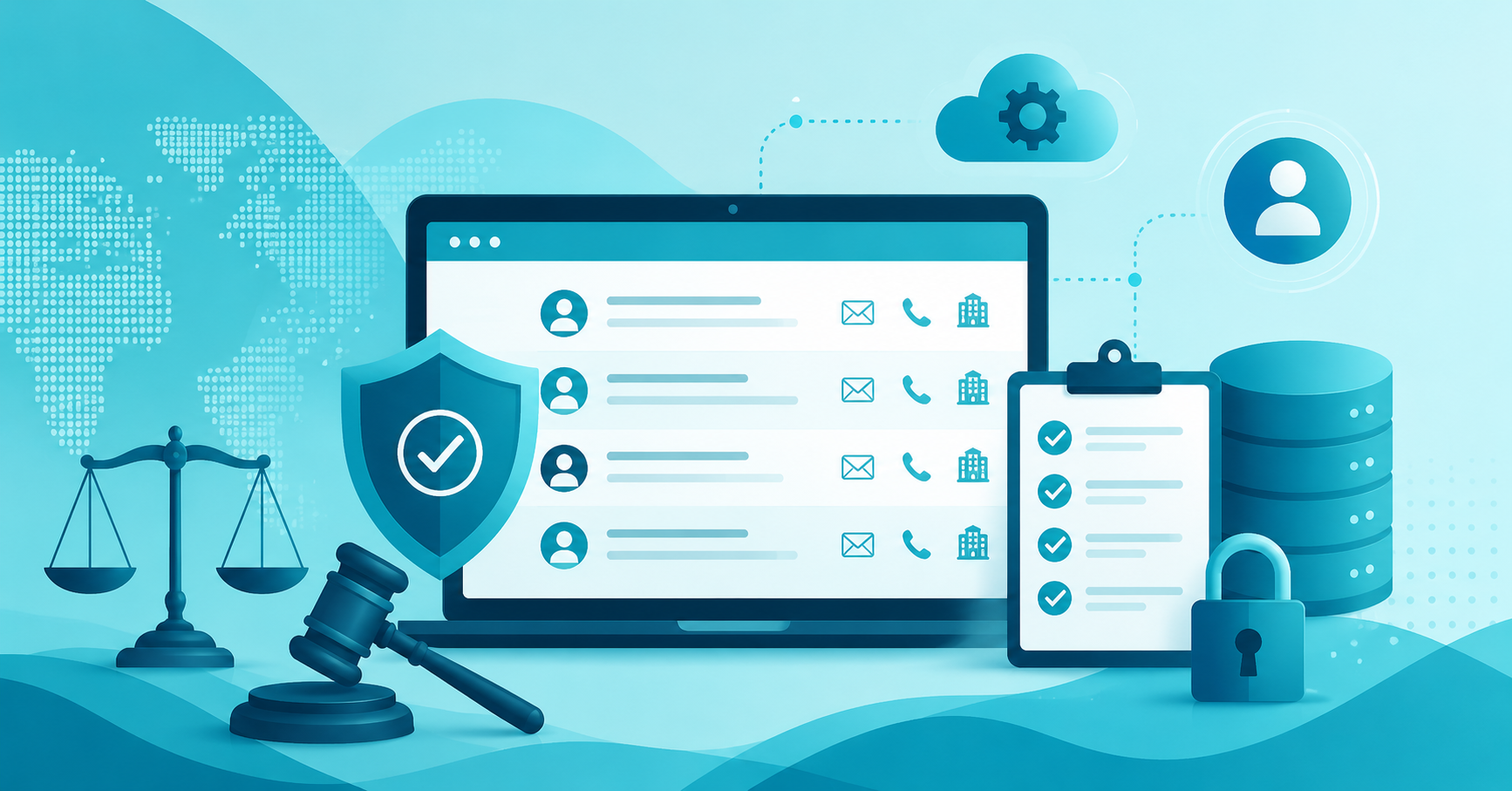
How to Evaluate B2B Data Vendors for Accuracy and Compliance
If you’re building a sales or marketing pipeline, at some point you’ve probably wondered: can I just buy a business database and start reaching out? The short answer is yes, in most cases but “legal” and “risk-free” aren’t the same thing. How you use the data, where it came from, and who’s in it all matter just as much as whether you paid for it.
This guide breaks down what actually makes a business database purchase legal, which regulations apply, and what to check before you commit your budget to a provider.
A business database, in this context, is a structured collection of company and contact records, including names, job titles, work emails, phone numbers, and firmographic details sold or licensed by a data provider for sales, marketing, or recruiting outreach. This is different from:
Most B2B teams use a mix of these, but purchasing a maintained, verified business database is the fastest way to scale outbound without months of manual research.
Yes, purchasing a business database is legal in the United States, and generally permitted in most jurisdictions when the data is business contact information used for business-relevant outreach. No law bans the sale or purchase of business contact data outright.
What the law actually regulates is how you use it afterward: whether you have a lawful basis to contact those people, whether you honor opt-out and deletion requests, and whether the provider sourced the data transparently. The purchase itself rarely triggers a violation sloppy usage after the purchase is where most legal exposure comes from.
Different regions take very different approaches to business contact data. Here’s what actually applies.
GDPR treats a professional’s work email and job title as personal data, even in a B2B context. Cold outreach to EU/UK contacts is only permitted under a documented lawful basis — typically legitimate interest — and it comes with real conditions: the message must be relevant to the person’s role, you must disclose where the data came from, and you must provide a clear opt-out. If you buy a database with EU or UK contacts, you inherit the responsibility of justifying that lawful basis yourself.
California’s business-to-business exemption expired in 2023, meaning a California resident’s work email, direct phone number, and job title are now fully protected personal information under CCPA/CPRA. Businesses must let people opt out of the sale or sharing of their data, and if your provider sells B2B contact data, you inherit “Do Not Sell” obligations the moment you buy the list.
Canada’s federal privacy law requires organizations to have a reasonable basis for collecting and using personal information, including business contact details, and to be transparent about how that data is used. When a business database changes hands, consent doesn’t automatically transfer with it — the new owner is still responsible for using the data appropriately and honoring requests to stop contact.
India’s Digital Personal Data Protection Act extends data protection obligations to personal data processing more broadly, including contact information used for business outreach. Buyers need to be able to show a lawful basis for processing and must support individuals’ rights to access or correct their data.
The purchase itself is usually fine. The problem is when a provider can’t tell you where the data came from or whether there was ever a lawful basis to collect it. A list scraped from unknown sources, sold with no documentation, and stripped of any consent trail puts the legal risk entirely on the buyer even if the seller never faces consequences.
This is the single biggest distinction between a legally safe purchase and a risky one: verified, transparently sourced business data sits in a completely different risk category than an unverified list of “500,000 decision-makers” with no documented origin.
For example, ReachStream is certified in ISO 27001:2022 and SOC 2, and compliant with GDPR, CCPA, PIPEDA, and DPDPA — the kind of documented, audited combination of security certification and regulatory compliance you should be looking for in any provider before you buy.
ReachStream is certified in ISO 27001:2022 and SOC 2, and compliant with GDPR, CCPA, PIPEDA, and DPDPA. That combination reflects the two things a buyer actually needs to verify before purchasing a business database: audited security practices around how the data is stored and handled, and documented compliance with the privacy regulations that govern the regions your prospects are in. Beyond certifications, ReachStream provides real-time email verification and regular data refreshes, which helps reduce both deliverability risk and the legal exposure that comes with contacting stale or invalid records.
Buying a business database is legal in the vast majority of cases; the real risk lies in what happens after the purchase. Where the data came from, whether there’s a lawful basis to contact each person, and how quickly you honor opt-outs matter far more than the fact that money changed hands. Choose a provider that can show you both audited security practices and documented regulatory compliance, verify the data before you send a single email, and treat compliance as an ongoing responsibility rather than a box you check once at checkout.
No, purchasing an email list is not inherently illegal. What matters legally is how the data was sourced, whether you have a lawful basis to contact those people in their region, and whether you honor opt-out requests after the purchase.
Not outright. GDPR allows cold B2B outreach under a legitimate interest basis, but you need to document that basis, keep the message relevant to the person’s role, and provide a working opt-out.
It depends on the region. In the US, consent isn’t required upfront for business email, but you must honor opt-outs quickly. In the EU/UK, you need a documented lawful basis, and full opt-in consent is the safest approach for individual contacts.
You still carry responsibility for how the data is used, even if the provider sourced it improperly. This is why verifying a provider’s certifications and compliance claims before purchase matters more than the price of the list itself.
Business contact data decays steadily as people change jobs and companies restructure, so active lists should be re-verified regularly rather than treated as a one-time purchase.
Look for transparent sourcing, recognized security certifications like ISO 27001 and SOC 2, documented compliance with regulations such as GDPR, CCPA, PIPEDA, and DPDPA, and built-in opt-out and suppression list support.
Marketing professional, specializing in SEO, content strategy, social media, performance marketing, prospecting, and demand generation.
Access 200M+ verified business emails and grow your sales pipeline effortlessly.
Don't forget to share this post!















Check out our other blogs!
Email ID Checker: Verify Any Email ID Online
ICP Refinement for SDRs: Using Data Filters to Stop Wasting Touches
Email Validator: Validate Email Format, Domain and Mailbox