



> ReachStream
A Look at How Startups Use ReachStream to Build Pipeline Faster

Most early-stage B2B startups run sales the same way at first: a founder or a single SDR pulling contacts from LinkedIn, a couple of free tools, and whatever list a past job left them with. It works for the first dozen deals. It stops working the moment someone has to hit a number every week.
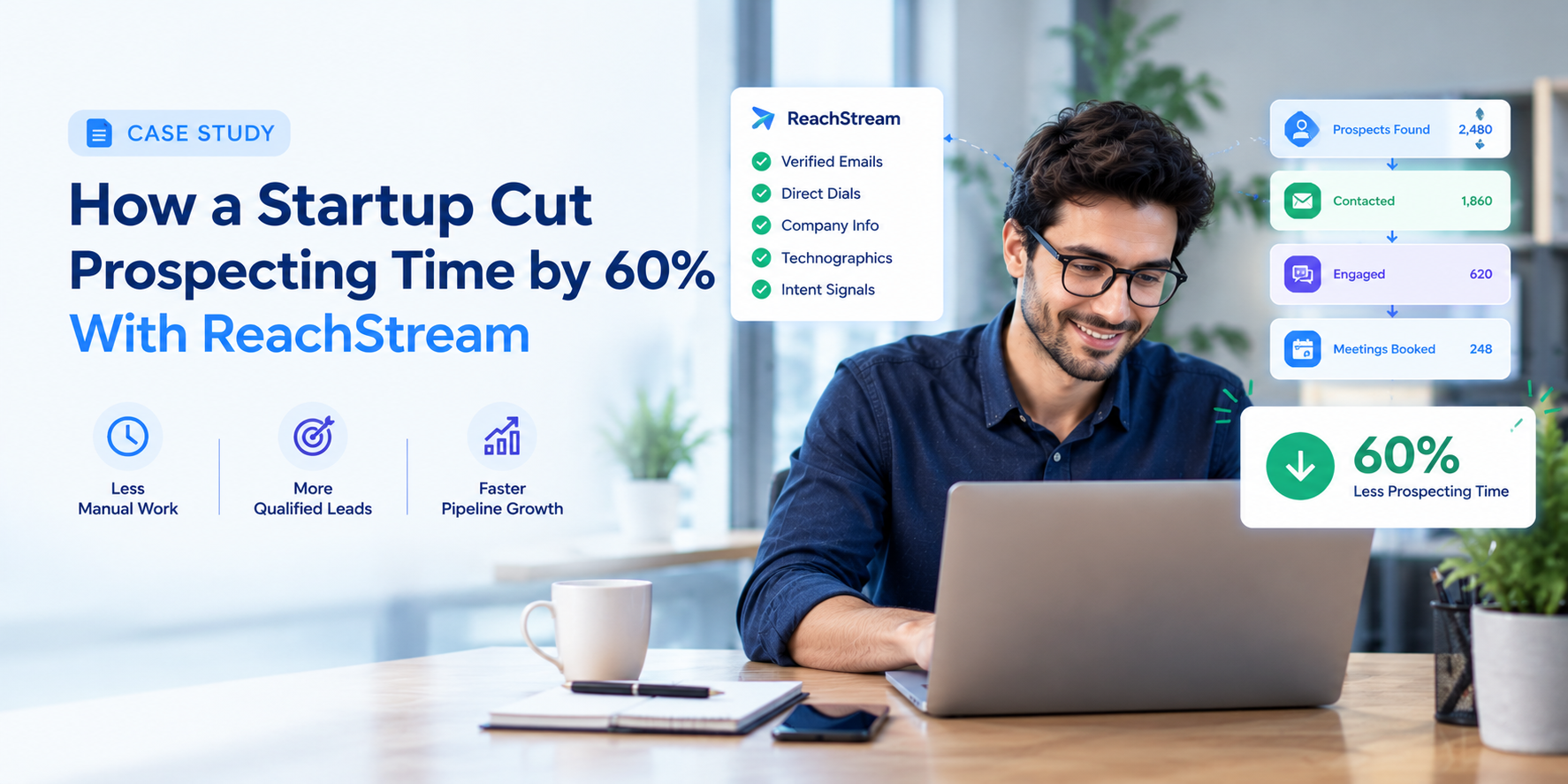
This ReachStream startup case study looks at a pattern that shows up again and again across SaaS startup teams that switch to a single verified data platform: the time a rep gets back isn’t really about the tool, it’s about everything they stop doing by hand once one place handles search, verification, and export together. This reachstream case study startup focuses on what changes week to week.
Before switching, the team’s sales prospecting ran through three separate tabs: LinkedIn for finding people, a free email guesser for contact details, and a spreadsheet for everything else. Manual research like this is fine for ten contacts a week. It becomes the actual bottleneck once a startup needs forty or fifty.
The team estimated close to half of every prospecting day went into Manual research and reconciling Multiple data sources that didn’t agree with each other, verifying guessed emails separately, checking whether a title on LinkedIn still matched the company a contact worked. None of it was selling. Sales efficiency suffers first in a small team, long before sales performance numbers show it on a dashboard.
The switch wasn’t about finding more leads. It was about not needing Multiple data sources to trust one list. ReachStream’s database covers 500M+ verified contacts across 150+ countries, with email verification built into the export step rather than as a separate task, which is the part that actually removed work from the team’s week. Startup B2B data accuracy matters more when a team can’t afford to chase a bad lead twice.
The team started on ReachStream’s free plan: 100 verified export credits a month, no credit card required, with unlimited browsing and filtering before anything counts against the credit limit. For a ReachStream for startups use case, that’s enough to test real data quality against a real target list before committing budget.
Credits are only spent on verified emails, so the team could filter, research, and shortlist as long as they wanted, and only pay in credits for the contacts they actually planned to reach out to. That’s also where B2B data enrichment for startups pays off fastest: a verified export is enrichment the team doesn’t have to do by hand afterward.
A startup sales workflow built around one verified source looks simple on paper: filter by industry, headcount, and seniority, capture the contact, verify the email, load it into outreach. The team’s SDR workflow followed exactly that shape once ReachStream replaced the separate research and guessing steps, with the Chrome extension pulling contact details straight off a LinkedIn profile instead of retyping anything.
Outbound sales still took effort. It just stopped taking effort on tasks that had nothing to do with actually talking to a buyer. Pipeline generation moved faster once filtering and verification stopped competing for the same hour of the day.
Reply rates moved too, though less dramatically: verified emails meant fewer bounces eating into sender reputation, which kept the inbox healthy enough that replies weren’t getting buried behind spam-folder placement from a damaged domain. Sales velocity is really just less time between finding a prospect and sending a relevant message.
The team looked at a couple of affordable ZoomInfo alternatives for startups before deciding, since ZoomInfo’s pricing is quote-based and generally out of reach for a pre-seed budget. ReachStream’s paid tiers start at 29$ a month on annual billing, against a free plan with 100 credits, which made it realistic to test before committing any budget at all.
A ReachStream SaaS case study like this one usually comes down to the same tradeoff: a lower ReachStream startup ROI ceiling than an enterprise platform, but a much lower cost to find out if it’s working.
| Approach | Best For | Time per Verified Contact | Scalability | Data Freshness Risk |
|---|---|---|---|---|
|
Before: manual research |
A handful of high-priority accounts |
15 to 20 minutes |
Low, does not scale past a short list |
Low, checked in real time by a person |
|
After: ReachStream |
Building verified lists at startup speed |
Under a minute |
High, scales with credit volume |
Low, verified at the point of export |
|
Enterprise alternative |
Larger teams with signal-driven prioritization needs |
Seconds to minutes |
High, but behind a quote-based contract |
Low, but often a bigger spend than a startup needs |
ReachStream pricing for startups starts at the free (100 export credits a month) and moves into paid plans from 29 dollars a month on annual billing, scaling with credit volume. For a startup sales intelligence budget, that’s a meaningfully different conversation than a quote-based enterprise contract that assumes a much bigger team and a much bigger check.
The ReachStream free plan for startups exists specifically so a team can answer that question before paying for anything.
Loading an entire exported list into a sequence without checking for Unqualified leads first, which the team did once before tightening their filters. Skipping a trial period on the free plan and jumping straight to a paid tier before confirming data quality matched their market. Treating Manual research as a one-person job that didn’t need documenting, so the process broke when that person was out.
And measuring sales productivity by contacts exported instead of qualified meetings booked, which looked good on a dashboard and meant nothing for sales performance. Sales development roles are often the first hire a startup makes once this kind of workflow is in place, since there’s finally enough structure for someone new to step into.
This ReachStream startup case study isn’t really about one team’s exact numbers. It’s about what happens when sales prospecting stops depending on Manual research and Multiple data sources that don’t agree with each other. A startup that fixes this early gets more of its limited sales hours back for actual selling, which compounds every week it keeps running that way.
Author

Access 200M+ verified business emails and grow your sales pipeline effortlessly.
Don't forget to share this post!















Check out our other blogs!
What Is B2B Data and Why It Matters for Modern Sales Teams
A Buyer’s Checklist for Evaluating B2B Data Providers
How to Sync B2B Data with Your Outreach Sequences