


How to Evaluate B2B Data Vendors for Accuracy and Compliance
Sales departments often generate hundreds of leads yet struggle to produce predictable revenue because representatives spend hours engaging with prospects who lack the budget, authority, or genuine business need to purchase. Lead qualification solves this operational bottleneck by establishing a systematic evaluation process that prioritizes prospects based on organizational fit, operational pain points, decision-making authority, purchasing timeline, and engagement signals. Without a rigorous qualification framework, sales pipelines fill with unqualified prospects, increasing customer acquisition costs and slowing deal velocity.
This guide outlines a proven five-step framework that sales and marketing teams use to determine whether a B2B lead warrants immediate sales engagement, further nurturing, or disqualification.
Moving a contact from raw data to a closed contract requires distinct qualification stages. Understanding the definitions of a lead, a marketing-qualified lead, a sales-qualified lead, and an opportunity ensures that sales and marketing teams operate with shared criteria.
Stage | Definition | Primary Objective |
Lead | Any contact or organization that shares basic contact information. | Initial data capture and CRM entry. |
Marketing-Qualified Lead (MQL) | A contact showing interest through content downloads or website visits. | Evaluation by marketing to assess engagement. |
Sales-Qualified Lead (SQL) | A prospect verified by sales as meeting ICP criteria with an active business need. | Handoff to account executives for discovery. |
Opportunity | A qualified prospect in the active sales pipeline with confirmed BANT criteria. | Solution presentation and contract closure. |
Effective lead qualification depends on evaluating multiple data dimensions simultaneously. Basing decisions solely on a single indicator, such as job title or website visits, often leads to misallocation of sales resources. Organizations evaluate several core signals when assessing a prospect:
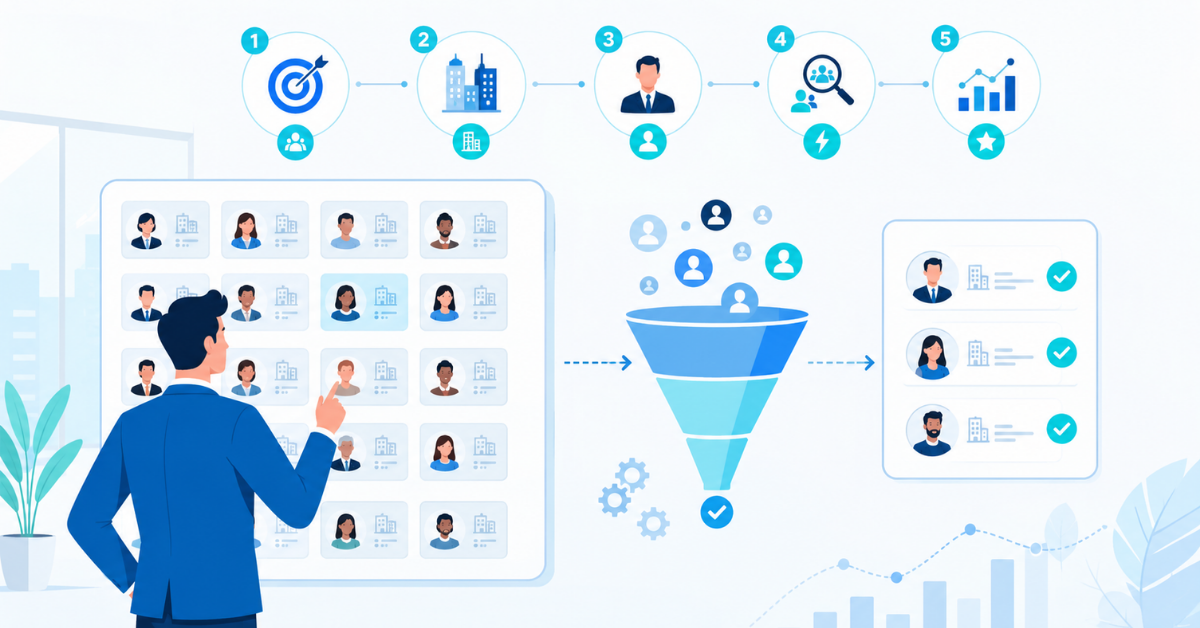
Implementing a structured evaluation process eliminates ambiguity and accelerates revenue generation. Sales teams apply five sequential steps to qualify prospective buyers.
Evaluating organizational fit represents the foundational filter of lead qualification. If a prospect’s company does not match the Ideal Customer Profile (ICP), attempting to sell the product is a waste of time. Sales teams evaluate firmographic data against established benchmarks.
Example
A cybersecurity provider sells enterprise platforms starting at $50,000. A healthcare provider with four hundred employees matches the ICP. Conversely, a local retail boutique with three employees is a poor fit due to an insufficient budget and a lack of enterprise infrastructure. The sales team disqualifies the boutique while routing the healthcare provider to an account executive.
Engaging contacts who lack purchasing authority stalls sales cycles. Sales development representatives must map the buying committee to identify individuals who possess budget control or influence over procurement decisions.
Example
An analytics vendor sells logistics optimization software. A junior inventory analyst submits a form. While they experience daily friction, they lack procurement authority. The representative asks qualifying questions to identify the Director of Supply Chain, then engages that leader with tailored insights.
A qualified lead must experience a genuine operational problem that the vendor’s solution resolves. Sales professionals uncover needs through active listening and targeted discovery questions exploring underlying pain points.
Example
During a discovery call, a prospect explains that manual spreadsheets cause daily scheduling delays, resulting in 4 hours of administrative overhead per manager per week. The representative connects this pain point to the software’s automated dispatch feature, confirming a strong business need.
Assessing economic viability and urgency ensures sales resources focus on deals with realistic closing timelines. Modern B2B sales cycles require evaluating complex internal procurement processes and multi-departmental sign-offs.
Example
Two manufacturers request demos. Company A has allocated a budget, secured executive sponsorship, and requires deployment within 3 months. Company B has no budget until next year and no formal sponsor. The sales team prioritizes Company A for immediate engagement while placing Company B into an educational nurturing track.
Lead scoring assigns numerical values to prospects based on firmographic attributes and behavioral signals. This quantitative approach ensures high-value prospects receive immediate attention while lower-tier leads undergo additional qualification.
Lead Score Range | Qualification Status | Recommended Action |
85 – 100 Points | High Fit / Sales-Ready | Immediate routing to senior account executives. |
50 – 84 Points | Moderate Fit / Developing | Enrollment in targeted nurturing campaigns. |
0 – 49 Points | Low Fit / Unqualified | Retention in automated newsletters or disqualification. |
Qualification criteria vary depending on the business model and target market. Examining industry-specific applications clarifies how organizations adapt their evaluation standards.
Industry | Primary ICP Focus | Key Qualification Criteria | Typical Deal Velocity |
SaaS | User licenses, IT stack | Software compatibility, seat count | Fast |
Manufacturing | Production volume | Equipment specs, delivery timelines | Slow |
Professional Services | Project scope | Strategic goals, executive sponsorship | Moderate |
A cloud HR software company evaluates inquiries using automated fields. When a technology firm with 500 employees requests a demo, the system confirms that its headcount matches the ICP and logs visits to pricing pages. The lead receives a high score, triggering an invitation to a discovery call.
An industrial robotics manufacturer evaluates inquiries based on factory capacity and capital expenditure cycles. A parts supplier inquires about assembly automation. The sales team reviews production volume and planned budget before scheduling an on-site assessment.
A consulting firm qualifies clients by examining restructuring needs and advisory budgets. When a financial enterprise seeks support for digital transformation, the partner evaluates whether the client possesses the internal leadership and budget required to sustain a six-month engagement.
Organizations select frameworks aligning with their sales methodology. Combining multiple models provides comprehensive visibility into prospect viability.
The BANT framework evaluates Budget, Authority, Need, and Timeline. This method ensures representatives verify financial capacity and decision-making access early, preventing prolonged negotiations with contacts who cannot authorize purchases.
The CHAMP framework prioritizes Challenges before evaluating Authority, Money, and Prioritization. By focusing on operational challenges, sales teams build value-driven relationships before discussing pricing.
Lead scoring combines quantitative firmographic attributes with behavioral tracking to rank prospects. Automated models update tiers dynamically as individuals interact with digital content.
Lead qualification functions as an operational routing mechanism. Structured workflows ensure every prospect receives appropriate treatment based on evaluation results.
Qualified prospects meeting thresholds require rapid routing to representatives. Automated assignment rules distribute leads based on territory or industry, maximizing conversion rates.
Prospects who exhibit fit but lack immediate budget should not be discarded. Enrolling these contacts in educational sequences maintains brand awareness until buying conditions align.
Removing unqualified prospects protects sales productivity. Disqualification prevents representatives from wasting energy on accounts with zero probability of conversion.
Avoiding operational pitfalls ensures qualification processes deliver consistent growth.
Accessing accurate firmographic and contact data forms the foundation of any repeatable qualification process. High-quality data eliminates friction during initial prospect research.
Platforms like ReachStream support teams by providing access to verified business data. When sales teams use accurate information, the entire evaluation workflow runs more efficiently.
Accurate data accelerates the research phase, allowing specialists to focus on validating business needs rather than manual data entry.
Establishing a scalable revenue engine requires integrating qualification into a seamless workflow that connects data acquisition to pipeline conversion.
Define ICP ──► Find Leads ──► Verify Data ──► Qualify ──► Score ──► Route ──► Nurture ──► Convert
Lead qualification bridges marketing campaigns and sales execution. When integrated with robust lead generation strategies, sales prospecting tools, and centralized databases, a structured process transforms market interest into predictable revenue.
Determining whether a B2B lead warrants engagement requires a disciplined methodology. By executing five core steps—checking ICP fit, identifying decision-makers, understanding business needs, evaluating budget, and scoring readiness—organizations focus on high-value opportunities. Effective qualification centers on verifying genuine fit and buying potential.
For broader strategic insights, explore The Ultimate B2B Lead Generation Guide (2026).
It is the process of evaluating prospects to determine if they match the ICP and possess the budget, authority, need, and timeline to purchase.
Checking ICP fit, identifying decision-makers, understanding business needs, evaluating budget/timeline, and scoring the lead.
Matching firmographic criteria, holding purchasing influence, having a clear pain point, and having allocated funds.
An MQL shows engagement; sales for active need and budget vet an SQL.
A framework evaluating Budget, Authority, Need, and Timeline.
It assigns values based on fit and behavior to prioritize engagement.
When the company fails ICP fit, lacks budget/authority, or has no business need.
Whenever significant time passes, or new engagement signals occur.
Marketing professional with a Master’s degree in Marketing, specializing in SEO, content strategy, social media, performance marketing, prospecting, and demand generation.
Access 200M+ verified business emails and grow your sales pipeline effortlessly.
Don't forget to share this post!















Check out our other blogs!
Is Buying B2B Data Legal? What You Need to Know
Intent Data: What It Is and How to Use It for Campaign Targeting
What Mid-Market SaaS Teams Need in Lead Gen Tools
ReachStream Prospect for E-commerce Brands: Outbound Case Study