


Unlimited Data.
Infinite Possibilities.
Infinite Possibilities.
Looking for B2B data? Download Unlimited data using our Chrome extension at just $79/month.
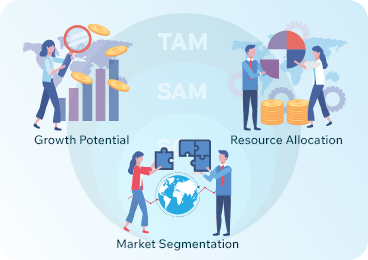
>The Role Of TAM
How to Evaluate B2B Data Vendors for Accuracy and Compliance
Every successful B2B growth strategy begins with understanding the size of the market opportunity. Without this clarity, teams risk targeting the wrong segments and setting revenue goals based on assumptions.
This is where Total Addressable Market (TAM) becomes important. TAM helps businesses understand the full revenue potential of their target market and guides better sales and marketing decisions.
In this guide, we explain what TAM is, why it matters, how to calculate it, and how platforms like ReachStream help turn TAM insights into actionable prospecting strategies.
Total Addressable Market, commonly referred to as TAM, is the total revenue opportunity available for a product or service if it captures 100% of its defined target market. It represents the maximum possible demand for what you are selling — assuming no competition, no resource constraints, and complete market penetration.
It is the ceiling of your revenue potential within a specific market.
Understanding what TAM is the starting point for any serious B2B market analysis and getting it right makes every downstream decision sharper.
TAM is not just a number for pitch decks, it is a strategic tool that shapes decisions across sales, marketing, product, and finance.
Here is why total addressable market matters:
In short – TAM brings clarity. It turns ambiguous growth into a grounded, data-backed strategy.
TAM, SAM, and SOM are three interconnected concepts that together give businesses a complete picture of their market potential. Understanding the distinction is critical for accurate market sizing.
A quick way to think about TAM, SAM, and SOM:

Everyone you can realistically
reach and serve today
Everyone you can realistically
win in the next 1–3 years

Everyone who could
ever buy your product
Many businesses make the mistake of presenting their TAM as their realistic near-term opportunity. The three-layer framework keeps strategy grounded in what is actually achievable while maintaining sight of the long-term market potential.
TAM, SAM, and SOM are three interconnected concepts that together give businesses a complete picture of their market potential. Understanding the distinction is critical for accurate market sizing.
The top-down method starts with broad market data from industry reports, analyst firms, or government sources – then narrows down to your specific market segment.
This approach is faster but can be less precise. It is more susceptible to over-estimation if the broader figures are not carefully segmented.
The bottom to top approach builds the TAM figure from the ground up using your own data:
The bottom-up method is generally more accurate and credible because it is grounded in real market data rather than broad estimates. It is the preferred approach for investor presentations and TAM calculation exercises at a strategic level.
Despite its importance, accurate total addressable market analysis is something many B2B teams struggle to get right.
The most common challenges include:
Overcoming these challenges requires both disciplined methodology and access to high-quality, up-to-date B2B market data.
Calculating TAM accurately requires the right combination of tools and data sources. Here is what B2B teams
typically use:
The most reliable TAM estimates combine multiple sources to create a more accurate and actionable view of the market.
ReachStream is a B2B data platform built for teams that need accurate, verified contact and company intelligence to power their go-to-market strategy — including TAM analysis.
With access to 200M+ global contacts and 15M+ companies, our platform provides B2B teams the data infrastructure to calculate, validate, and act on their total addressable market with precision.
Here is how ReachStream supports every stage of TAM analysis:
ReachStream bridges the gap between TAM analysis and execution – turning a market sizing exercise into a live, actionable prospecting strategy.
For B2B teams serious about TAM insights and go-to-market precision, ReachStream delivers measurable, practical advantages:

Understanding Total Addressable Market (TAM) is an ongoing strategic process that supports key B2B decisions. It helps businesses set revenue targets, allocate budgets, and prioritize the right market segments.
Effective TAM analysis combines a clear methodology with reliable market data. Without accurate data, TAM estimates can become too broad to guide real strategy.
With verified data and advanced filtering, ReachStream helps B2B teams calculate TAM more accurately and turn those insights into targeted prospecting efforts.
In simpler terms, TAM represents the maximum market demand for what a business offers. It shows the full size of the opportunity available if every potential customer in the market bought the product or service.
TAM is the full market opportunity; SAM is the portion you can realistically serve, and SOM is the share you can realistically win in the near term.
TAM helps B2B teams set revenue targets, prioritize market segments, allocate budgets, and communicate growth potential to investors and stakeholders.
The top-down approach uses industry reports to estimate market size, while the bottom-up approach multiplies your number of potential customers by your average revenue per customer.
ReachStream gives teams access to 200M+ verified contacts and 15M+ companies, with 20+ filters to precisely define, size, and act on their total addressable market.

Author

Access 200M+ verified business emails and grow your sales pipeline effortlessly.
Don't forget to share this post!















Check out our other blogs!

The Best Email Lists for SaaS Companies in Growth Mode 2026

Do Bought Email Lists Actually Work? The Honest Answer

Is a Construction Email List Worth the Investment?