

How to Evaluate B2B Data Vendors for Accuracy and Compliance
Building a predictable, scalable B2B sales pipeline remains one of the most persistent operational hurdles for growing enterprises. Organizations often possess exceptional products, robust engineering teams, and deep industry knowledge. Yet, they still struggle with the mechanics of consistent prospecting, reaching busy decision-makers, qualifying inbound inquiries, or maintaining a steady flow of sales opportunities. Internal sales teams frequently find themselves overwhelmed by administrative burdens, data collection, and cold outreach, pulling them away from high-value closing conversations. B2B sales companies emerge as external strategic partners capable of shouldering specific segments of the commercial funnel or managing comprehensive outbound acquisition campaigns. Rather than viewing these external providers as simple substitutes for internal staff, modern sales leaders deploy them as specialized extensions of their go-to-market engine. This comprehensive buyer guide examines the mechanics of B2B sales companies, clarifies the structural distinctions among various provider types, outlines core service offerings, and establishes a rigorous evaluation framework to help businesses select the ideal partner for their unique commercial objectives.
Organizations striving for predictable commercial growth must understand how external sales partners integrate into the broader corporate architecture. Sales execution is not an isolated event but a continuous continuum moving from initial market awareness to closed revenue. External partners operate across this entire continuum, injecting specialized horsepower where internal bottlenecks restrict commercial momentum. Companies face constant pressure to shorten sales cycles while expanding their total addressable market, making external partnerships a vital means of operational scalability.
Internal sales teams often face resource constraints that limit their ability to run simultaneous outbound campaigns across multiple target verticals. By engaging external sales specialists, businesses decouple revenue generation capacity from internal headcount limitations. These external partners bring standardized methodologies, battle-tested messaging frameworks, and dedicated prospecting bandwidth that immediately amplify top-of-funnel activity. Furthermore, external sales organizations provide objective market feedback, helping executive leadership refine their product positioning, pricing models, and ideal customer profiles in response to real-time buyer reactions.
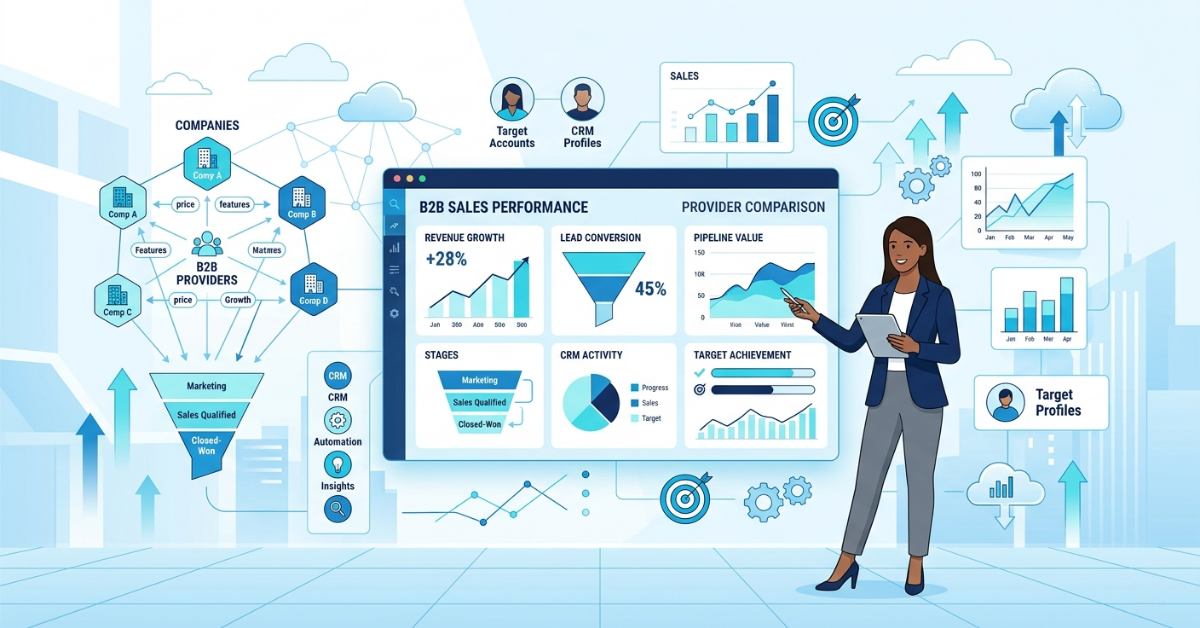
Commercial success relies on an unbroken chain of operational handoffs where raw market interest transforms into closed contracts through disciplined staging.
Commercial expansion frequently demands capabilities that fall outside the core competencies or immediate bandwidth of an existing internal team.
The external sales ecosystem features diverse provider types, each designed for specific operational needs and commercial maturity stages. Understanding these distinct categories prevents costly mismatches between corporate expectations and agency capabilities. B2B sales companies vary significantly in their operational focus, ranging from pure data providers and lead generation agencies to comprehensive full-cycle sales outsourcing firms. Selecting the correct category requires a careful audit of internal team strengths, existing technology stacks, and primary revenue bottlenecks.
Organizations launching new product lines often require top-of-funnel specialists to build immediate market awareness and gather initial feedback. In contrast, mature enterprises may require sophisticated account-based sales providers to penetrate named enterprise accounts. Misunderstanding these functional boundaries frequently leads to misaligned vendor relationships, wasted commercial budgets, and frustrated internal stakeholders. By categorizing providers according to their primary operational focus, executive buyers can align external agency strengths with their specific growth stage, ensuring maximum return on commercial investment and sustainable pipeline velocity.
Lead generation providers focus primarily on top-of-funnel volume, constructing expansive lists of prospective accounts and delivering initial contact details.
Sales outsourcing providers assume responsibility for executing a larger portion, or even the entirety, of the outbound sales motion under the client’s brand.
Appointment setting agencies specialize in bridging the gap between initial outreach and a confirmed calendar invite for internal account executives.
Sales development representative agencies focus intensely on the middle-of-funnel qualification process and systematic prospecting execution.
Account-based sales providers cater to enterprises targeting high-value, enterprise-grade accounts through highly customized, multi-channel campaigns.
B2B Lead Generation Companies | Top-of-funnel data acquisition and contact list assembly | High-volume outbound campaigns and broad market testing | Contact databases, bulk email lists, and firmographic data |
Sales Outsourcing Companies | End-to-end sales execution and pipeline management | Rapid international expansion or lean startups | Full outbound sales team, CRM management, and deal closing |
Appointment Setting Companies | Prospect engagement and calendar scheduling | Internal closers needing a steady stream of meetings | Cold calling, meeting booking, and basic interest verification |
Sales Development Agencies | Dedicated prospecting and qualification workflows | Scaling mid-market firms with constrained internal SDR bandwidth | Outreach campaigns, lead scoring, and meeting handoffs |
Account-Based Sales Providers | Named-account targeting and executive engagement | Enterprise sales targeting high-value accounts | Customized messaging, multi-stakeholder mapping, and ABM execution |
External sales partners provide a modular suite of services designed to address specific operational friction points within the commercial workflow. Rather than forcing organizations into rigid, all-or-nothing contracts, modern sales agencies enable clients to secure targeted interventions when internal resources fall short. These service offerings span the entire revenue lifecycle, from initial contact discovery and firmographic enrichment to multi-channel outreach orchestration and preliminary lead vetting.
Deploying external services effectively requires establishing clear operational SLAs and shared performance benchmarks between the internal revenue team and the external vendor. When agencies have complete visibility into product value propositions and ideal customer parameters, their services seamlessly integrate with internal CRM systems and closing workflows. This operational synergy eliminates friction, accelerates deal velocity, and ensures that prospective buyers experience a coherent, professional brand narrative from their very first interaction through to final contract execution.
Precision outreach begins with rigorous prospect research and business contact database verification to isolate exact decision-maker titles.
Outbound sales development forms the operational backbone of external sales engagements through multi-channel cold email and phone prospecting.
External sales providers use structured evaluation frameworks to thoroughly vet prospects, protecting internal closing teams from wasted effort.
Appointment-setting specialists manage scheduling coordination and facilitate seamless operational handoffs, complete with detailed call notes.
Sophisticated sales partners analyze conversion drop-offs across pipeline stages and calibrate outreach velocity to smooth revenue fluctuations.
Selecting an external sales partner requires a disciplined evaluation process that aligns agency capabilities with specific organizational requirements and commercial goals. Decision-makers must look beyond flashy marketing claims and scrutinize an agency’s operational methodology, data hygiene practices, and cultural alignment with the host organization. A haphazard selection process often results in mismanaged campaigns, damaged brand reputation, and wasted commercial capital.
Effective evaluation begins with an internal audit of existing sales infrastructure, lead conversion rates, and revenue targets. Once internal baselines are established, leadership can develop comprehensive Request for Proposal (RFP) criteria that assess vendor capabilities across data-sourcing integrity, messaging personalization depth, regulatory compliance, and reporting transparency. Establishing rigorous vendor evaluation standards ensures that the chosen partner operates as a true strategic extension of the internal team, driving measurable pipeline expansion and sustainable revenue growth.
Organizations must articulate the exact operational problem to be resolved before reviewing external provider proposals.
An agency’s familiarity with your specific target market dictates campaign efficacy across buyer personas and complex sales cycles.
The quality of an external sales partner depends heavily on their underlying technology stack, data hygiene, and CRM integration.
Examining sample outreach sequences and regulatory compliance protects corporate brand equity during high-volume campaigns.
Navigating vendor evaluations requires a structured inquiry framework that probes strategy, data integrity, and performance measurement. Instead of relying on generic sales pitches, procurement teams must ask pointed questions that reveal the agency’s operational rigor and problem-solving capabilities under challenging market conditions. This structured questioning exposes potential operational vulnerabilities before contracts are signed, ensuring complete alignment on deliverables, KPIs, and escalation procedures.
A thorough vetting framework examines how agencies construct ideal customer profiles, handle data verification, maintain domain sender reputation, and define qualified leads. By demanding transparency across these critical operational dimensions, business leaders safeguard their commercial investments and establish clear accountability standards that govern the agency relationship throughout its lifecycle.
Data Quality & Sourcing | Real-time verification, compliance adherence, and CRM sync | Static purchased lists, high bounce rates, and opaque data sources |
Targeting & ICP Alignment | Custom account mapping and persona segmentation | One-size-fits-all messaging and unwillingness to refine ICP |
Outreach Methodology | Multi-channel cadences, personalization, and deliverability | Spammy blast tactics, poor email authentication, and aggressive tone |
Reporting Transparency | Real-time dashboards, clear KPI definitions, and attribution | Vanity metrics focusing solely on activity volume rather than revenue |
Deciding whether to outsource sales functions or build an internal team depends on an organization’s current growth stage, resource availability, and strategic complexity. Outsourcing offers distinct structural advantages for businesses facing specific operational constraints or pursuing rapid expansion. Lean organizations lacking the capital or time to recruit, hire, and train an internal sales team benefit immediately from external infrastructure.
However, outsourcing is not a panacea; certain operational environments demand an in-house commercial team to protect vital intellectual capital and manage complex enterprise relationships. Weighing the trade-offs between fixed-cost internal scaling and flexible variable-cost outsourcing requires a careful assessment of product complexity, sales cycle duration, and long-term strategic objectives. Leadership must evaluate these operational dimensions objectively to construct a hybrid commercial model that optimizes cost efficiency while maximizing revenue growth velocity.
Lean organizations lacking recruitment capital, rapid new-market expansion milestones, and agile product-launch testing favor external sales partnerships.
Organizations selling highly complex technical solutions with long sales cycles and deep strategic enterprise relationships require dedicated internal personnel.
Time to Deployment | Slow (3 to 6 months for recruiting, hiring, and onboarding) | Rapid (Deployable within weeks) |
Fixed vs. Variable Cost | High fixed overhead (salaries, benefits, software licenses) | Scalable variable investment tied to service tiers |
Product Expertise | Deep, proprietary product and technical knowledge | Broad commercial expertise requiring initial client enablement |
Management Overhead | Requires dedicated sales management, coaching, and HR support | Managed externally with periodic strategic alignment reviews |
Flexibility & Scaling | Difficult and costly to downscale or restructure headcount | Highly flexible to scale capacity up or down based on market demand |
Evaluating the return on investment from an external sales partner requires tracking a balanced blend of operational activity and financial outcomes. Relying solely on vanity metrics—such as email volume or dial counts—creates a distorted view of campaign efficacy and obscures underlying pipeline inefficiencies. True commercial accountability demands rigorous tracking of leading operational indicators alongside lagging financial returns.
Sales leadership must establish transparent attribution models that link external outreach campaigns directly to closed revenue and pipeline expansion. Regular quarterly business reviews, comparing projected pipeline value against actual closed-won contracts, ensure that both the client organization and the external agency remain aligned on performance expectations, optimization goals, and long-term revenue targets.
Operational monitoring requires tracking leading indicators including qualified lead volume, meetings booked, and conversion rates across pipeline stages.
Commercial partnerships must prove financial viability through cost per qualified lead, customer acquisition cost, and overall return on investment.
While external sales agencies execute outreach and appointment-setting, their success fundamentally depends on the quality of the underlying business contact data and prospect intelligence. ReachStream supports modern B2B sales organizations by delivering verified business contact data, advanced search filters, and comprehensive contact enrichment capabilities.
Rather than replacing specialized sales companies or internal teams, ReachStream functions as an essential data asset within the broader sales technology stack. By providing verified contact intelligence and streamlined prospecting tools, sales organizations and their external partners eliminate wasted outreach effort, improve deliverability, and accelerate pipeline development from initial list building to closed revenue.
Sustainable revenue generation requires harmonizing every component of the commercial ecosystem. Businesses achieve predictability by integrating Lead Generation → Sales Leads → Prospecting → Lead Qualification → Sales Software → Sales Engagement → Pipeline Management → Revenue.
When deployed effectively, external sales partners, specialized B2B sales lead databases, advanced prospecting tools, and robust sales engagement software operate in seamless alignment. Organizations that balance external expertise with proprietary data assets and disciplined internal closing processes create a resilient, scalable growth engine capable of weathering market shifts and achieving long-term commercial dominance.
Selecting the appropriate B2B sales partner requires a methodical approach grounded in strategic clarity and operational alignment. Organizations must begin by identifying their exact commercial bottlenecks, defining precise ideal customer profiles, and establishing rigorous evaluation criteria for data integrity, outreach methodology, and reporting transparency.
Whether engaging a specialized lead generation agency, an appointment-setting provider, or a full-funnel sales outsourcing firm, success depends on continuous performance tracking of both operational activity and financial return. By combining external sales expertise with reliable prospecting tools and structured internal closing workflows, businesses establish a predictable foundation for sustained market expansion. For a broader exploration of modern commercial growth strategies, review The Ultimate B2B Lead Generation Guide (2026).
A B2B sales company serves as an external strategic partner, assisting businesses with specific phases of the commercial funnel, including prospect research, outbound sales development, lead qualification, and appointment setting.
Lead generation companies primarily focus on top-of-funnel data acquisition and bulk contact list building. In contrast, sales outsourcing companies provide active sales execution, handling multi-channel outreach, prospect engagement, and opportunity nurturing.
Outsourcing is ideal when an organization lacks internal bandwidth, needs to enter a new geographic market rapidly, is launching a new product and requires immediate market feedback, or wants to scale sales capacity without incurring permanent hiring overhead.
Pricing structures vary widely by scope and provider type, typically combining monthly retainer fees with performance-based bonuses, tiered hourly billing, or per-meeting pricing models, depending on campaign complexity.
B2B sales companies generate leads by combining verified business contact databases, targeted firmographic research, and multi-channel outreach campaigns across cold email, phone prospecting, and social selling channels.
Businesses should evaluate sales partners based on their industry expertise, familiarity with target markets, data verification practices, outreach compliance standards, and transparency in reporting pipeline and revenue metrics.
Key performance indicators should include both activity metrics (meetings booked, qualification rates, pipeline value generated) and financial metrics (cost per qualified lead, customer acquisition cost, and overall return on investment).
Yes. Many organizations deploy external sales partners specifically to handle top-of-funnel prospecting and appointment setting, feeding qualified opportunities directly to internal account executives who manage closing conversations.
Marketing professional with a Master’s degree in Marketing, specializing in SEO, content strategy, social media, performance marketing, prospecting, and demand generation.
Access 200M+ verified business emails and grow your sales pipeline effortlessly.
Don't forget to share this post!















Check out our other blogs!
Is Buying B2B Data Legal? What You Need to Know
Intent Data: What It Is and How to Use It for Campaign Targeting
What Mid-Market SaaS Teams Need in Lead Gen Tools
ReachStream Prospect for E-commerce Brands: Outbound Case Study