

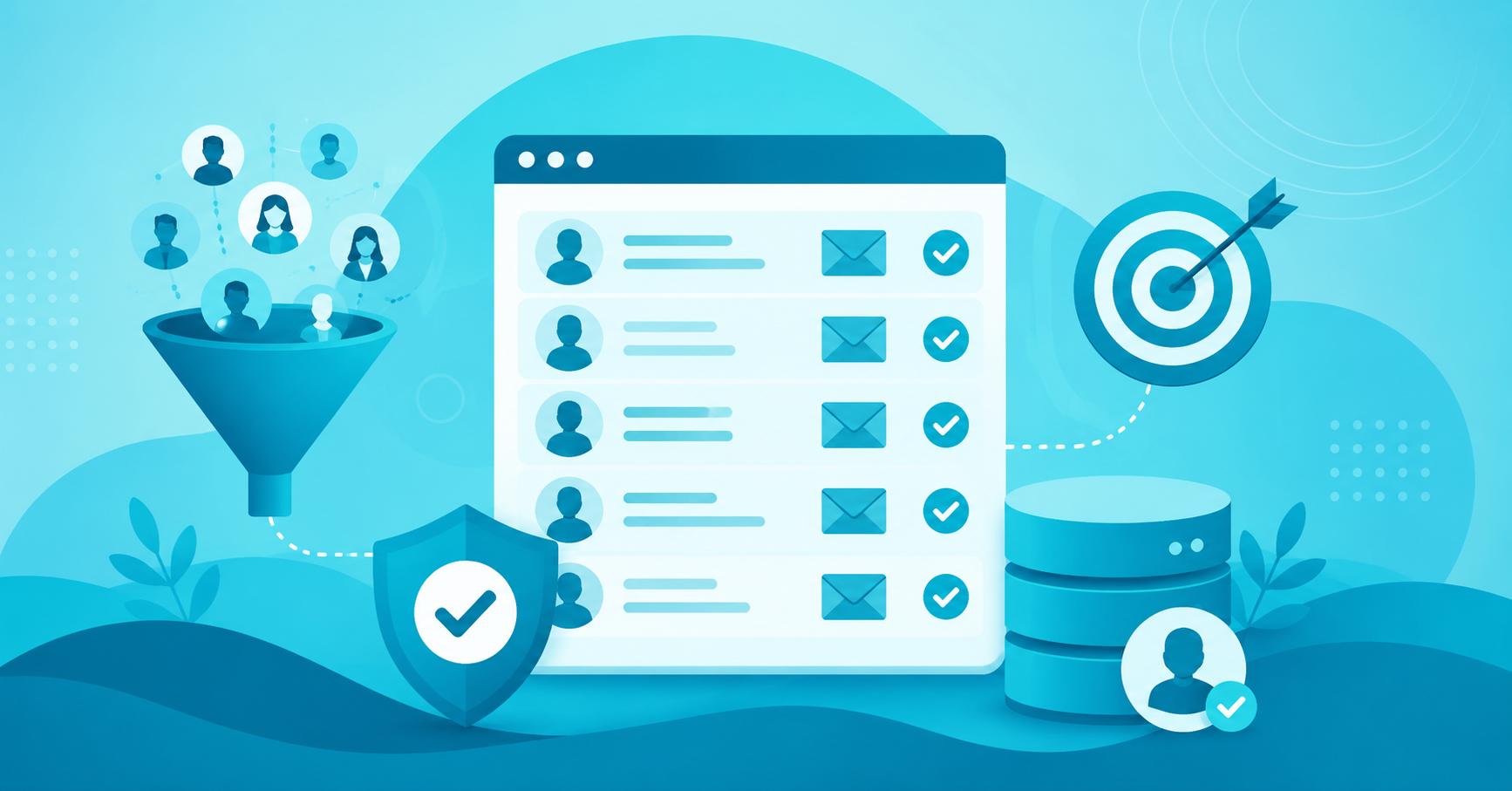
How to Evaluate B2B Data Vendors for Accuracy and Compliance
Most teams treat a B2B email list like a spreadsheet of addresses: the bigger, the better. But a list of 50,000 unverified contacts will consistently underperform a list of 500 accurate, well-targeted ones. The difference isn’t luck. It’s what’s actually in the list beyond the email field itself.
This guide breaks down what really makes a B2B email list good, the signs that yours might be working against you, and how to build or upgrade one that actually drives replies and pipeline.
A B2B email list is a structured set of business contacts usually including name, job title, company, and email address used to reach decision-makers for sales, marketing, or recruiting outreach. But that’s the bare-minimum definition. In practice, a working B2B email list is closer to a live dataset than a static file: it needs context (who these people are and why they matter to you), verification (whether the emails still work), and structure (how the contacts are organized for use).
Treat it as infrastructure, not a one-time purchase, and everything downstream. deliverability, reply rates, pipeline – gets easier.
An email address alone tells you almost nothing useful. It doesn’t tell you if the person still works there, whether they have any influence over a buying decision, or whether contacting them is even compliant in their region. A list built purely around volume of email addresses tends to fail in the same predictable ways:
A good B2B email list solves all of this before a single email goes out.
Every contact needs a working, deliverable email address ideally verified in real time rather than checked once at the point of purchase. Verification status (valid, invalid, catch-all, unknown) should inform whether a contact gets emailed at all, not just flagged after the fact.
A B2B email list is only as useful as the relevance of the people on it. Modern B2B buying involves multiple stakeholders, so a list that only reaches one role in the buying committee tends to stall deals later in the sales cycle. Titles, seniority, and department need to actually map to your ICP, not just sound close enough.
Knowing a contact’s company size, industry, revenue band, and tech stack turns a flat contact list into something you can actually segment and personalize against. Without this layer, every email reads generic — and generic is what gets ignored or marked as spam.
A single, undifferentiated list sent one generic message performs worse than smaller, well-organized segments. Group contacts by tier, industry, buying stage, or intent signal so your messaging can actually speak to what each segment cares about.
Every region has different rules for cold B2B email, and the responsibility for compliance sits with the sender, not just the data provider. A good list comes with a documented, transparent sourcing trail and clear support for opt-outs and suppression this protects you legally and keeps your list usable long-term.
A few warning signs tend to show up before a list becomes a real liability:
If any of these sound familiar, the problem usually isn’t your outreach — it’s the list underneath it.
A B2B email list with 10,000 contacts and a 15% bounce rate is worse than a list of 1,000 contacts with a 2% bounce rate — not just because the smaller list converts better, but because high bounce rates actively damage the sender reputation you need for every future campaign. A tightly targeted list of a few hundred accurate contacts that match your ICP will consistently outperform a sprawling, unverified database, because relevance and deliverability compound while raw volume just adds noise.
Company size, industry, job titles, geography — nail this down before pulling a single contact. Every other step in the process depends on having a clear target to filter against.
Whether you’re building organically or licensing from a data provider, prioritize sources that can tell you exactly where the data came from and how recently it was verified. A provider that can’t answer that is a provider you can’t fully trust with your sender reputation.
Layer in firmographic and technographic data, then split your list into segments before your first send not after you notice poor performance.
B2B contact data decays continuously as people change roles and companies restructure. Build in a recurring verification and refresh cycle rather than treating your list as a one-time purchase.
This is the first, most direct signal of list quality. A healthy B2B list should keep bounce rates in the low single digits anything higher points to stale or unverified data.
Track how quickly contacts on your list become invalid or outdated over time. A list that decays fast needs a tighter refresh cadence to stay usable.
ReachStream is built around the idea that a B2B email list is only as good as what sits behind the email address verified accuracy, firmographic context, and clean segmentation, not just volume. The platform provides real-time email verification, 15+ filtering attributes to keep contacts aligned to your ICP, and free automatic updates on previously downloaded contacts to help offset natural data decay.
ReachStream is certified in ISO 27001:2022 and SOC 2, and compliant with GDPR, CCPA, PIPEDA, and DPDPA, giving teams a documented, audited foundation to build a compliant B2B email list on top of.
A good B2B email list is never just a column of email addresses it’s accurate, verified, relevant to the right roles, enriched with context, properly segmented, and compliant with the regions it reaches. Chasing volume without those fundamentals in place is how lists quietly turn into deliverability and compliance liabilities. Build (or buy) with quality as the starting point, not an afterthought, and every downstream metric — opens, replies, pipeline gets easier to move.
A good B2B email list is accurate relevant, verified, to your ICP, and properly segmented — size alone doesn’t predict performance, and an unverified list of 50,000 contacts will typically underperform a clean, targeted list of a few hundred.
Best practice is continuous or monthly verification, since B2B contact data decays steadily as people change roles and companies restructure.
A well-maintained B2B email list should keep bounce rates in the low single digits. Rates climbing toward 10% or higher usually signal stale or unverified data.
No. A smaller, accurately targeted list aligned to your ICP typically produces more pipeline than a larger, unverified one, since it reduces wasted outreach and protects deliverability.
A B2B database is the broader source of contact and company records a provider maintains, while a B2B email list is typically a filtered, ICP-specific subset pulled from that database for a particular campaign or use case.
Generally yes, provided the provider sources data transparently and you honor opt-outs and regional compliance requirements — the responsibility for compliant use sits with the sender, not just the list provider.
Marketing professional, specializing in SEO, content strategy, social media, performance marketing, prospecting, and demand generation.
Access 200M+ verified business emails and grow your sales pipeline effortlessly.
Don't forget to share this post!















Check out our other blogs!
Email ID Checker: Verify Any Email ID Online
ICP Refinement for SDRs: Using Data Filters to Stop Wasting Touches

Email Validator: Validate Email Format, Domain and Mailbox