



How to Evaluate B2B Data Vendors for Accuracy and Compliance

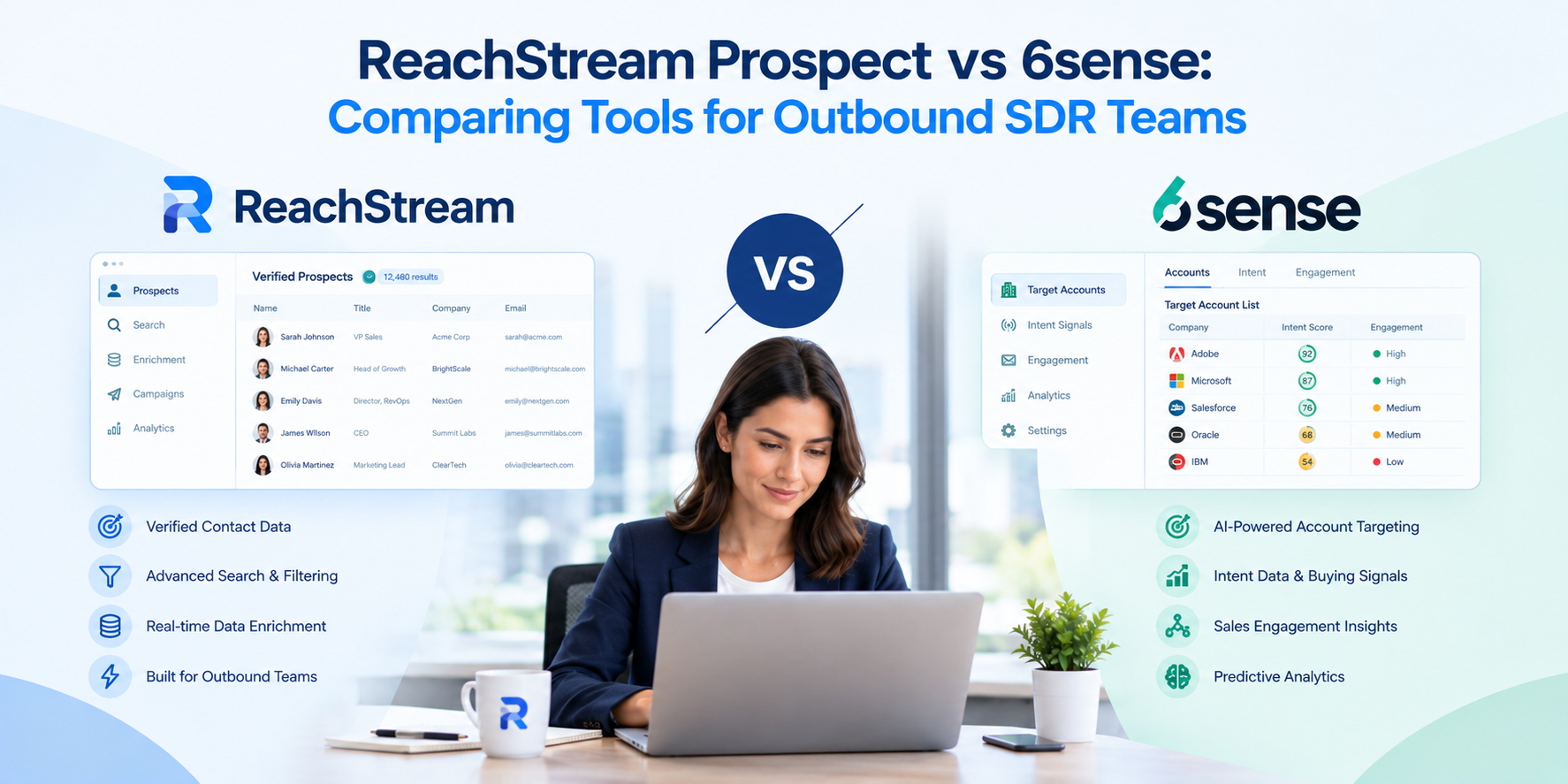
ReachStream Prospect vs 6sense comes down to the job you need done. ReachStream Prospect is a B2B contact and company database built for finding people, verifying emails and exporting lists. 6sense is a revenue AI platform, and its Sales Intelligence product adds buyer intent and predictive account scoring on top of contact search.
For an outbound SDR team, that usually means two different starting points. If reps lose hours hunting for names, emails and direct dials, a contact database is the closer match. If they already have plenty of names but cannot tell which in-market accounts deserve a call this week, intent signals and account scoring carry more weight. Plenty of teams need some of both.
This article compares ReachStream Prospect and 6sense for outbound SDR teams. The two tools overlap less than you might expect. The sections below follow a typical prospecting workflow, from choosing accounts to sending a list into outreach, and a table near the end shows the main differences side by side.
Outbound prospecting follows four steps: pick target accounts, find the right people, build and qualify a list, then move that list into outreach. Most sales prospecting tools cover only part of that chain, and SDR prospecting software tends to lean toward either the contact side or the account side.
ReachStream Prospect covers steps two and three directly. Reps filter by job title, seniority, department, industry, company size, technology and location, check contact details, and export a list to a CSV file or sync it to a CRM. List building and the Chrome extension sit inside the same workflow.
6sense outbound prospecting starts one step earlier. Sales Intelligence highlights accounts that look to be in market, maps the buying group at each one, and then offers contact details for the people it surfaces. In a ReachStream Prospect vs 6sense workflow comparison, that is the main structural difference: one tool begins with people, the other begins with accounts.
A B2B contact database is a searchable collection of business contacts and company records, usually with job titles, emails and phone numbers, that sales teams filter instead of researching one person at a time.
The ReachStream B2B Database behind Prospect holds 500M+ contacts, 50M+ companies and 100M+ direct dials. Contact and company views are unlimited on every plan, email views are unlimited on paid plans, and export credits are used when a list is downloaded or synced to a CRM. Contact data enrichment fills gaps on records a team already owns, which helps keep CRM data enrichment from turning into a manual chore.
6sense provides business emails and direct dials for key personas inside target accounts. Data credits unlock and export emails, phone numbers and enriched records, and its workflows can keep CRM and marketing automation records updated.
Verification is where marketing language gets vague, so compare the mechanics instead of the adjectives. ReachStream Prospect includes email verification inside the platform, with real-time verification and catch-all checks, includes ESP-verified emails, and applies credits to verified data. ReachStream Prospect puts its data accuracy at 95% and email deliverability at 90%.
6sense contact data is verified and its workflows keep CRM and marketing automation records enriched and current, though no verification method. Because verification is described differently on each side, this article does not rank one above the other.
A sample test settles the question faster. Pull 100 verified B2B contacts for the same titles and region from each tool, run them through your own email verification step, and compare bounce rates and connect rates.
ReachStream Prospect is filter-first. Reps can search by job title, seniority, department, industry, SIC code, technology, company type, employee size, revenue and location. AI Conversational Search is designed to let reps describe a target in plain language, and Similar Companies can help expand a list from accounts that already fit the ICP.
6sense approaches discovery from the account side. Reps search by company attributes, CRM filters and engagement activity, open a persona map that supports buying committee mapping, and use the list builder. Contact acquisition, buyer discovery and the list builder come with the packages that include data credits, so the package you buy matters.
Buyer intent signals are behavioral data, such as searches, content reads and site visits, that suggest an account may be researching a purchase. In 6sense, intent sits at the center of Sales Intelligence: keyword research, third-party intent, web visitor identification and a predictive model that estimates buying stage. SDRs use it to decide which in-market accounts to call first, not to find an email address.
Contact data answers a different question: once the right accounts are chosen, who works there and how do you reach them. ReachStream Prospect is built around filters, technology data and similar-company search, not a separate intent signal feed. Teams that run account-based marketing alongside outbound sometimes pair a contact database with an intent platform for that reason.
Intent still needs follow-through. A hot account without a reachable contact stalls, and a verified contact at a quiet account still needs a reason to reply.
ReachStream Prospect has native Salesforce and HubSpot integrations, plus ReachAPI for other systems and a Chrome extension that pulls contact details from LinkedIn.
6sense integrates with Salesforce and HubSpot CRM. Its sales engagement connections let reps enroll contacts into Salesloft or Outreach cadences from company and people search, and its Chrome extension works across prospect websites, LinkedIn and connected CRMs.
| Criteria | ReachStream Prospect | 6sense | Why it matters for SDRs |
|---|---|---|---|
|
Core focus |
B2B contact and company database with filters, enrichment and list exports |
Revenue AI platform; Sales Intelligence adds intent, predictive scoring and contact search |
Decides whether the tool helps you find people or choose accounts |
|
Contact data |
500M+ contacts, 50M+ companies and 100M+ direct dials |
Business emails and direct dials, unlocked with data credits |
Reachable contacts turn a target list into outreach |
|
Verification |
Built-in email verification; ESP-verified emails from the Starter plan |
Verified contact data, kept current in your CRM and MAP through workflows; no accuracy figure given |
Stale or invalid contacts lead to bounces and wasted dials |
|
Buyer intent |
Filters and technology data; no separate intent signal feed |
Intent keywords, third-party intent, web visitor identification and predictive buying stage |
Helps reps pick which accounts to call first |
|
CRM and outreach |
Native Salesforce and HubSpot sync, ReachAPI and a Chrome extension |
Salesforce and HubSpot CRM, Salesloft and Outreach, plus a Chrome extension |
Cuts copy-and-paste between research and sequences |
|
Pricing and plans |
Free plan with 100 export credits a month; paid plans from $29 a month billed annually |
Pricing not disclosed, book a demo |
Sets the cost per reachable contact and per seat |
ReachStream Prospect has five plans. Billed annually, Starter is $29 a month for 60,000 export credits a year, Pro is $49 for 120,000, and Business is $79 for 240,000 with up to three seats. Monthly billing runs $39, $59 and $99, with 5,000, 10,000 and 20,000 export credits a month. Enterprise is custom, and unused credits do not roll over. The free plan includes 100 export credits and 200 email views a month.
6sense takes a different route. The Sales Intelligence pricing page covers three paid packages, Sales Intelligence with Data Credits, with Predictive AI, or with both. Prices are not disclosed, so book a demo. That makes 6sense vs. ReachStream pricing a comparison of a public price list with undisclosed pricing, so book a demo to see the 6sense side.
Check both pages before deciding, since plans and prices can change. In a ReachStream Prospect vs 6sense pricing review, credits, seats and included features matter more than the entry price alone.
ReachStream Prospect suits SDR teams whose main job is building and refreshing prospect lists. Reps can search 500M+ contacts and 50M+ companies by title, seniority, industry, technology and location, check emails and direct dials, and send lists to Salesforce or HubSpot. It is one of several 6sense competitors for sales teams, although it overlaps mainly on contact data and not on intent.
The free plan includes 100 export credits a month, enough to test the data against your own market before paying. 6sense is the closer match when account prioritization and buying group visibility are the bigger gaps, and some teams run a contact database and an intent platform side by side.
ReachStream Prospect and 6sense overlap on contact data but start from different problems. ReachStream Prospect centers on searchable contact and company data with public pricing. 6sense Sales Intelligence adds intent and predictive scoring to its contact search and does not disclose pricing, so you need to book a demo.
The ReachStream Prospect vs 6sense decision for an SDR team is practical: where do reps lose time today, which data has to reach the CRM, and what does a month of real usage cost. Run both tools on the same sample and let the results show which workflow each one supports.
There is no single best 6sense alternative for outbound SDR teams, because the answer depends on the job. If reps mainly need emails, direct dials, and filterable lists, a contact database such as ReachStream Prospect is a closer match for outbound prospecting. If intent signals and predictive scoring matter most, look for platforms that include them.
Building lists and ranking accounts are separate jobs. ReachStream Prospect focuses on list building with filters, enrichment and email verification, while 6sense Sales Intelligence pairs list building with intent data and predictive scoring.
6sense provides business emails and direct phone numbers for key personas, unlocked with data credits. ReachStream Prospect has 100M+ direct dials, available on paid plans.
Yes. ReachStream Prospect has native Salesforce and HubSpot integrations, and 6sense integrates with Salesforce and HubSpot CRM. 6sense also connects with Salesloft and Outreach for sales engagement.
Author

Explore 500M+ contacts, 50M+ companies and 100M+ direct dials in ReachStream Prospect.
Don't forget to share this post!















Check out our other blogs!
What Is B2B Data and Why It Matters for Modern Sales Teams
A Buyer’s Checklist for Evaluating B2B Data Providers
How to Sync B2B Data with Your Outreach Sequences