



How to Evaluate B2B Data Vendors for Accuracy and Compliance

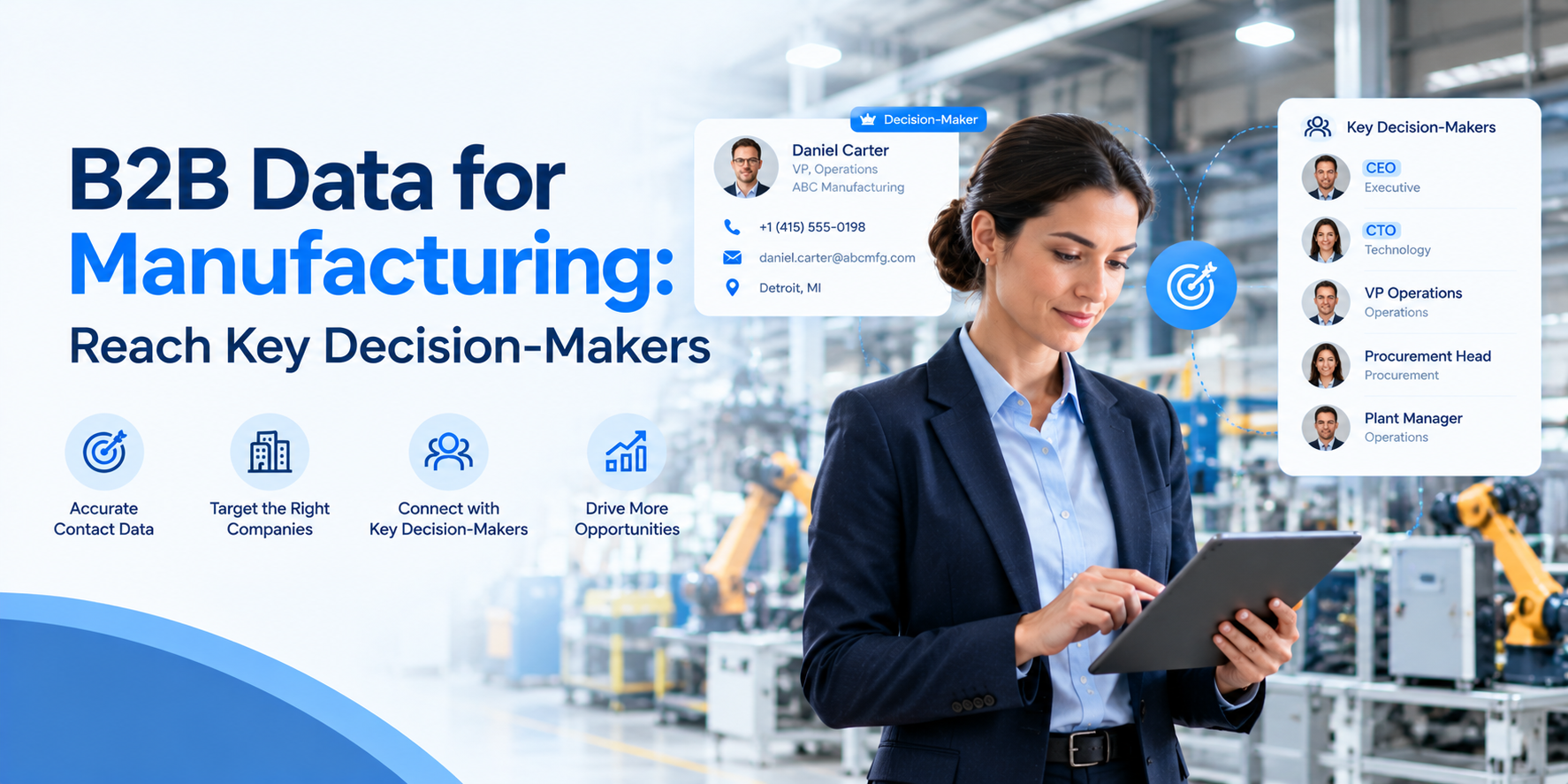
B2B data concerning manufacturing consists of structured information about manufacturing companies and the individuals who act on their behalf: it includes firmographic details such as the NAICS code, the number of plants, the headcount of employees, and revenue, along with verified contacts for the plant manager, the procurement lead, or the operations director who actually approves a purchase.
A usable manufacturing B2B data record goes beyond a company name and a phone number. At minimum it should carry the NAICS code so you can confirm it is actually a manufacturer and not a distributor, plant location and employee count per site, revenue band, and the production categories the plant runs.
On the contact side, the better B2B data providers serving manufacturing include direct emails and titles for the roles that actually touch a purchase: plant manager, operations director, procurement lead, and increasingly a digital transformation or automation owner.
Manufacturing leads list quality also depends on how the company data and the contact data are tied together. A list of 10,000 manufacturing leads is close to worthless if half of them point to a corporate HQ switchboard instead of the plant where the buying decision actually gets made.
A database advertising a million manufacturing contacts is not automatically more useful than one with a hundred thousand if the data accuracy is poor. Manufacturing plants change hands, consolidate, and relocate often enough that a manufacturing leads list built eighteen months ago can carry a meaningful share of dead contacts and old plant addresses by the time it loads into outbound sales.
Prioritize manufacturing company data providers that show a refresh cadence and a verification method, not just a total record count, since data accuracy drops fast in a sector this fragmented.
Real-time email verification catches invalid addresses before they ever reach your sequencing tool, which matters more in manufacturing than in most sectors because plant-level contacts change jobs, retire, or get reorganized without much public notice. Checking data verification at the point of export, not months later, keeps your sender reputation intact.
It also keeps outbound sales teams from burning a quarter’s worth of effort chasing a bounced list instead of talking to buyers.
Generic filters for industry, company size, and location are a starting point, but b2b manufacturing companies need sharper cuts: NAICS code down to the sub-industry, whether the company is a contract manufacturer or an OEM, number of plants, and workforce size per site where that detail is available.
Account targeting that stops at “manufacturing” as a single category tends to mix a 15-person machine shop in with a 3,000-person industrial supplier, and those two accounts need completely different outreach.
Manufacturing sales intelligence tools increasingly layer intent data on top of firmographic and contact data: a plant posting job openings for a new production line, a facility expanding its floor space, or a company researching automation vendors are all signals worth weighting into account prioritization.
None of that replaces accurate contact data, but it helps a lead qualification process focus limited SDR time on the manufacturing prospect data most likely to convert this quarter rather than next year.
Manual research still has a place for a short list of high-value manufacturing accounts, especially when a rep wants to confirm the current plant manager before a first call. But manual research does not scale past a short list.
If you are selling into hundreds or thousands of manufacturing B2B data accounts a year, a maintained manufacturing leads list from a b2b database providers platform does the heavy lifting on contact enrichment, and the rep’s time goes into the outreach itself rather than the research.
| Approach | Best for | Time per verified contact | Scalability | Data freshness risk |
|---|---|---|---|---|
|
Manual research |
Small list of high-priority manufacturing accounts |
15 to 20 minutes |
Low, does not scale past a short list |
Low, checked in real time by a person |
|
Database search |
Building manufacturing leads lists at volume |
Seconds to minutes |
High, scales to thousands of records |
Depends entirely on provider refresh rate |
|
Hybrid |
Most manufacturing sales and marketing teams |
Database for volume, manual for top plants |
Medium, scales with team size |
Mixed, varies by which method sourced the contact |
Define the decision-maker profile: job title alone is not enough for manufacturing accounts. Note seniority, plant versus corporate location, and whether the role sits in operations, procurement, or engineering, since manufacturing buying committees average around six stakeholders at the enterprise level and closer to 5.6 at mid-market companies, with managers involved in roughly half of manufacturing deals.
Pull manufacturing company data that includes NAICS code and plant count to confirm a true manufacturer, then segment the universe into the b2b manufacturing companies worth prioritizing first. Search for the actual titles that hold budget, from plant manager to procurement director, cross-check with verified emails before a sequence goes out, and route the finished manufacturing decision-maker data into your CRM.
A free plan is a reasonable way to test data quality for manufacturing accounts before paying for anything. Run a sample of fifty manufacturing prospect records through it and check whether the plant-level contacts actually resolve, not just the corporate HQ listing.
The stronger manufacturing company data providers combine firmographic detail, like plant count and production category, with verified contact data and intent signals in one record, rather than making you stitch together three separate exports for account intelligence.
Skipping the verification question entirely: many b2b data providers predict plant-level emails from a pattern without confirming them, which shows up as a wave of bounces the moment a campaign goes out.
Treating all manufacturing B2B data as one segment is another common mistake; a 12-person job shop and a 2,000-person industrial supplier need different messaging and different decision-makers. Finally, teams often skip pipeline generation planning altogether and buy a manufacturing leads list without first defining which NAICS codes, plant sizes, and titles actually match their ideal customer, which turns account targeting into guesswork.
Author

Access 200M+ verified business emails and grow your sales pipeline effortlessly.
Don't forget to share this post!















Check out our other blogs!
What Is B2B Data and Why It Matters for Modern Sales Teams

A Buyer’s Checklist for Evaluating B2B Data Providers

How to Sync B2B Data with Your Outreach Sequences