



> Best Practice
How to Evaluate B2B Data Vendors for Accuracy and Compliance

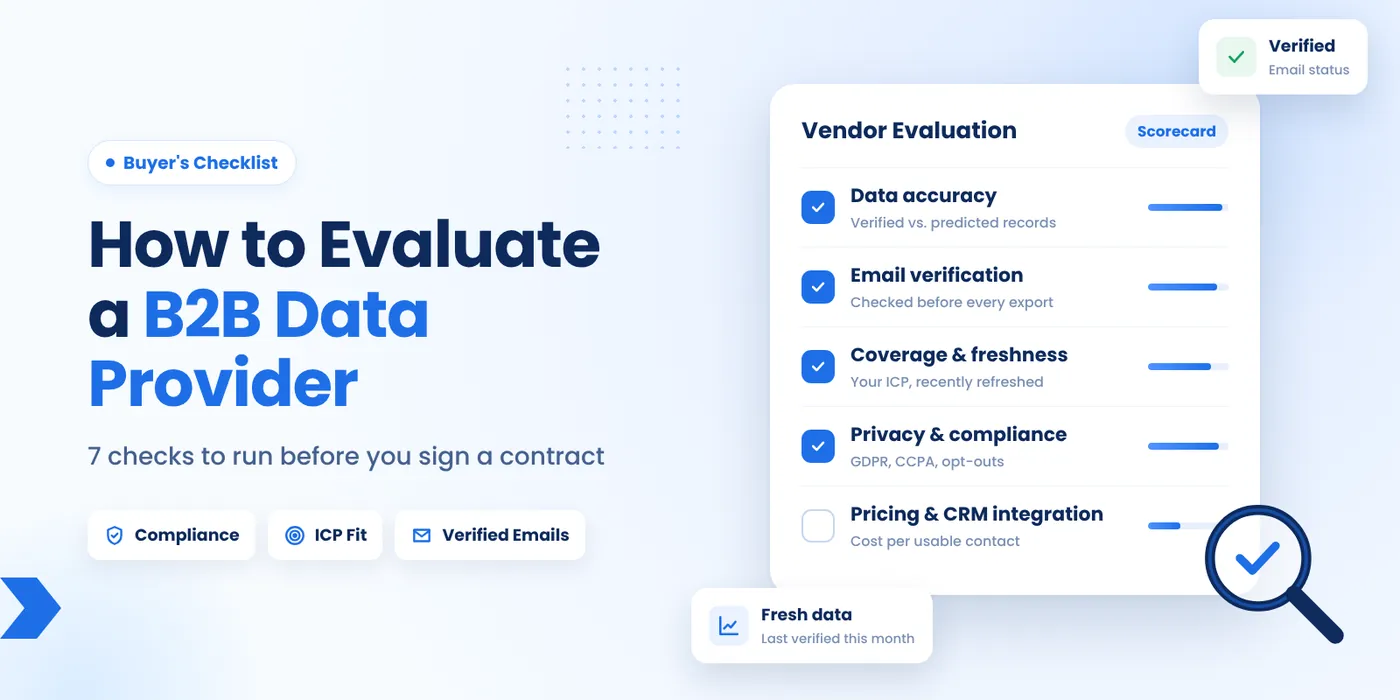
A B2B data provider is worth paying for only if its records are accurate, current, legally sourced, and close enough to your ideal customer profile that your reps can use them on day one. Everything else, from AI features to slick dashboards, sits on top of those four things. If a vendor can’t show you how it handles each one, keep looking.
The trouble is that most providers sound identical in a demo. Everyone claims high accuracy, millions of contacts, and easy CRM integration. This buyer’s checklist is meant to cut through that, with the questions to ask, the tests to run on a sample, and the answers that should make you walk away.
It’s written for B2B sales, marketing, and revenue teams who are choosing a data platform for the first time or replacing one that has stopped pulling its weight.
Bad data is expensive in ways that rarely show up on an invoice. Gartner estimates that poor data quality costs organizations an average of $12.9 million a year, and a good share of that lands on sales and marketing: wasted rep hours, bounced campaigns, and pipeline forecasts built on contacts who left the company months ago.
B2B data also goes stale quickly. Industry estimates put B2B data decay somewhere between 22.5% and 70% a year, depending on the segment, because people change jobs, companies get acquired, and email domains get retired. A provider that looked fine during the trial can quietly fall apart by the third quarter if it doesn’t refresh its records.
Then there’s deliverability. Google and Yahoo expect bulk senders to keep spam complaint rates under 0.3%, and high bounce rates damage sender reputation fast. When the list is wrong, it isn’t just one campaign that suffers. Your domain does too.
Data accuracy is the first thing to pin down, and it’s also the claim vendors are most relaxed about. “95% accurate” means very little until you know what was measured. Ask whether the figure refers to email deliverability, job title accuracy, phone connect rates, or something else, and when it was last measured.
Next, ask about B2B data sourcing. Common B2B data collection methods include public web sources and company websites, business registries and filings, contributory networks where users share contact data, partnerships with other vendors, and in-house research teams who check records by hand. None of these is wrong on its own.
What matters is that the provider can tell you which B2B data sources feed its records, how they’re combined, and how conflicts between sources get resolved. A vendor that says “proprietary methods” and nothing more is asking you to trust a black box with your sender reputation.
B2B data verification is where good providers pull ahead. There’s a big difference between an email confirmed live at the mail server and one guessed from a firstname.lastname pattern. Ask what share of the database is verified versus predicted, and how recently.
Solid data validation usually includes syntax and domain checks, SMTP-level email verification, catch-all detection, and a re-check before export rather than only when the record was first added. If a vendor sells you on its verified email database, ask whether verification happens at the moment you download a contact or whether you’re getting a status that might be six months old.
You can also run your own check. Push a few hundred exported contacts through an independent email verifier and compare the results with what the provider told you. If the gap is large, you’ve learned something important before signing anything.
A provider with 300 million contacts can still be a poor fit if it’s thin in the markets you sell into. B2B data coverage should be judged against your own ideal customer profile, not the headline number. ICP data coverage is the share of your target accounts, and the buying roles inside them, that a provider can actually return with usable contact details.
Check coverage on three levels. Account coverage: does it have the companies you care about, by region, industry, and size? Contact coverage: does it have the right people, including the managers who often run evaluations, and not only C-suite names? And depth profiling: how complete is each record? A full profile usually carries job title, seniority, department, work email, direct dial, revenue, and tech stack.
If you segment by revenue, headcount, or growth, look closely at those fields, because a good firmographic data provider keeps them current instead of copying last year’s filing. If you sell software, a technographic data provider that shows which tools an account already runs is often worth more than another million contacts. ReachStream’s technographic data is one example of this kind of filter.
B2B data freshness tells you how recently a record was confirmed as correct. That’s different from accuracy at the point of collection, because even a perfect record ages. Given how fast B2B data decay sets in, ask every vendor three things: how often the full database is refreshed, whether fields like job titles and emails are checked more often, and whether each record shows a last-verified date you can filter on.
Monthly or continuous refresh cycles are a fair expectation in 2026. Annual refreshes aren’t. If the answer is vague, look at the last-verified dates on the sample you pull during your trial and judge the spread yourself.
Search contact and company data by industry, company size, seniority, and technology, then judge the data accuracy for yourself before you commit.
B2B data privacy rules apply to work emails and direct dials, not only consumer data, and the penalties are large enough to matter. Under GDPR, regulators can fine up to €20 million or 4% of global annual turnover, whichever is higher. In California, the CCPA allows fines of up to $7,988 per intentional violation after the 2025 inflation adjustment, and several other US states have passed similar laws.
Your provider’s B2B data compliance won’t absorb all of your own responsibility, but a careless vendor can certainly add to it. Ask for its privacy policy, its data processing agreement, and any certifications it holds, such as SOC 2 or ISO 27001. Check how it handles opt-outs, suppression lists, and Do Not Call rules for phone numbers. If you sell into Europe, Canada, or India, confirm it accounts for GDPR, PIPEDA, and DPDPA as well.
| Evaluation area | What to ask the vendor | A strong answer | A red flag | How to test it |
|---|---|---|---|---|
|
Accuracy and verification |
What share of emails is verified, and when? |
Verified at the mail server and re-checked before export |
Emails guessed from name patterns, no verification date |
Run 200 to 500 exported emails through an independent verifier |
|
Coverage and freshness |
How many of our target accounts and roles do you cover? |
Shows coverage on your own account list, with last-verified dates |
Only quotes total database size |
Upload 50 known accounts and count the usable contacts returned |
|
Compliance and pricing |
How is the data sourced, and what does a usable contact cost? |
Documented sources, GDPR and CCPA processes, clear credit rules |
Vague sourcing, hidden overage fees, auto-renewing annual lock-in |
Read the DPA and divide the plan price by verified contacts exported |
B2B data provider pricing comes in a few common shapes: per-seat licenses, credit-based plans where each export or reveal uses a credit, flat platform fees with usage caps, and custom enterprise contracts. Self-serve plans usually run from free to around $100 per user a month, while enterprise platforms are often sold on annual contracts that reach well into five figures.
The sticker price is the least useful part of the comparison. What counts is B2B data cost per usable contact. A cheaper plan that returns 30% bounces costs more in practice than a pricier one with clean data. Check what’s bundled, too.
Is email verification included or billed separately? Are CRM integration and B2B data enrichment part of the plan or sold as add-ons? Good enrichment fills gaps in records you already own, such as missing titles or phone numbers, without overwriting what your team has fixed. For a closer look at keeping those records in sync, see our guide to syncing B2B data with outreach sequences.
We’d rather you run this checklist on ReachStream Prospect than take our word for it, but here’s how it lines up against the criteria above.
ReachStream gives you access to 500M+ business contacts across 400+ industries, with contact and company data you can filter by industry, company size, seniority, location, and technology. Paid plans include a built-in email verifier with ESP-level checks, so addresses are verified before they reach your sequences. ReachStream states 95% data accuracy and 90% email deliverability.
The platform also covers data enrichment, an ABM list builder, a Chrome extension, CRM-ready exports, and API access. For more on the verification side, read our look at the verified B2B email database.
Pricing is published. The Free plan includes 100 export credits a month. Starter is $39 a month for 5,000 credits, Pro is $59 for 10,000, and Business is $99 for 20,000 credits with three seats, with lower rates on annual billing. That makes the cost-per-contact easy to check against anyone else on your shortlist. The full breakdown is on the pricing page.
Pull a free sample of verified contacts, run it through the same checklist you use for every other vendor, and compare the results side by side.
The right B2B data provider is the one whose data holds up when you test it on your own accounts. Accuracy, verification, freshness, coverage of your ICP, and clean compliance matter far more than database size or a long feature list.
Use the same B2B data provider checklist for every vendor, test on the same sample, and compare cost per verified contact rather than price per seat. It takes a week or two of work, which is a lot cheaper than finding out six months into an annual contract that half your list bounces.
See how ReachStream Prospect brings search filters, email verification, and enrichment together in one B2B data platform, with plans that start free.
Look for verified data accuracy, regular refresh cycles, strong coverage of your ideal customer profile, documented compliance with laws like GDPR and CCPA, and pricing that’s clear about credits and add-ons. Database size matters far less than whether the contacts in your target market are correct and reachable.
Start by defining your ICP, then pull a sample of accounts you already know from each shortlisted vendor. Verify the emails independently, test the CRM integration with real records, review the compliance documents, and compare cost per verified, usable contact. Using the same sample for every vendor keeps the comparison fair.
Ask what share of emails is verified and when, how often the database is refreshed, which sources the data comes from, how opt-outs and deletion requests are handled, and what’s included in each plan. It’s also worth asking whether bounced contacts are credited back and whether you can start on monthly billing.
Export a sample of 200 to 500 contacts from accounts your team knows well and check titles and employment against what you know. Then run the emails through an independent verifier and record the valid, invalid, and catch-all rates. Comparing those numbers with the vendor’s stated accuracy shows how reliable its claims are.
ReachStream Prospect offers 200M+ business contacts across 400+ industries, a built-in email verifier on paid plans, and compliance with GDPR, CCPA, SOC 2, and ISO 27001:2022. Its pricing is published, starting with a Free plan of 100 export credits a month and paid plans from $39 a month. The fairest way to compare it is to run the same sample test you use for other vendors.
Sign up for the Free plan, export contacts from accounts you know, and check them against your own records. Run the emails through an independent verifier and compare the bounce and catch-all rates with your current provider. ReachStream states 95% data accuracy, and a test on your own ICP is the best way to see how that holds up in your market.
Author

Abdul Kareem writes about B2B sales prospecting, email deliverability, and cold outreach for ReachStream, focusing on practical guidance that sales and marketing teams can put to use right away.
Access 200M+ verified business emails and grow your sales pipeline effortlessly.
Don't forget to share this post!















Check out our other blogs!
What Is B2B Data and Why It Matters for Modern Sales Teams
A Buyer’s Checklist for Evaluating B2B Data Providers
How to Sync B2B Data with Your Outreach Sequences