

How to Evaluate B2B Data Vendors for Accuracy and Compliance

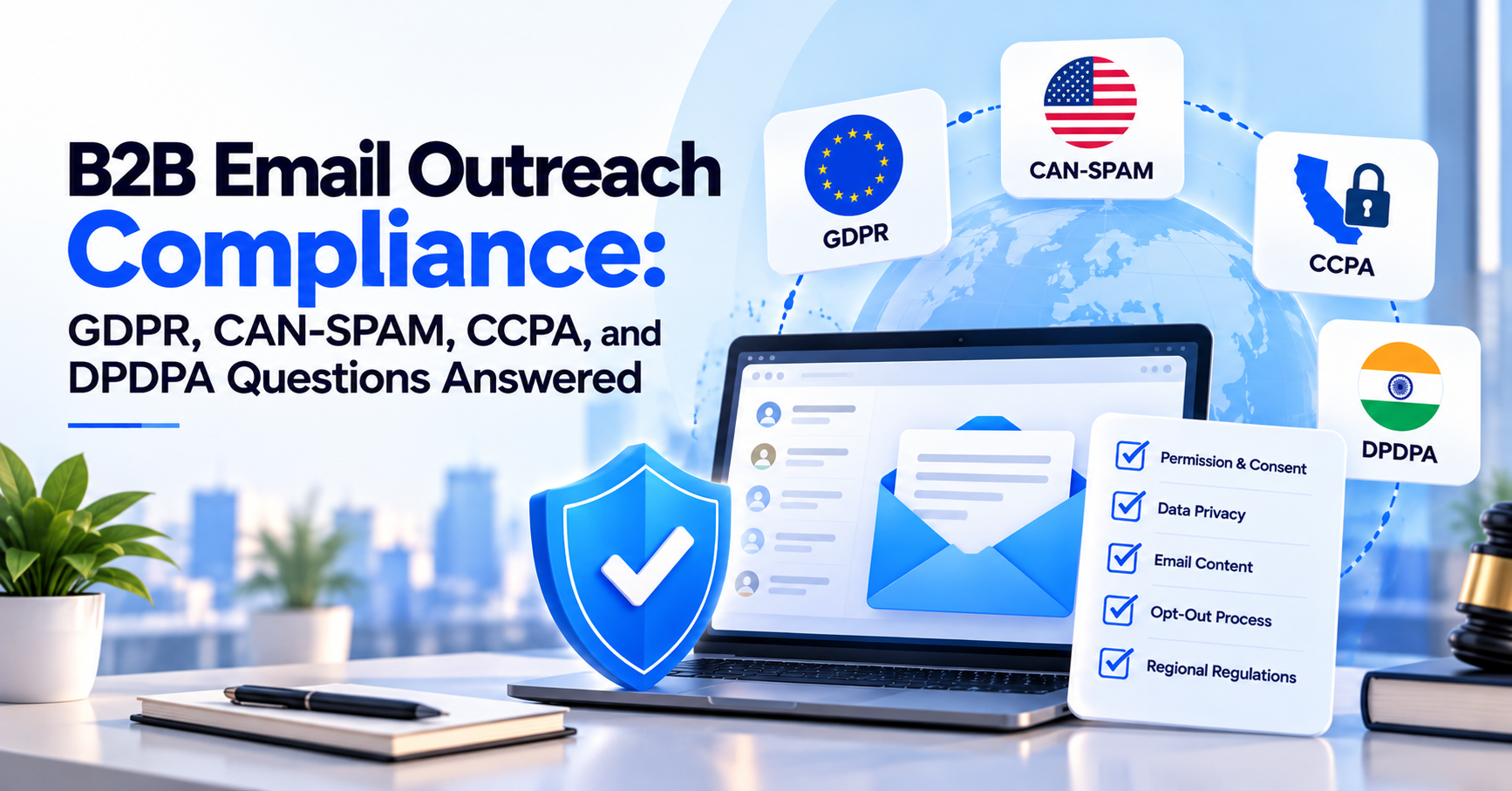
B2B email outreach compliance means following the privacy and anti-spam laws that cover business email: GDPR in Europe and the UK, CAN-SPAM in the US, CCPA in California and DPDPA in India. Cold email to business contacts is usually legal, but only when you have a defensible reason for contacting someone, say who you are, honor opt-outs quickly and keep your data clean.
The common worry is that B2B is exempt because you’re writing to a work address. It mostly isn’t. A name and a company email count as personal data under most of these laws, and the penalties aren’t written with a business-to-business carve-out.
This guide answers the questions sales and marketing teams ask most: whether cold email is legal, which law applies to which list, what a compliant workflow looks like and where email verification and data quality fit in.
In most markets, yes. No major law bans B2B cold email outright. What the B2B cold email laws do is set conditions: who you can contact, what the message must say, how fast you stop when someone objects and how you treat the data behind the list.
The US sits at the permissive end. Germany sits at the strict end, and the UK and France fall somewhere in between. India is the newest piece, with its rules phasing in through 2027.
So the useful version of the question isn’t ‘is cold email legal?’ but ‘is this email legal to this person in this country?’ That’s why splitting lists by region before you send matters as much as the copy itself.
Yes. The CAN-SPAM Act covers all commercial email, and it doesn’t care whether the recipient is a consumer or a procurement manager. It works on an opt-out model, so you can send a first cold email without prior permission as long as you follow the rules.
Those rules are short: accurate From, To and Reply-To details, a subject line that isn’t misleading, a clear statement that the message is an ad, a valid physical postal address and an unsubscribe option that you honor within 10 business days. Penalties run to more than $53,000 for each violating email, and you stay responsible for messages sent on your behalf by agencies or tools. Our guide to CAN-SPAM cold email rules goes through the requirements line by line.
Yes, whenever you process personal data of people in the EU, EEA or UK, and a business email that identifies someone counts. That’s the heart of GDPR B2B email. You need a lawful basis, and for outreach it’s usually legitimate interest.
Legitimate interest isn’t a free pass. You need a specific purpose, a reason email is necessary and a case that the person would reasonably expect to hear from you given their role. Write that assessment down before the first send. If you got the contact from a third party, Article 14 asks you to tell the data subject within one month, and Article 21 gives them a right to object, after which you stop.
National ePrivacy rules sit on top of GDPR. In the UK, corporate subscribers aren’t covered by the consent rule for marketing email, Germany expects far more consent, and France allows outreach tied to someone’s professional role if you inform them and offer an opt-out.
Fines reach €20 million or 4% of global annual turnover, and France’s data protection authority, the CNIL, fined Solocal Marketing Services €900,000 in 2025 over its prospecting practices.
CCPA. California’s B2B exemption expired on 1 January 2023, so business contact details now count as personal information like any other. The law covers for-profit companies that meet at least one threshold: annual gross revenue above $25 million (inflation-adjusted), data on 100,000 or more California consumers or households, or half their revenue from selling or sharing personal information.
For CCPA B2B email, the question is less about permission to send and more about notice, access and deletion requests and honoring opt-outs of sale or sharing. Fines are around $8,000 per intentional violation.
DPDPA. India’s Digital Personal Data Protection Rules were notified on 13 November 2025 and phase in over time. The Data Protection Board is already in place, consent manager rules follow on 13 November 2026 and the main duties on notice, consent and security start on 13 May 2027.
Under DPDP email compliance, the person is a data principal, you’re the data fiduciary and consent must be clear, specific and itemised. The Act has no general legitimate interest ground for marketing like GDPR does, and penalties go up to ₹250 crore.
A verified contact is one whose address has been checked against the mail server and whose details are current. Verification is a data quality step, not a legal shield, but it supports compliance in practical ways: you aren’t mailing dead addresses, you aren’t holding stale personal data for longer than you need, and you can show you take accuracy seriously, which data protection law expects.
In a compliant workflow, tag every contact with its source, country and date added. Run email verification before the first send, keep opt-outs on one suppression list that every tool checks, and review or delete contacts who don’t engage after a set period. This applies to B2B email lists you build yourself and to ones you buy. Our guide to B2B data privacy covers handling in more depth.
The four laws overlap less than people assume. CAN-SPAM regulates the email itself. GDPR and DPDPA regulate the personal data behind it. CCPA sits in the middle, focusing on what you do with information about California residents.
That split is why a message can pass CAN-SPAM and still breach GDPR: the footer is perfect, but you had no lawful basis for holding the contact.
| What to check | GDPR | CAN-SPAM | CCPA | DPDPA |
|---|---|---|---|---|
|
Where it applies |
People in the EU and EEA, and in the UK under UK GDPR |
All commercial email to US recipients, consumer or business |
Personal information of California residents, held by covered businesses |
Digital personal data of individuals in India |
|
Permission model |
Lawful basis needed; legitimate interest can work, but national ePrivacy rules vary |
Opt-out: you may email first, then honor opt-outs within 10 business days |
No opt-in for email; notice, opt-out of sale or sharing, access and deletion rights |
Consent-based, with a narrow list of legitimate uses |
|
Maximum penalty |
Up to €20 million or 4% of global annual turnover |
More than $53,000 per violating email |
About $8,000 per intentional violation, inflation-adjusted |
Up to ₹250 crore, the highest tier |
They’re closer than most teams realise. Gmail and Yahoo expect authenticated mail with SPF, DKIM and DMARC, a one-click unsubscribe for bulk senders and a spam complaint rate below 0.3%. The legal basics, an honest sender identity and a working opt-out, are exactly what keeps complaints low.
That makes cold email compliance and deliverability one project seen from two sides. Strong email deliverability depends on clean data: verified addresses cut bounces, and tight targeting cuts complaints.
When you compare the best email verification tool for your team, look at catch-all handling, bulk speed, API access and price. Our email verification software comparison and cold email deliverability checklist are good places to start.
ReachStream Prospect is built to sit inside your existing compliance process, not replace it. Contact and company records are sourced and verified against documented consent and legitimate-interest standards, and the platform is built on infrastructure certified to ISO and SOC 2 Type II, so the data itself starts from a defensible, audited base.
On top of that, ReachStream supports the day-to-day mechanics of staying compliant: records can be filtered and suppressed by region before a list ever leaves the B2B data platform, opt-outs and unsubscribes are easy to exclude from future pulls, and so exports are structured. This keeps a GDPR, CCPA, PIPEDA, DPDPA: obligation are attached, in a same spreadsheet.
No platform replaces its own legal review. Use ReachStream for the data side of compliance , accurate records, regional suppression, and a documented lawful basis per contact and keep legal or privacy team responsible for interpreting how those regional rules apply to your specific campaigns and processes.
B2B email outreach compliance comes down to four habits: know which law covers each contact, record a lawful basis, send honest emails with a fast opt-out, and keep your data accurate and sourced. Cold email stays a legitimate channel when you do those four things.
This guide is general information, not legal advice, and the rules keep moving, especially DPDPA as its main duties arrive in May 2027. Check your own situation with a qualified lawyer, then build the workflow once and let your tools enforce it. For the data side, our piece on what makes a good B2B email list is a useful next read.

Author

Access 200M+ verified business emails and grow your sales pipeline effortlessly.
Don't forget to share this post!















Check out our other blogs!
Email ID Checker: Verify Any Email ID Online
ICP Refinement for SDRs: Using Data Filters to Stop Wasting Touches

Email Validator: Validate Email Format, Domain and Mailbox