



> Best Practice
How to Evaluate B2B Data Vendors for Accuracy and Compliance

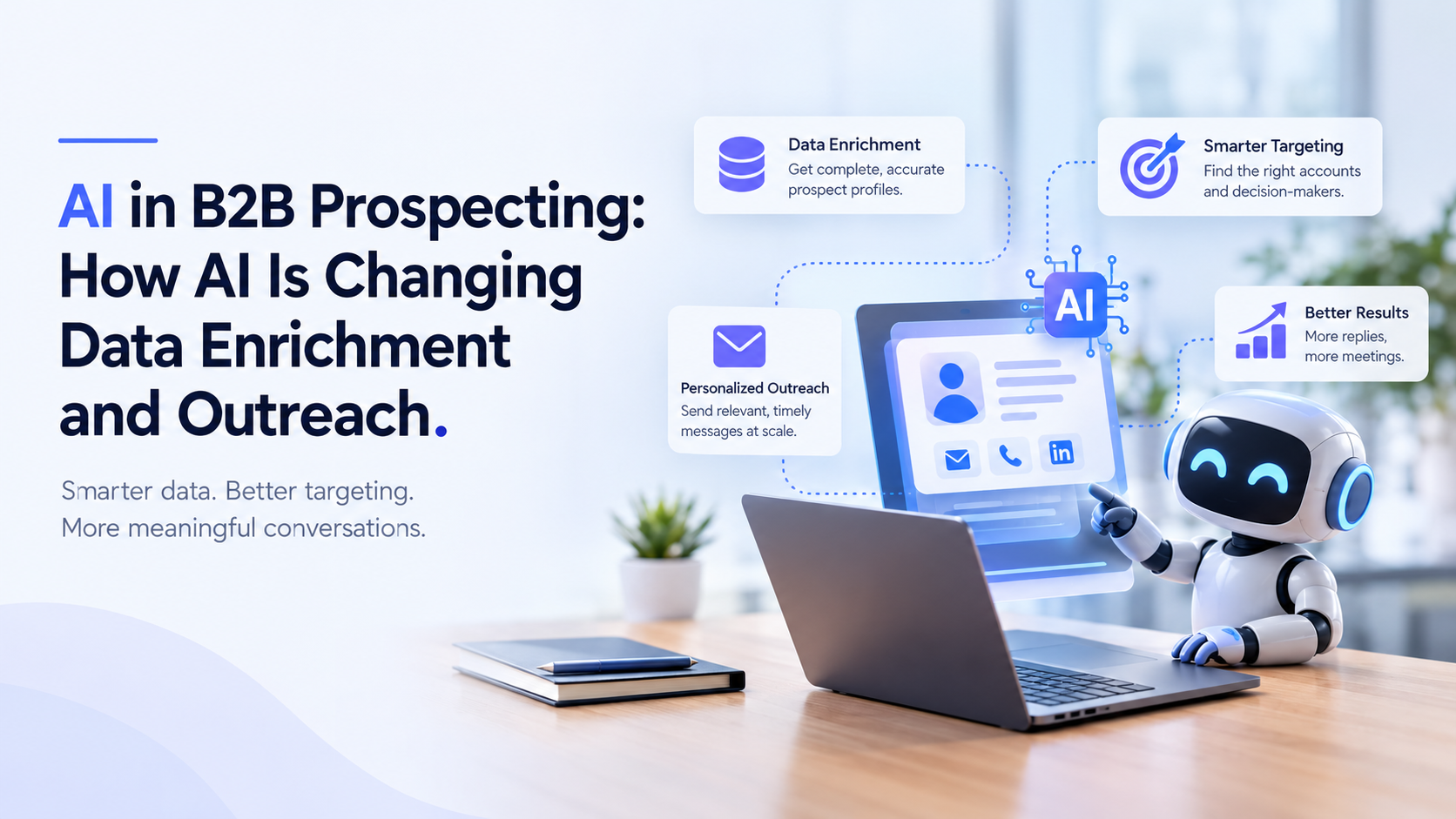
AI in B2B prospecting means software that finds accounts, ranks them, and flags the right moment to reach out, instead of a rep scrolling LinkedIn for twenty minutes before every call. Eighty-one percent of sales teams have now adopted or are testing AI somewhere in their workflow, up from roughly half just two years ago, so the question isn’t really whether to use AI for B2B prospecting anymore.
It’s how to use AI for B2B prospecting without drowning your pipeline in generic, half-personalized noise. This guide covers what AI data enrichment actually does to a contact record, how AI prospecting tools decide who to surface first, and where AI B2B prospecting still needs a human to check its work.
AI for B2B prospecting usually runs in four stages: discovery, finding companies that fit your ICP, enrichment, filling in firmographic and contact details, scoring, ranking accounts by fit and intent, and outreach, drafting or triggering the first touch. AI prospecting software handles all four, though most teams still want a person reviewing stage three and four before anything goes out.
What makes this different from a normal CRM workflow is the AI discovery step. Instead of a rep building a list from a static database, the system keeps finding new accounts that match your ICP as they start showing buying signals.
Layers of AI Prospecting is a useful way to think about the stack instead of treating it as one tool. The bottom layer is data, firmographic, technographic, and contact records that need to be accurate before anything else works. The next layer is enrichment, where AI enrichment tools fill gaps and verify what’s already there. Scoring and signal detection sit on top of that, and outreach sits last, closest to the rep.
Most AI prospecting platforms only really own one or two of these layers, which is why so many sales stacks end up with three or four point tools stitched together with Zapier.
AI data enrichment tools pull firmographic and technographic details, verify emails, and append direct dials to records that used to sit half-empty in a CRM. The honest answer to how AI can improve B2B data accuracy is that it cross-checks multiple sources against each other and flags the records where sources disagree, instead of trusting whichever list got imported last.
B2B data enrichment used to mean a one-time import. AI data enrichment tools now re-check records on a schedule, so a contact who changed jobs six weeks ago doesn’t sit in your CRM under their old title indefinitely. Data Integrity tools are really what’s doing the heavy lifting here, matching, duplicating, and flagging conflicting records before a person ever sees them.
AI sales intelligence tools are decent at this when the underlying data is clean, and noticeably worse when it isn’t, which is really a data quality problem wearing an AI costume. AI research into org charts and hiring patterns is improving fast, but it still works best as a shortlist generator, not a final verdict.
Predictive analytics scores accounts on how likely they are to buy based on patterns from your own closed-won deals, not a generic industry benchmark. Signal-based prospecting goes a step further and watches for specific triggers, a new hire, a funding round, a tech stack change, that have historically preceded a deal.
Teams using signal data report meaningfully better conversion than teams relying on traditional lead scoring alone, and accounts showing three or more active buying signals convert at roughly double the rate of accounts with just one. That gap is most of the argument for ai sales prospecting over a static target list.
AI Prospecting vs Traditional Prospecting isn’t really a fair fight anymore on raw list-building speed, AI wins that easily. Where it gets more even is accuracy: a rep manually verifying fifteen accounts by hand often still beats an unsupervised AI pass on data quality, just at a fraction of the volume.
Intelligent Prospecting usually means pairing the two. AI handles the volume and the first pass of scoring, and a person checks the accounts that actually make the shortlist before outreach goes out.
| Stage | Manual Approach | AI-Assisted Approach | Time Required | Risk if Unchecked |
|---|---|---|---|---|
|
Discovery |
Small list of high-priority accounts |
15 to 20 minutes |
Low, does not scale past a short list |
Low, checked in real time by a person |
|
Enrichment |
Building lists at volume |
Seconds to minutes |
High, scales to thousands of records |
Depends entirely on provider refresh rate |
|
Outreach |
Most sales and marketing teams |
Database for volume, manual for top accounts |
Medium, scales with team size |
Mixed, varies by which method sourced the contact |
How AI lead generation tools work usually breaks into five steps. First, the system pulls firmographic and technographic data that matches your ICP. Second, it appends contact details and verifies them against multiple sources. Third, it scores each account using predictive analytics trained on your historical wins. Fourth, it flags buying signals, like funding events or hiring spikes, that have shown up before past deals.
Fifth, it either drafts outreach or hands a ranked list to a rep.Skipping the verification step is where most of these systems lose trust fast. A ranked list full of bounced emails gets ignored by week two, no matter how good the scoring model is underneath it.
The state of AI prospecting in 2026 looks less like a single tool and more like a layer sitting on top of the CRM most teams already have. Reps using AI daily are roughly twice as likely to hit target, and teams running AI across the funnel are meaningfully more likely to see revenue growth than teams that aren’t.
The gap now isn’t access to AI prospecting tools, most sales orgs have at least one. It’s whether anyone actually uses the AI features built into the tools they already pay for, versus pasting notes into a generic chatbot and calling it a day. Most AI Lead Generation Platforms released in the last year lean harder on enrichment accuracy than flashy automation, which tracks with what actually moves reply rates.
The biggest of the AI Prospecting Mistakes teams make is trusting a score without ever checking the data underneath it. A high-scoring account built on a stale job title or a dead email address is still a dead lead, no matter how confident the model sounds.
ReachStream supports AI-powered B2B prospecting by sitting underneath the scoring and discovery layer as the verified data source. ICP matching only works if the firmographic and technographic data behind it is accurate, and that’s the part AI models can’t fix on their own, they can only work with what’s in the record.
AI B2B data platforms are only as good as their weakest data source. ReachStream keeps that source clean so the AI prospecting platforms built on top of it, yours or anyone else’s, have something reliable to score in the first place. That reliability is becoming a bigger part of AI in B2B sales strategy than the scoring model itself.
AI Prospecting for B2B Sales isn’t going anywhere, and the future of AI B2B prospecting is less about replacing reps and more about making sure the data underneath the model is something worth trusting. Get AI data enrichment and verification right first. Everything built on top of it, scoring, signals, outreach, only works if the record at the bottom is accurate.
Author

Access 200M+ verified business emails and grow your sales pipeline effortlessly.
Don't forget to share this post!















Check out our other blogs!
What Is B2B Data and Why It Matters for Modern Sales Teams
A Buyer’s Checklist for Evaluating B2B Data Providers
How to Sync B2B Data with Your Outreach Sequences