


How to Evaluate B2B Data Vendors for Accuracy and Compliance

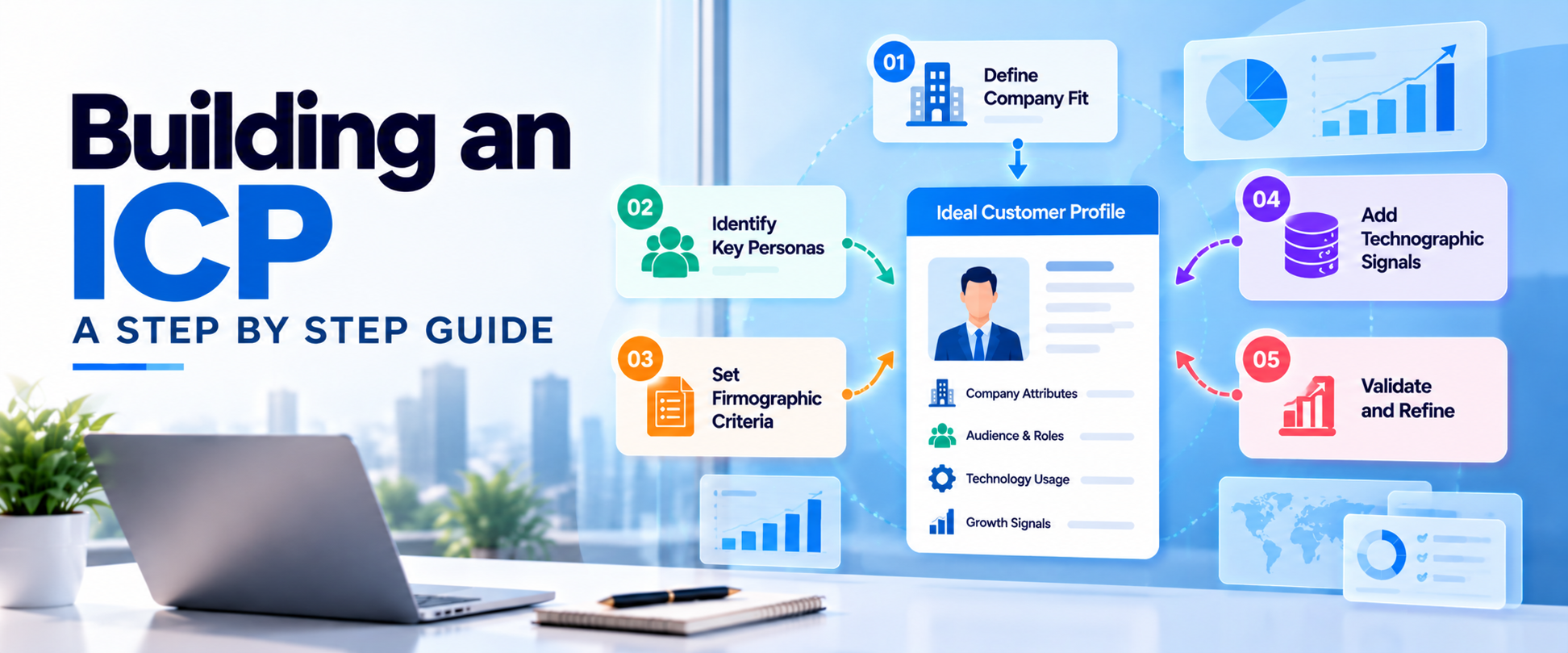
To build an ideal customer profile, study your best customers, find what they have in common, write those traits down and then use them to decide which accounts to chase. An ideal customer profile, or ICP, describes the type of company that gets the most value from your product and brings you the most value in return.
The hard part is not the definition. It is getting the profile specific enough to change decisions. A line such as ‘mid-sized technology companies’ does not tell a rep who to call or tell marketing where to spend. A good B2B ICP names the industry, company size, revenue range, geography and the situations that make a company ready to buy.
Start with the customers you already have. Pull a list of your best customers, meaning the ones who stay longest, pay well, expand over time and need the least hand-holding. Fewer than twenty is fine. The point is to look for patterns, not to build a statistical model.
Run a CRM analysis next. Compare closed-won deals against closed-lost ones and look at deal size, sales cycle length, retention and expansion. Check which industries, company sizes and regions show up most among the winners. Where the CRM data is thin or messy, this is a good moment to clean it up first.
Then talk to people. Customer interviews tell you what the CRM cannot: why they bought, what problem they were trying to solve and what nearly stopped them. Ask three or four customers and two or three who churned. The contrast is often more useful than the praise. Our guide to creating an ideal customer profile covers the interview questions in more detail.
ICP attributes fall into a few groups. Firmographics describe the company: industry, company size by employees, annual revenue, geography and ownership. Technographics describe its technology stack, meaning the tools it already uses. Behavioural and situational traits cover buying triggers, growth stage and how the company buys.
Add the problem side as well. List the pain points your best customers had before they bought, and the outcomes they measure now. A profile that only lists company traits can tell you who looks right. One that includes pain points tells you who needs you.
Finally, record disqualifiers. These are traits that mark a company as a poor fit, such as being too small to afford your product or running a system you cannot integrate with. Disqualifiers support lead qualification and save sales time on deals that were never going to close. An ideal customer profile template keeps all of this in one page, and our ICP worksheet template is a good starting point.
A firmographic ICP answers who the company is. A technographic ICP answers what it runs on. Used together they sharpen the profile far beyond what either gives alone.
Firmographic filters narrow the market by industry, company size, revenue and geography. Technographic filters then narrow it by technology stack. If your product integrates with a particular CRM or replaces a certain type of tool, companies that already use that software are far more likely to be a fit.
This is the core of a data-driven ICP: start from facts about the accounts that work, not from opinion. For a deeper look at how the two data types differ, see our comparison of firmographic vs technographic data and our guide to firmographic data for demand generation.
The ICP vs buyer persona question trips up many teams, and the answer is that they work at different levels. An ICP describes the account: the type of company worth selling to. A buyer persona describes an individual: the role, goals and concerns of someone who influences or makes the decision.
You need the ICP first. It tells you which companies to target. Then you create one or more personas for the people inside those companies, such as the economic buyer, the day-to-day user and the technical evaluator. Each persona has different pain points and responds to different messages.
Skipping the ICP and starting with personas leads to well-written messages sent to the wrong companies. Starting with the ICP keeps sales and marketing alignment simple, because both teams agree on which accounts count before anyone debates what to say to them.
An ideal customer profile for SaaS usually leans on company size, growth stage and technology stack, because software buying depends on budget, team size and integrations. Here is a sample profile for a hypothetical sales engagement tool, shown for illustration only.
Industry: B2B software and services. Company size: 50 to 500 employees. Revenue: growing, with a dedicated sales team of at least five reps. Geography: North America and the UK. Technology stack: uses a major CRM and an email platform. Buying triggers: a new head of sales, a recent funding round or a rapid hiring push. Disqualifiers: no outbound sales motion, or a sales team of one.
Notice how each line can be checked against data. That is what makes a profile usable. If you cannot filter for a trait in your CRM or a data tool, either find a proxy for it or take it out of the profile.
Good ICP data comes from three places, and each answers a different question. The table below compares internal CRM analysis, customer interviews and third-party market data.
Use all three where you can. The CRM tells you what happened, interviews tell you why and market data tells you how big the opportunity is.
| Data source | Question it answers | Best for | Effort | Watch out for |
|---|---|---|---|---|
|
CRM analysis |
Which kinds of accounts have actually won and stayed |
Finding patterns in industry, company size and sales cycle |
Low if your data is clean |
Incomplete or inconsistent CRM records |
|
Customer interviews |
Why customers bought and what nearly stopped them |
Pain points, buying triggers and language to use |
High, with scheduling and note-taking |
A small sample that may not represent everyone |
|
Third-party firmographic and technographic data |
How many matching accounts exist and where they are |
Sizing the market and building target account lists |
Low once filters are set |
Quality varies, so check how the data is sourced and refreshed |
Review your ICP at least once a year, and sooner after a big change such as a new product, a new market or a shift in who your best customers are. Many teams also run a lighter check each quarter, comparing recent wins against the profile. If your best new customers no longer match, the profile needs to change.
Yes, a company can have more than one ICP. A business that sells to two distinct segments, such as small agencies and large enterprises, will usually need a profile, because their budgets, buying processes and pain points differ.
Keep the number small, though. Two or three well-defined profiles are manageable, while ten dilute your focus. Where segments overlap, treat one as primary and use it to decide where most of the effort goes.
Once your profile is written, ReachStream Prospect helps you turn it into a list. You can filter by industry, role, company size, revenue and location, build dynamic lists that update automatically and use Similar Companies to find businesses that resemble your best customers. Technology Insights adds a technographic view, so you can look for accounts using specific tools.
The built-in email verifier checks addresses before you use export credits, and lists can sync to your CRM, including native Salesforce and HubSpot integrations. If you run account-based programs, our guide on how marketing teams use ReachStream for ABM shows how an ICP feeds account selection.
To build an ideal customer profile, start from your best customers, confirm the patterns with CRM analysis and interviews, add firmographic and technographic traits, write down disqualifiers and test the profile on a small account list. Then review it regularly so it keeps pace with your market. For your next read, see our guide to intent data for campaign targeting and our overview of B2B data.
Compare ReachStream’s plans and Start Building Verified Lead Lists Today
Author

Access 200M+ verified business emails and grow your sales pipeline effortlessly.
Don't forget to share this post!















Check out our other blogs!
Email ID Checker: Verify Any Email ID Online
ICP Refinement for SDRs: Using Data Filters to Stop Wasting Touches

Email Validator: Validate Email Format, Domain and Mailbox