



What Is the Difference Between Firmographic and Technographic Data?

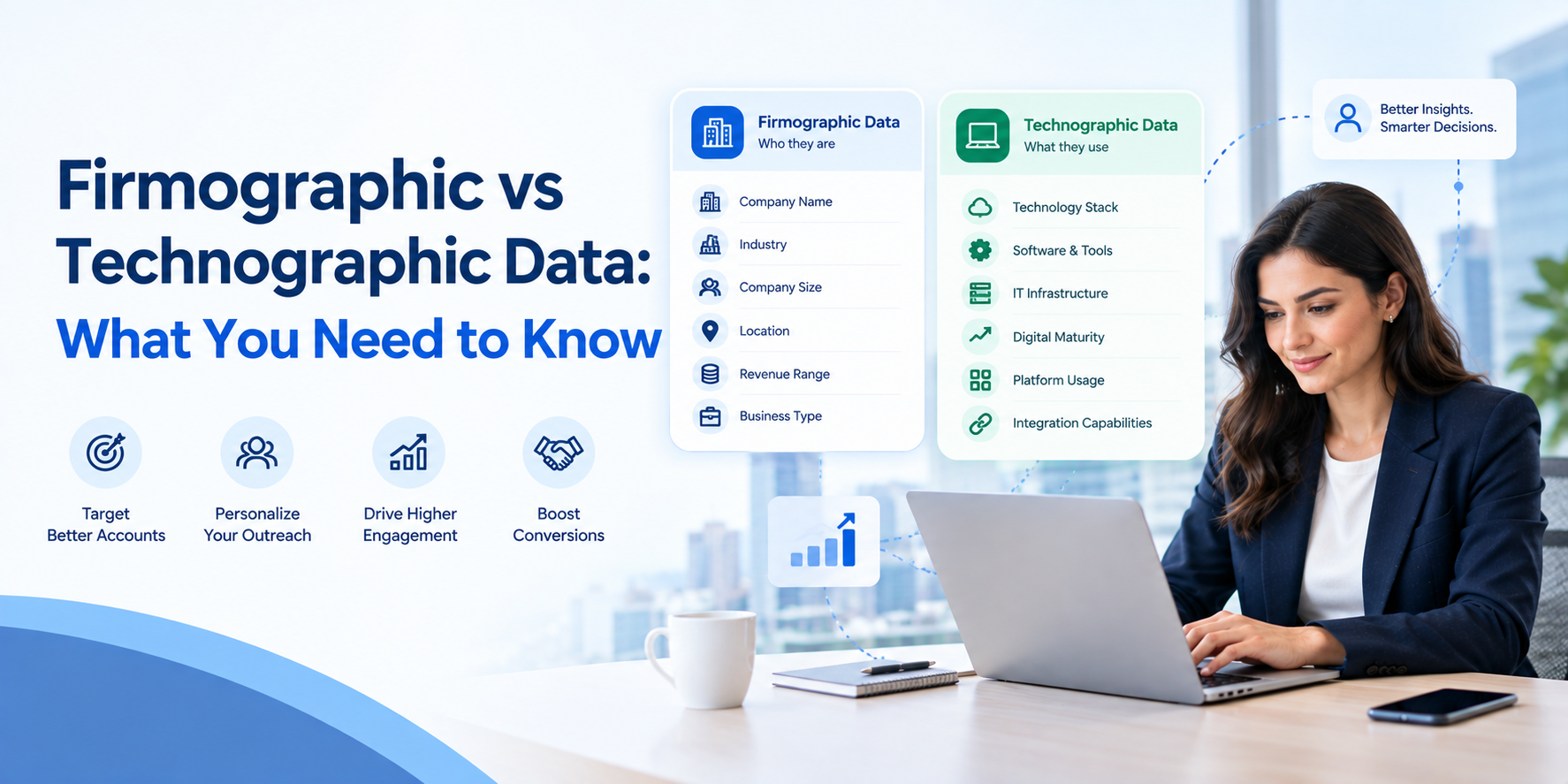
Firmographic data is structured information about a company itself: industry, employee headcount, revenue band, headquarters location, ownership type, and funding stage (sometimes misspelled firmagraphics data). Think of it as the business equivalent of demographic data for a person, it tells you what kind of organization you’re looking at, not what that organization runs internally.
If you’ve ever Googled what is firmographic data, this is the short version: firmographics meaning, in practice, is everything that describes a company’s size, shape, and structure rather than its day-to-day tools.
Technographic data is information about the software and tools a company actually runs: its CRM, marketing automation platform, cloud infrastructure, analytics stack, sales engagement tools, and security systems. Where firmographic data tells you what a company is, technographic data tells you what a company uses, and that distinction is the whole reason technographic data exists as its own category.
A technographic data provider typically builds this picture from website technology scans, job postings that mention specific tools, integration marketplaces, and ecosystem partnerships between vendors.
Firmographic vs technographic data comes down to one question: are you describing the company, or are you describing what the company runs? Technographic data vs firmographic data isn’t really a competition, they answer different questions.
Firmographic and technographic data together tell you both who to target and when to reach them: firmographic data narrows the universe to companies that fit your ideal customer profile, while technographic data tells you which of those companies have a gap, an aging tool, or a stack your product plugs into cleanly.
A few firmographic vs technographic examples make the split concrete. Firmographic: a 500-person fintech company headquartered in Austin with 80 million dollars in recent funding. Technographic: that same company running Salesforce as its CRM, Marketo for marketing automation, and AWS for cloud infrastructure, with no dedicated sales engagement tool in its stack yet.
The firmographic profile tells you the company is a plausible fit; the technographic detail tells you exactly where your product would slot in, and gives a rep something concrete to open a conversation with.
Firmographic vs demographic is a mix-up worth clearing up early. Demographic data describes an individual, age, job title, income, education. Firmographic data describes the organization that person works for, industry,
size, revenue, location.
A VP of Sales is a demographic profile; the 1,200-employee logistics company she works for is a firmographic one. B2B teams need both, a buyer persona built only on demographic data misses whether the company itself
is even a fit.
A technographic data provider rarely gets its information from a single source. Website technology detection scans public-facing code for tracking pixels, chat widgets, and analytics tags. Job posting analysis picks up tools named explicitly in a company’s own hiring ads, ‘experience with HubSpot required’ is a strong signal.
Integration and app-marketplace listings show which companies have connected a given tool to their systems. Ecosystem relationships, partner directories, case studies, certification logs, round out the picture. No single method is complete on its own when mapping a full technology stack, which is why the better firmographic data tools and technographic data tools blend several signals rather than relying on one.
Firmographic data alone tells you a company could be a fit. Technographic data alone tells you what a company runs but not whether it’s even the right size or industry to matter. Combined, they power real account intelligence: a GTM strategy that ranks accounts by ICP fit first, then by a gap in their software stack or a displacement opportunity second.
Layer buying signals and account intent data on top, a company researching competitor pricing pages, hiring for a role your tool would support, and you move from a flat list to a genuinely prioritized one. This is the backbone of most modern ABM programs, not one data type, but all three stacked together. Layering B2B intent data on top of both only sharpens that prioritization further.
| Data Type | What It Describes | Example Fields | Typical Source | Best Used For |
|---|---|---|---|---|
|
Firmographic data |
The company itself: size, industry, revenue, location |
Employee count, revenue band, industry, HQ, funding stage |
Registries, financial databases, firmographic data tools |
ICP fit, account segmentation |
|
Technographic data |
The technology stack a company runs |
CRM, marketing automation, cloud, analytics, security tools |
Website scans, job postings, integrations, technographic data provider feeds |
Gap analysis, timing, competitive displacement |
|
Firmographic + technographic (combined) |
Fit and readiness together |
ICP match layered with tech-stack signals and intent data |
Sales intelligence platform, B2B data enrichment tools |
Account prioritization, ABM, GTM strategy |
Most GTM teams start with firmographic filters, industry, headcount, revenue, geography, to build a reasonably sized universe of accounts that fit the ideal customer profile. From there, technographic data narrows further: which of those accounts run a competitor’s tool, which have a gap in their software stack, which just added a new integration to their API infrastructure that signals they’re investing in the category.
Sales intelligence platforms that expose both layers side by side let reps build account intelligence into outreach instead of researching each company from scratch, which also supports lead generation further up the funnel.
A technographic data provider is a service that detects, tracks, and sells information about which software companies run. When evaluating one, check detection breadth, how many technologies and categories it tracks, refresh frequency, how often stale tool detections get corrected, and whether it integrates directly into your CRM or sales intelligence platform rather than requiring a manual export.
Also ask how the provider handles data decay: job titles and tech stacks both drift constantly, and a provider that doesn’t actively re-verify will hand you confidently wrong data within months. The best data enrichment providers, and the stronger B2B data enrichment tools generally, combine technographic detection with firmographic and intent data in a single record.
The most common mistake is treating firmographic and technographic data as interchangeable, they answer different questions, and conflating them leads to messaging that misses the mark. A close second is using stale technographic data; a tool detected six months ago may already be gone.
Teams also tend to buy firmographic data tools and technographic data tools from two different vendors and never actually merge the records, leaving reps to manually cross-reference two separate lists. Finally, some teams skip firmographic and technographic data for targeting altogether and rely only on job title, which ignores whether the company itself is even a fit.
Firmographic vs technographic data isn’t a choice between two competing approaches, it’s two different lenses on the same account. Firmographic data tells you whether a company is the right shape to be a customer; technographic data tells you what that company already runs and where the gaps are. The teams that combine both, and layer in intent and buying signals on top, consistently outperform alone.
Author

Access 200M+ verified business emails and grow your sales pipeline effortlessly.
Don't forget to share this post!















Check out our other blogs!
What Is B2B Data and Why It Matters for Modern Sales Teams
A Buyer’s Checklist for Evaluating B2B Data Providers

How to Sync B2B Data with Your Outreach Sequences