
TL;DR
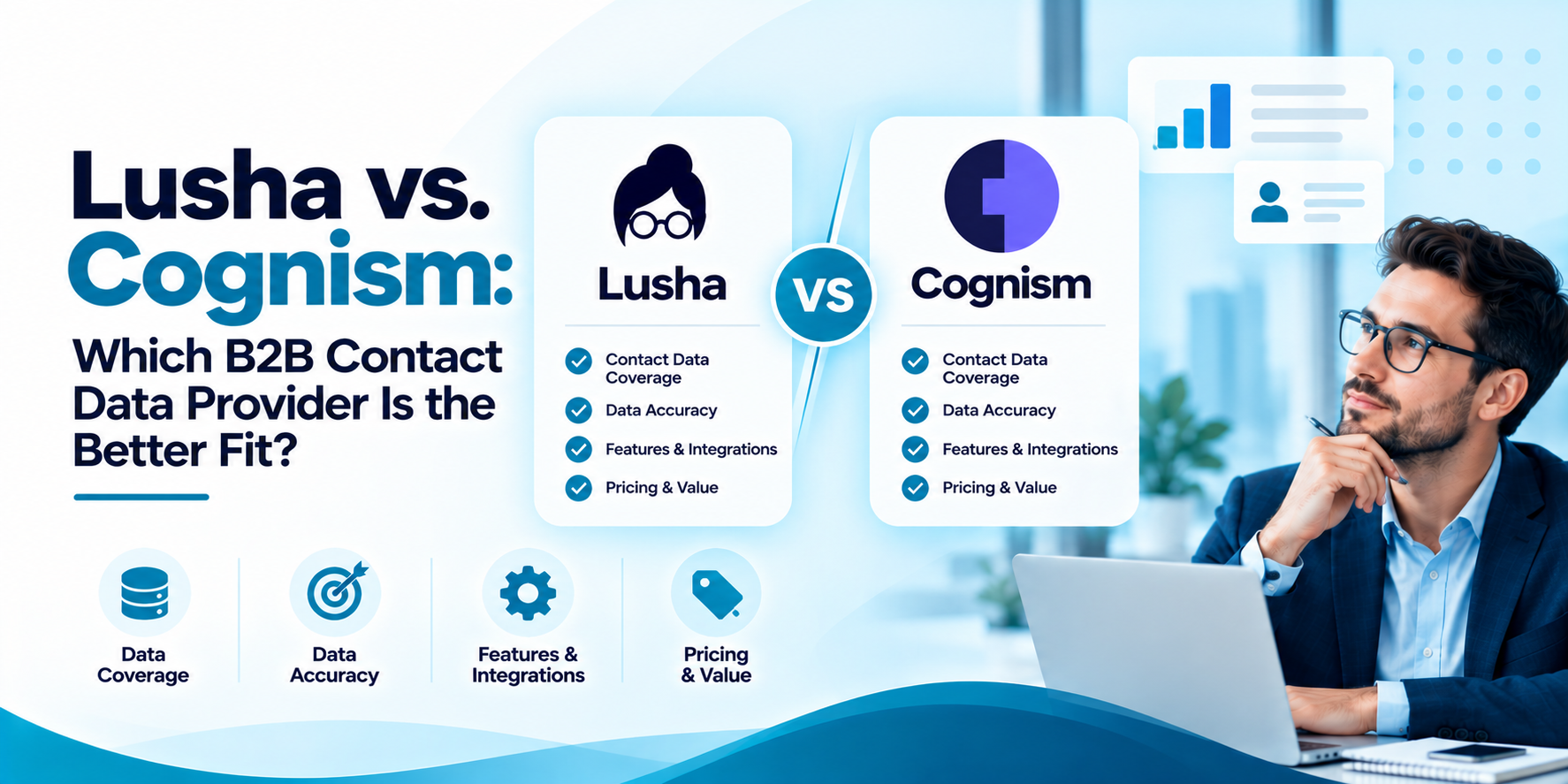
- Lusha vs. Cognism is a choice between self-serve speed and a quote-based, Europe-focused platform.
- Lusha lists a free plan and a Chrome extension, and Cognism sells through quotes and demos.
- Lusha says an email costs one credit and a phone number costs five.
- Cognism highlights phone-verified mobiles and Do Not Call screening.
- All accuracy and coverage figures are vendor claims, so test both on contacts you know.
- Compare yearly totals for your seats, not headline prices.
- ReachStream offers 500M+ contacts, 50M+ companies and 60M+ direct dials, plus 100 free export credits a month.
What Is the Difference Between Lusha and Cognism?
Lusha vs. Cognism comes down to what you need your data to do. Lusha is built for quick, self-serve lookups, with a free plan and a Chrome extension that works inside your browser. Cognism is built for teams that sell into Europe and want phone-verified mobile numbers and compliance checks, and it sells through quotes and demos.
Lusha vs. Cognism: How Do Features Compare?
Lusha vs Cognism features overlap more than the marketing suggests, so it helps to separate the core jobs. Both help with contact discovery: you search for a person or company and get an email, a phone number or both. Both sit in the sales intelligence software category and add company intelligence such as size, industry and location.
Lusha leans on a lightweight Chrome extension and self-serve credits. Cognism leans on a fuller platform, with phone-verified mobiles, Do Not Call list screening and, according to its site, optional buyer intent data from Bombora.
Neither one is a full outreach suite. Both are prospecting tools that feed your CRM and sequencer, so the real question is which one finds the right people in the markets you sell to. Feature names change often, so confirm what your plan includes before you sign.
Lusha vs Cognism Pricing: What Will You Pay?
Pricing is where the two feel most different. Lusha publishes plans on its site, including a free plan with a small monthly allowance of 40 credits. On its pricing page, an email costs one credit and a phone number costs five, so phone-heavy work uses credits quickly. Paid plans add more credits and team features.
Cognism takes a different route. Its site describes quote-based pricing with Standard and Pro tiers and a CRM Enrichment option, and you usually start with a demo. That is why Lusha vs Cognism pricing is hard to compare line by line: one shows numbers up front, the other sells on scope, seats and regions. Ask both vendors for a yearly total for your team size and compare totals rather than headline rates.
Lusha vs Cognism Data Accuracy: What to Know
Accuracy claims deserve a careful read. Lusha states 98% email accuracy and roughly 85% to 86% for phone numbers on its site, from a database it describes as 515M+ contacts. Cognism says its mobile numbers are verified by phone, which it presents as a main reason teams choose it for outbound calling. These are vendor-reported figures, not independent results.
Lusha vs Cognism data accuracy will also vary by market and job level. A sample is the fairest test: take 100 contacts you already know, run them through each trial or demo, and count the emails that bounce and the numbers that connect. Our guide to B2B data accuracy explains how to run that test.
Which Platform Covers Europe Better?
Cognism positions itself around European and compliance-minded outreach, and its site highlights GDPR-aware data and Do Not Call screening. Lusha also publishes compliance information and says its database is global. When you read Cognism vs Lusha data coverage claims, check the countries and job levels you actually target rather than the headline totals.
If you sell mainly in the UK and the EU, ask each vendor for a sample list in your segment. If you also sell in North America or Asia, test those too. Lusha vs Cognism contact database size matters less than how many of your own target accounts each one covers. Our guide to what Cognism is and how its compliance works goes deeper on the European side.

How Do Integrations and Workflows Compare?
Both tools meet you where you already work. Lusha’s Chrome extension shows contact details while you browse LinkedIn and company sites, which suits quick lookups, and we cover it in our Lusha Chrome extension review. According to their sites, both offer CRM integration with common systems and data enrichment, so records in your CRM can stay current.
Workflow matters more than a feature list here. A business email finder that saves two clicks per lead is worth little if records still need manual cleanup afterwards. Our guide to automated data enrichment workflows shows how to keep records fresh, and syncing B2B data with outreach tools covers the handoff.
Explore a ReachStream alternative
Search by role, industry and location, then export verified contacts.
How Do Lusha and Cognism Stack Up Side by Side?
The table compares the two vendors on the points buyers ask about most, with ReachStream added for reference. It reflects each vendor’s public site and should be checked before you buy.
| Area | Lusha | Cognism | ReachStream | What to look into |
|---|---|---|---|---|
|
Pricing |
Published plans, including a free plan |
Quote-based, with Standard and Pro tiers |
Free plan plus Starter, Pro and Business |
Total yearly cost for your seats |
|
Strength |
Quick lookups in a Chrome extension |
European focus and phone-verified mobiles |
Filters across 500M+ contacts |
Fit with your target markets |
|
Watch-outs |
Phone numbers use more credits |
Demo and quote needed |
Coverage varies by region and role |
Accuracy on a sample you know |
How Do You Choose Between the Two?
- List your markets: Note the regions and roles you target.
- Set a budget: Decide what you can spend per seat each year.
- Pull a sample: Use 100 contacts you already know.
- Run both trials: Count bounces and connected calls.
- Check the CRM fit: Confirm sync works with your system.
- Read the contract: Look at renewal terms and credit rules.
Lusha vs Cognism for Small Businesses
For SDRs and account executives who live in the browser, Lusha’s speed and free entry point make it easy to try. Larger teams that call European prospects all day may lean toward Cognism for its phone-verified mobiles and compliance focus. Sales managers should also look at seat controls, reporting and how each tool handles credits across a team.
For Lusha vs Cognism for lead generation, think about volume. Credit-based plans reward targeted lookups, while quote-based plans suit bigger, steadier lists. Marketers and RevOps teams building a B2B list should test bulk export limits as well. Our guide to the best sales prospecting tools compares more options.
Lusha vs Cognism for Sales Teams
- Start free: Lusha lists a free plan, which suits a tiny team testing lookups.
- Expect a demo: Cognism sells by quote, so plan time for a call.
- Count your seats: Price a plan for the people who will really use it.
- Watch credits: On Lusha, phone numbers use more credits than emails.
- Think about growth: Check how the price changes if the team doubles.
- Compare a few more: Look at other vendors before you commit.
Where Does ReachStream Fit In?
If neither fits, ReachStream Prospect is worth a look. It is designed to help teams find decision makers across 500M+ contacts, 50M+ companies and 60M+ direct dials, with filters for industry, job title, seniority, location, company size and technologies used. AI Search lets you describe the buyers you want in everyday language, and Similar Companies helps you expand from accounts that already fit.
A built-in email verifier, data enrichment, CSV export, the Reach API and native Salesforce and HubSpot sync cover the handoff to your stack. Coverage differs by region and role, so test any search on the Free plan.
To see how the field looks, read our guides to Lusha alternatives and Cognism alternatives, or the ReachStream vs Lusha vs Hunter.io comparison. You can also explore the ReachStream Prospect page.
Plans offered the Free plan includes 100 contact export credits a month with no credit card, Starter is $29 a month billed yearly ($39 monthly) for 5,000 export credits a month, Pro is $49 a month billed yearly ($59 monthly) for 10,000, and Business is $79 a month billed yearly ($99 monthly) for 20,000 credits and 3 seats. Enterprise is custom.
Start with 100 free export credits a month
No credit card needed. Test coverage for the roles you contact most.
Lusha vs. Cognism: The Short Version
The short version: Lusha vs. Cognism is a choice between a quick, self-serve tool with a free plan and a quote-based platform with a European focus. Test both on your own contacts, compare real yearly totals and confirm every vendor figure on its site. For your next read, see ReachStream vs Clearbit vs Cognism and Lusha pricing explained.
Find a plan that fits your team size
Scale Your Prospecting Without Stretching Your Budget Explore ReachStream Pricing
Frequently Asked Questions
1. What is the difference between Lusha and Cognism?
Lusha vs. Cognism is mainly a difference in approach. Lusha offers self-serve plans, a free tier and a Chrome extension for fast lookups, while Cognism sells by quote and highlights European data, phone-verified mobiles and compliance. Both work as a B2B contact database for sales teams.
2. Is Lusha better than Cognism for B2B prospecting?
Neither is better for everyone. In Lusha vs. Cognism, Lusha tends to suit small teams that want quick, self-serve prospecting, and Cognism tends to suit teams that call European buyers. Test both on a sample of your own contacts before you decide.
3. Which is better for sales teams, Lusha or Cognism?
Sales teams that work mostly in the browser and want a low-cost start may prefer Lusha. Teams that need phone-verified mobiles for outbound calling in Europe may prefer Cognism. Managers should compare seat controls, credit rules and CRM sync.
4. How do Lusha and Cognism compare in data accuracy?
Both vendors publish accuracy claims. Lusha states 98% for email and about 85% to 86% for phone on its site, and Cognism highlights phone-verified mobile numbers. These are vendor figures, so run your own sample of 100 known contacts and compare bounces and connected calls.
5. How do Lusha and Cognism features differ?
In Lusha vs. Cognism, the main feature differences are the Chrome extension and self-serve credits on one side, and phone-verified mobiles, Do Not Call screening and optional buyer intent data on the other. Both offer CRM integration and data enrichment. Confirm what each plan includes.
6. Which platform has better European B2B contact data?
Cognism positions itself around European data and compliance, so it is often shortlisted for UK and EU outreach. Lusha also covers Europe, but coverage varies by country and role. Ask each vendor for a sample list in your segment and check it against contacts you know.
7. How much does Lusha cost compared with Cognism?
Lusha lists a free plan with 40 credits a month, where an email costs one credit and a phone number costs five. Cognism uses quote-based pricing, so there is no public price to compare. Ask both for a yearly total based on your seats and regions.
8. Does Lusha have a free plan while Cognism needs a demo?
Yes, Lusha lists a free plan on its site, so you can try it without talking to sales. Cognism sells through quotes and usually starts with a demo, based on its public site. Both can change, so check current details.

Junaid Hussain Khan
Author
Junaid Hussain Khan

Junaid Hussain Khan is the Business Development Manager at ReachStream, adept at forging strategic partnerships and identifying new market opportunities to propel ReachStream’s growth and strengthen its position in the B2B ecosystem.
Share
Table of Contents
Access 500M+ verified business emails and grow your sales pipeline effortlessly.
Power Your Sales
with Targeted Data
Junaid Hussain Khan is a Senior Manager, Business Development at ReachStream. He leads strategic partnerships, uncovers new market opportunities, and helps drive ReachStream's growth and its position in the B2B ecosystem.
Don't forget to share this post!















Check out our other blogs!
Catch-All vs Invalid vs Risky Emails: Which Should You Send To?
November 18, 2026
What Is a Catch-All Email? How to Check and Verify One
November 18, 2026
Customer Stories: How Teams Cut Bounce Rates with ReachStream
November 18, 2026