


Understanding B2B Data Decay: Why It Goes Stale So Fast
How Fast Does B2B Data Really Decay?

- B2B data decay runs at roughly 20 to 30 percent a year, and email addresses specifically go bad around 23 percent annually.
- The fastest-moving fields are job titles and phone numbers, because people change roles and carriers far more often than they move offices.
- Employee turnover is the biggest driver: millions of professionals change jobs every month, and each move can break an email, a title, and a phone number at once.
- Poor data quality costs the average organization an estimated 12.9 million dollars a year, with U.S. businesses losing an estimated 3.1 trillion dollars annually in total.
- There is no single universal decay rate. Decay is concentrated in a handful of fields rather than spread evenly across a whole record.
- Monthly re-verification of active segments and quarterly full audits catch most decay before it reaches your sales sequences.
- ReachStream's real-time verification checks contact data at the point of search, not from a stale export pulled months ago.
What Is B2B Data Decay?
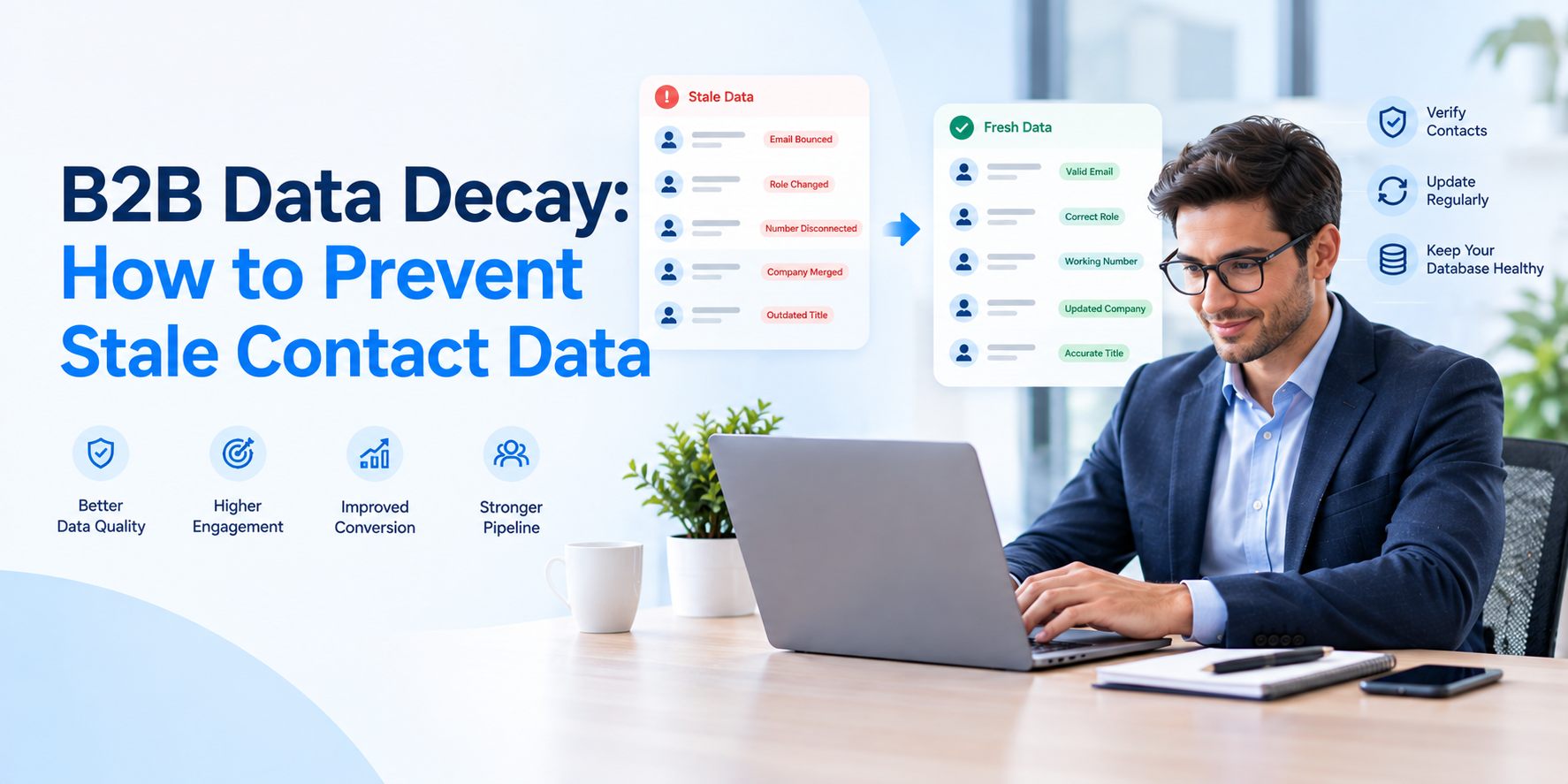
B2B data decay is the gradual loss of accuracy in a contact or company record as the real-world facts behind it change: a person moves to a new employer, takes a new title, switches phone carriers, or a company rebrands or relocates.
Why Does B2B Data Decay So Fast?
Data decay happens because the people and companies behind every record keep moving, and most databases don’t move with them. Roughly 30 percent of professionals change jobs in a given year, and when they do, their work email stops working, their title changes, and their direct line often gets reassigned to someone else entirely. Add in company-level changes, mergers, rebrands, office closures, and database.
How Fast Does B2B Data Decay?
Which B2B Data Fields Decay Fastest, and Why?
Decay isn’t spread evenly across a record, it’s concentrated in a few fields. Job titles and phone numbers move fastest, because people change roles and switch mobile more often than they relocate. Work email addresses decay quickly too, especially after a job change, since most companies disable a departing employee’s inbox within days. Company name and physical address are the most stable fields, people change jobs constantly.
What's Actually Driving B2B Data Decay?
The Real Cost of B2B Data Decay
The single biggest driver is employee turnover. In June 2026 alone, an estimated 3.2M Americans quit their jobs, and median employee tenure has fallen to 3.9 years, the lowest level since 2002. Everyone in those moves can invalidate a work email, a job title, and a direct phone number. Company-side changes add to it: mergers, rebrands, office relocations, and org restructures all quietly break records that were first captured.
How Does Stale CRM Data Affect RevOps?
Stale data doesn’t just sit quietly in the CRM, it actively misleads every team that relies on it. Marketing sends campaigns to addresses that bounce, damaging sender reputation. Sales reps chase contacts who’ve already left the company, or pitch a title that no longer exists.
| Data Field | Approx. Annual Decay | Main Driver | How Fast It Shows Up | Recommended Re-check |
|---|---|---|---|---|
|
Job titles & phone numbers |
25 to 30 percent |
Promotions, role changes, carrier switches |
Within 3 to 6 months of a role change |
Monthly for active segments |
|
Work email addresses |
23 percent (down from 28 percent in 2024) |
Job changes, company moves, inbox deactivation |
Fast, shows up as a hard bounce on next send |
Verify before every campaign |
|
Company name & address |
Low single digits most years |
Mergers, rebrands, office relocations |
Slow, often missed for a year or more |
Quarterly full audit |
How to Stop B2B Data Decay From Costing You Pipeline
Stopping data decay isn’t a one-time cleanup, it’s an ongoing discipline. Verify emails in real time at the point of capture or search, rather than relying on a static export that was accurate months ago. Re-check active segments monthly and run a full database audit, including deduplication, on a quarterly basis.
Why Shouldn't You Rely on a Single Universal B2B Data Decay Rate?
A single blended decay rate is a convenient average, not a planning tool. Decay is concentrated in specific fields, job titles and phone numbers move far faster than company addresses, so a database leaning on title-heavy outreach will feel the pain sooner than one built around firmographic filters.
Industry, company size, and how actively a list gets used all shift the real rate too; B2B estimates in published research range anywhere from 22% to over 40% a year. Treating 22.5% as gospel for your own list can leave you underestimating the risk on your fastest-decaying fields and overspending on verification for your most stable ones.
Common B2B Data Decay Mistakes to Avoid
The most common mistake is treating data cleanup as an annual project instead of ongoing hygiene; by the time next year’s sprint arrives, a third of the list has already drifted. A close second is validating email format only, catching obvious typos but missing the mailbox that was quietly disabled after an employee left.
Teams also tend to under-invest in phone and title accuracy because email gets all the attention, even though job titles decay just as fast. Finally, treating a purchased list as a one-time asset rather than a living one guarantees it decays into a liability within a year.
Where ReachStream Fits Into Your Data Quality Strategy
ReachStream addresses decay at the source: contact data is verified in real time at the point of search rather than pulled from a static export, and firmographic and technographic filters help you target the fields that stay stable, company and industry, while treating fast-moving fields like title and phone with the frequent re-checks they need. The result is a database that fights decay continuously instead of few quarters.
Conclusion
B2B data decay isn’t a one-time problem you fix and move on from, it’s a constant drift that starts the moment a record is captured. Job titles and phone numbers go first, email addresses follow close behind, and even the most stable fields eventually shift. Treating accuracy as an ongoing discipline, monthly spot checks, and quarterly audits, keeps pipeline, forecasting, and revenue.
Frequently Asked Questions
What is B2B data decay?
Why does B2B data go stale?
How fast does B2B data decay?
How does stale CRM data affect RevOps?
What is the best way to maintain accurate B2B data?
Why shouldn't companies rely on one universal B2B data decay rate?
Which B2B data fields become outdated fastest, and why?
Author

Access 200M+ verified business emails and grow your sales pipeline effortlessly.
Don't forget to share this post!















Check out our other blogs!

What Is B2B Data and Why It Matters for Modern Sales Teams

A Buyer’s Checklist for Evaluating B2B Data Providers


How to Sync B2B Data with Your Outreach Sequences