


How to Evaluate B2B Data Vendors for Accuracy and Compliance
In the competitive landscape of business-to-business (B2B) professional services, many agencies, consultancies, IT service providers, and specialized firms face a frustrating paradox: generating a high volume of inbound inquiries does not automatically translate into a robust, predictable sales pipeline. Unlike transactional e-commerce or standardized software products, B2B services involve intangible deliverables, higher financial commitments, and complex buying committees. Prospective clients rarely purchase consulting, software development, or specialized marketing services on impulse. Instead, buyers meticulously evaluate external expertise, industry credibility, past business outcomes, pricing models, and strategic alignment before committing resources.
Consequently, chasing raw lead volume often results in wasted sales bandwidth, elongated qualification cycles, and low conversion rates. Sustainable revenue growth requires shifting the strategic focus from volume acquisition to qualified lead generation. By aligning marketing and sales efforts around precise ideal customer profiles (ICPs), demonstrating verifiable expertise, deploying structured qualification frameworks, and leveraging advanced data intelligence, B2B service providers can attract, nurture, and convert high-value accounts that drive long-term profitability.
The economics of B2B service delivery dictate that time and specialized human capital are finite resources. When sales teams expend energy on prospects who lack budget, authority, or genuine intent, the entire operational engine suffers. Understanding the true cost of misaligned prospecting highlights the imperative for rigorous lead qualification.
When marketing campaigns prioritize quantity over fit, organizations experience severe operational friction. Sales representatives spend excessive hours conducting discovery calls with low-potential accounts that will never convert. This misallocation of time detracts from engaging high-value prospects who match the ideal customer profile. Furthermore, crafting customized proposals and scope-of-work documents for unqualified buyers consumes valuable billable hours from subject matter experts and partners.
Low-fit leads invariably lead to extended sales cycles, inflated customer acquisition costs (CAC), and disappointing conversion rates. When prospects lack the organizational maturity or budgetary capacity to absorb professional services, closing the deal often requires unsustainable discounting or scope creep, ultimately undermining project profitability and client satisfaction.
A truly qualified service lead represents an organization that requires external expertise, has the financial capacity to invest, and demonstrates a clear intent to solve a pressing business problem. To eliminate ambiguity, sales and marketing leaders evaluate prospective leads across seven core dimensions:
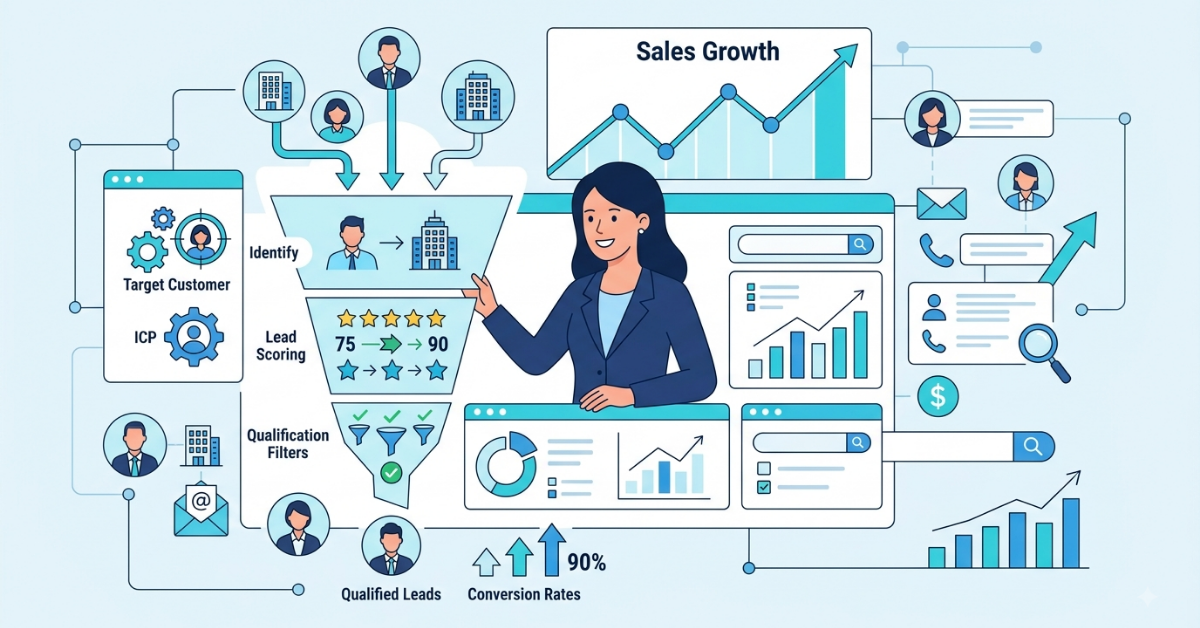
Lead generation strategies cannot succeed without a rigorously defined foundation. For B2B service providers, this foundation begins with an Ideal Customer Profile (ICP) that specifies both the target enterprise and the individual stakeholders involved in the purchasing decision.
Enterprise targeting requires moving beyond broad demographics to analyze structural characteristics that dictate service viability. Service providers must examine parameters such as annual revenue, employee headcount, geographical footprint, and overarching business model. For example, a specialized cybersecurity consultancy might target mid-market financial institutions that generate between $50 million and $500 million in annual revenue and have distributed remote workforces.
Evaluating organizational growth stage is equally critical. Startups undergoing rapid scaling often require agile, high-touch advisory services, whereas mature enterprises typically seek standardized, scalable enterprise implementations. Defining these boundaries ensures that marketing campaigns and outbound prospecting sequences resonate with organizations that are structurally well-suited to derive maximum value from the service offering.
Isolated individuals rarely make B2B service purchases. Modern buying committees often comprise executive leadership, operational managers, and departmental heads who evaluate proposals from distinct perspectives.
Stakeholder Role | Primary Evaluation Focus | Key Information Requirements |
Chief Executive Officer (CEO) | Strategic alignment, ROI, risk mitigation | Executive summaries, long-term business impact, reputation |
Chief Financial Officer (CFO) | Cost structure, payment terms, financial payback | Total cost of ownership, financial models, case studies |
Operations Manager | Implementation friction, team disruption, workflow | Execution methodology, project timelines, onboarding plans |
Department Heads | Day-to-day utility, capability enhancement, expertise | Technical depth, functional capabilities, peer testimonials |
Reaching the right combination of stakeholders ensures that messaging addresses the economic, operational, and strategic priorities of the entire buying committee, shortening sales cycles and mitigating deal stagnation.
Once the ideal audience is established, service providers must deploy a balanced acquisition model that captures existing market demand while actively generating new pipeline opportunities.
Inbound marketing relies on positioning the service provider where active buyers are already searching for solutions. For B2B service firms, this involves comprehensive search engine optimization (SEO), thought-leadership articles, in-depth service pages, peer-reviewed case studies, webinars, and downloadable strategic frameworks.
When prospective buyers encounter complex operational hurdles, they typically conduct independent research through search engines and professional networks. Inbound assets provide immediate educational value, establishing the provider’s credibility long before a formal sales conversation occurs. This inbound gravity attracts high-intent prospects who are actively benchmarking solutions and evaluating potential partners.
While inbound marketing captures organic intent, outbound prospecting enables service providers to proactively initiate conversations with high-value accounts that align with their ICP. Modern outbound strategies discard generic, high-volume pitching in favor of highly personalized, multi-channel campaigns combining strategic cold email, targeted LinkedIn engagement, and Account-Based Marketing (ABM).
Outbound prospecting is particularly potent for niche B2B services where the total addressable market (TAM) is well-defined. By leveraging accurate contact databases and sales intelligence, business development teams can reach specific decision-makers with tailored hypotheses regarding their operational inefficiencies, igniting productive dialogues without waiting for inbound form submissions.
Because professional services cannot be sampled before purchase, mitigating perceived risk is the single most important function of B2B content strategy. Service buyers purchase trust and certainty; content must therefore demonstrate absolute mastery over complex domains.
Traditional testimonials that merely state a client was “great to work with” carry little weight in enterprise sales. High-converting case studies must follow a rigorous, results-oriented narrative structure that proves empirical impact:
Enterprise buyers respect advisory firms that educate rather than sell. Publishing comprehensive industry research reports, regulatory compliance checklists, technology stack comparisons, and expert guides positions the service provider as an indispensable authority in the industry. When prospective buyers utilize these resources to shape internal strategies, the provider naturally emerges as the preferred implementation partner.
Many B2B service websites commit the error of organizing service pages around internal nomenclature rather than client pain points. High-performing service pages begin by articulating the customer’s acute operational challenges, detailing the underlying root causes, outlining a transparent methodological approach, and concluding with verified business outcomes. This empathetic framing immediately signals to prospective buyers that the firm understands their unique operational environment.
Generating inquiries is only the first phase of revenue generation. To protect sales productivity, organizations must implement structured qualification protocols that rapidly distinguish high-potential prospects from early-stage researchers.
Sales and marketing teams utilize established frameworks such as BANT (Budget, Authority, Need, Timeline) or MEDDPICC to evaluate opportunity viability during initial discovery conversations. For B2B service providers, qualification must evaluate whether the client’s internal culture and operational readiness align with the provider’s delivery model. Misaligned expectations regarding project scope or organizational change management represent critical red flags that should prompt early disqualification.
Leads should be systematically categorized into three distinct operational pathways based on defined fit and intent criteria to optimize resource allocation:
Prospect Category | Qualification Criteria | Recommended Action Plan |
High-Potential Opportunities | High ICP Fit + High Buying Intent | Immediate routing to senior sales personnel for direct discovery and scoping consultations. |
Nurture Prospects | High ICP Fit + Low/Emerging Intent | Enrollment in automated educational email workflows, thought-leadership distribution, and periodic check-ins. |
Disqualified Accounts | Low ICP Fit or Insufficient Budget/Need | Graceful exclusion from active sales pipelines to preserve team bandwidth and focus resources. |
B2B service providers do not need to occupy every marketing channel to succeed. An optimal channel mix balances scalability with relationship-building, tailored directly to the complexity of the service offering and the purchasing habits of the target buyer.
Channel Category | Specific Channels | Best Strategic Use Case |
Organic Channels | SEO, LinkedIn organic content, industry publications | Building long-term brand equity and capturing high-intent inbound search demand. |
Direct Channels | Cold email, LinkedIn outreach, targeted calling | Penetrating enterprise accounts and accelerating outbound pipeline creation in niche markets. |
Relationship Channels | Channel partnerships, strategic referrals, industry events | Securing high-trust, high-conversion engagements with shortened sales cycles. |
Niche service providers—such as boutique agencies, specialized consultants, or regional IT service providers—rely heavily on granular industry and geographic filters. For these businesses, the ability to isolate specific job titles within tightly defined regional parameters is much more valuable than having access to millions of generic records.
Business Model / Motion | Primary Database Priority | Key Features Required |
Early-Stage Startup | Ease of use & affordability | Simple UI, quick learning curve, flexible credit options |
High-Volume Outbound | Contact accuracy & scale | High email deliverability, fast CSV exports, robust CRM sync |
Account-Based Marketing (ABM) | Firmographic depth & org mapping | Company hierarchy data, buying committee identification |
Niche Service Provider | Granular filtering | Precise industry taxonomies, regional and title targeting |
Because enterprise service purchases involve multiple stakeholders and lengthy deliberation, prospects often enter evaluation cycles long before initiating contact. Implementing robust lead nurturing systems ensures continuous engagement throughout extended sales cycles.
Effective nurturing is rooted in the progressive delivery of value. Rather than transmitting generic promotional blasts, nurturing sequences should provide targeted educational materials, relevant case studies addressing specific industry verticals, regulatory updates, and benchmarking insights. This consistent cadence keeps the service provider top of mind without fatiguing the prospect.
Segmentation is the cornerstone of successful lead nurturing. Prospects categorized by industry, operational role, and expressed pain points must receive customized messaging tailored to their specific operational context. Automated scoring models track ongoing engagement metrics, signaling to sales teams when an actively nurtured prospect exhibits behavioral shifts that indicate readiness for commercial discussions.
Modern lead generation relies heavily on integrated sales technology stacks that streamline data acquisition, pipeline tracking, and customer relationship management.
Identifying relevant target accounts and accurate decision-maker contact information is foundational to outbound success. High-quality B2B contact databases provide verified email addresses, direct-dial phone numbers, organizational hierarchies, and insights into the technology stack, enabling sales development representatives to execute precision prospecting campaigns with minimal bounce rates.
Customer Relationship Management (CRM) platforms serve as the operational nerve center for B2B service providers. Robust CRM architecture tracks lead source attribution, qualification statuses, multi-channel touchpoints, scheduled follow-ups, and pipeline progression stages. This centralized visibility empowers leadership to forecast revenue accurately and identify operational bottlenecks within the sales funnel.
While strategy and content form the foundation of lead generation, executing high-volume outbound campaigns requires reliable data infrastructure. ReachStream is a vital component of a comprehensive B2B lead generation and sales workflow, empowering service providers to accelerate prospect discovery and outreach.
ReachStream provides B2B service providers with access to millions of verified professional contacts, comprehensive company intelligence, and granular decision-maker data. By using advanced search filters by industry vertical, company size, geographic region, and executive seniority, sales teams can rapidly curate highly targeted prospect lists. Furthermore, data enrichment capabilities and browser extension tools enable business development professionals to capture verified contact details directly during web research and LinkedIn prospecting, significantly reducing manual data entry and improving outbound campaign efficiency.
Sustainable revenue growth for B2B service providers is achieved through adherence to a repeatable, end-to-end framework that synchronizes marketing and sales execution:
[ Define ICP ]
↓
[ Attract Inbound ]
↓
[ Identify Decision-Makers ]
↓
[ Qualify Potential ]
↓
[ Nurture Pipeline ]
↓
[ Convert Opportunities ]
Generating predictable, high-value revenue requires B2B service providers to abandon archaic, volume-driven prospecting methods in favor of precision-led strategies. By anchoring lead generation in a rigorously defined Ideal Customer Profile, demonstrating verifiable expertise through outcome-driven case studies, balancing inbound capture with outbound prospecting, systematically qualifying opportunities, and leveraging robust sales technology, service firms can build resilient sales pipelines.
For organizations seeking to streamline prospect discovery and enhance the efficiency of outbound campaigns, integrating advanced intelligence platforms like ReachStream provides a distinct competitive advantage. Ultimately, sustainable growth in professional services is achieved by focusing relentlessly on client fit, verified business value, and long-term partnership potential.
For a broader exploration of foundational methodologies, explore The Ultimate B2B Lead Generation Guide (2026).
B2B service provider lead generation is the strategic process of attracting, identifying, and qualifying prospective corporate clients for professional services such as consulting, IT development, and specialized agency offerings.
Providers combine inbound marketing (SEO, educational content, case studies) with outbound prospecting (targeted cold email, LinkedIn outreach, and sales intelligence databases) to identify and engage high-fit accounts.
A qualified service lead exhibits verified alignment with the Ideal Customer Profile (ICP), an acute operational need, appropriate budgetary capacity, decision-making authority, and a realistic project timeline.
An optimal channel mix depends on the service model. It combines organic search (SEO), direct outbound prospecting (cold email and LinkedIn), and high-trust relationship channels such as strategic referrals and partnerships.
Providers can enhance lead quality by defining strict ICP parameters, publishing expertise-driven content that filters out misaligned buyers, and implementing rigorous qualification frameworks during initial discovery calls.
Service providers achieve the best results by utilizing a hybrid model: inbound marketing captures existing search demand, while outbound prospecting proactively initiates conversations with high-value target accounts.
Success should be evaluated using pipeline metrics such as Marketing Qualified Leads (MQLs), Sales Qualified Leads (SQLs), pipeline value, cost per qualified lead, customer acquisition cost, and overall return on investment.
B2B contact databases provide verified professional contact information, company intelligence, and decision-maker data, enabling sales teams to execute targeted outbound campaigns with high accuracy and minimal bounce rates.
Marketing professional with a Master’s degree in Marketing, specializing in SEO, content strategy, social media, performance marketing, prospecting, and demand generation.
Access 200M+ verified business emails and grow your sales pipeline effortlessly.
Don't forget to share this post!















Check out our other blogs!
Is Buying B2B Data Legal? What You Need to Know
Intent Data: What It Is and How to Use It for Campaign Targeting
What Mid-Market SaaS Teams Need in Lead Gen Tools
ReachStream Prospect for E-commerce Brands: Outbound Case Study