




How to Evaluate B2B Data Vendors for Accuracy and Compliance

Prospecting for startup founders comes down to three jobs you can do yourself: decide exactly who buys, find accurate contact details for those people, and reach out consistently enough to start real conversations. You don’t need SDRs for that. A tight ideal customer profile, a source of verified email and direct-dial data, and a few protected hours a week will carry most.
Founder-led sales isn’t a stopgap, either. In the early months, nobody explains the problem, the product or the roadmap better than the person who built it, and buyers can tell. Founder-led sales means the founder personally runs prospecting, demos and closing until a repeatable process exists.
Early buyers aren’t only buying software. They’re buying the team’s judgment and the odds that you’ll still be around next year. A founder on the call answers both questions without anyone saying them out loud.
There’s a practical upside too. Every objection you hear in founder selling feeds straight back into positioning, pricing and the product itself. When that learning sits with a junior hire instead, it tends to get diluted on its way back to you.
That’s why most founder-led GTM motions treat the first 20 to 50 customer conversations as research as much as revenue. Founder-led growth at this stage is less about volume and more about learning which message lands with which buyer.
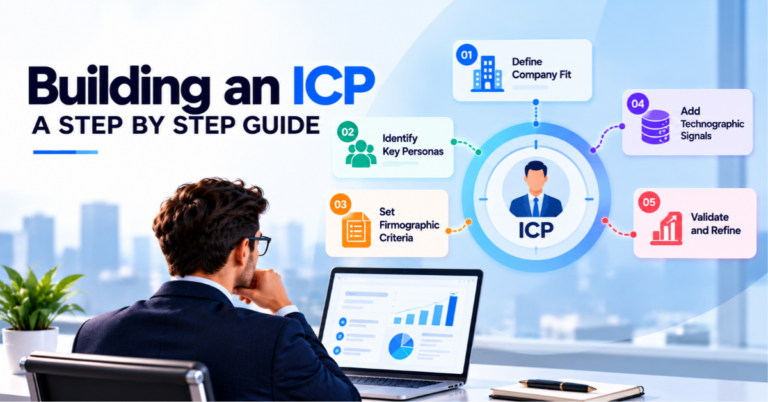
Start narrower than feels comfortable. Pick one industry, one company size band and two or three job titles that feel the pain you solve. A useful ideal customer profile also notes the trigger that makes them act now, such as a new funding round, a fresh leadership hire or a tool they’ve outgrown.
A short list of 200 well-matched accounts will teach you more than 5,000 loosely matched ones. Once replies start coming in, widen the net one variable at a time so you can tell what’s actually working.
Accurate B2B contact data is where many founders lose weeks. Guessing email formats, copying names off LinkedIn and checking company websites one person at a time works for a handful of accounts, but it collapses at a few hundred.
A B2B data platform lets you filter by industry, headcount, location, technology and seniority, then export business email addresses and direct dials in one pass. The detail that matters most is verification. Bounced emails hurt your sending domain, and a young domain has very little reputation to spare. Look for verified email data, and run any list you didn’t build yourself through a verifier before it goes anywhere near a sequence.
For most B2B startups, cold email is the backbone of founder-led outbound because it scales without eating your calendar. LinkedIn works well alongside it: view the profile, connect with a short note, then email. Phone works best for a smaller set of high-value accounts where you have direct-dial data and a clear reason to call.
Warm channels still matter. Investor and advisor introductions, former colleagues, communities where your buyers already gather and customers who’ll refer a peer often convert better than any cold outreach. The founders who build pipeline fastest usually run two channels well rather than five channels badly.
Keep the first email short, specific and about them. One line that shows you know their situation, one line on the problem you solve, and one low-pressure question. Leave the feature list for the call. Your subject line should read like a note from a colleague, not a campaign, and our guide to cold email subject lines has plenty of patterns to borrow.
Plan the sequence before you send anything. Instantly’s 2026 benchmark report puts the average cold email reply rate at 3.43%, with the top 10% of senders above 10.7%, and recommends four to seven touchpoints. Knowing how to follow up leads well is often the difference between the two.
The founder vs SDR prospecting question usually gets answered too early. An SDR is great at running a playbook. The catch is that at the seed stage there often isn’t a playbook yet, and asking a new hire to invent one is a tough ask.
Cost matters as well. Compiled 2026 figures based on Bridge Group and RepVue data put a US SDR’s on-target earnings at roughly $75,000 to $95,000, and the fully loaded cost at about $115,000 to $165,000 a year once tools, benefits and management time are included. Average ramp sits around three months, and average tenure is only 14 to 17 months.
A sensible marker for hiring is when you can describe who buys, why they buy and which message gets meetings, and you’ve closed enough deals to prove it. Until then, prospecting without SDRs keeps that learning, and that budget, with the founder.
| Approach | Typical cost | Founder time | Speed to pipeline | Best fit |
|---|---|---|---|---|
|
Manual founder research |
Free, apart from your time |
Very high |
Slow; research eats most of the week |
Your first 10 to 20 conversations |
|
Founder plus prospecting tools |
From $0; most lean stacks stay under $100 a month |
Moderate |
Fast; lists in minutes, follow-ups run on schedule |
Pre-seed to Series A, before a repeatable playbook |
|
First in-house SDR |
About $115K to $165K a year fully loaded |
Lower, but coaching still needed |
Slower at first; average ramp is about 3 months |
After the pitch and close rate are proven |
The startup prospecting stack in 2026 can be small. Most early teams need four things: a contact data source, an email verifier, a sending or sequencing tool, and a simple CRM. Everything else is optional until you have a repeatable process.
When you compare B2B prospecting tools for startups, ignore the size of the database on the landing page and look at verification, filters that match your ICP, monthly pricing and a free plan you can test properly.
The best prospecting software for startups is the one you’ll actually open every week and that doesn’t need a one-year contract. Lead generation tools with annual minimums tend to suit later-stage teams better. Our cold email deliverability checklist covers the sending side in more detail.
ReachStream Prospect is built for teams that need accurate B2B contact data without enterprise contracts, which makes it a natural fit for founder-led sales. You can search 500M+ business contacts by industry, company size, location, job title and technology used, then export ESP-verified business emails and direct dials straight into your CRM or sending tool.
A Chrome extension pulls contact details while you browse LinkedIn and company sites, the ABM list builder helps you work a short list of target accounts, and contact enrichment fills in missing fields on records you already have. A built-in email verifier checks addresses before they reach your sequences.
Pricing is built for early teams. The Free plan includes 100 export credits a month with no credit card required. Starter is $29 a month billed yearly ($39 monthly) for 5,000 export credits a month, and Pro is $49 a month billed yearly ($59 monthly) for 10,000. Founders who want to see it in practice can read how one startup cut prospecting time by 60%.
Prospecting for startup founders doesn’t require a sales team. It requires a narrow ICP, verified contact data, a short and well-timed sequence, and the discipline to show up every week. Founder-led sales keeps the learning close to the product and the cost close to zero while you work out what sells.
Hire SDRs once there’s a playbook worth handing over. Until then, a lean stack built around a reliable B2B data platform will do most of the heavy lifting.
Author

Access 200M+ verified business emails and grow your sales pipeline effortlessly.
Don't forget to share this post!















Check out our other blogs!
Email ID Checker: Verify Any Email ID Online
ICP Refinement for SDRs: Using Data Filters to Stop Wasting Touches


Email Validator: Validate Email Format, Domain and Mailbox